


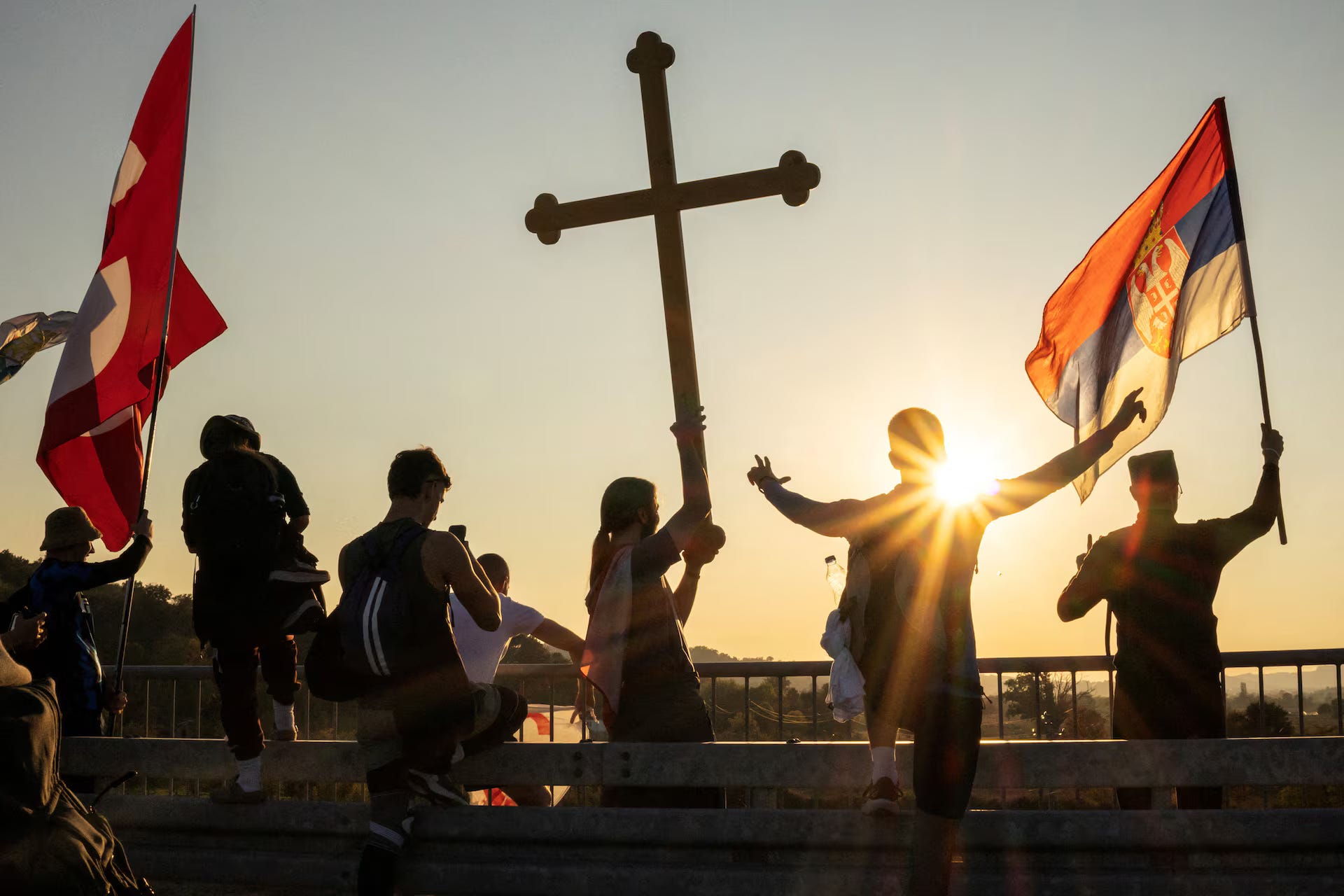
In a world where political life was increasingly dictated by Donald Trump, Benjamin Netanyahu, and their political imitators, all champions of what must be called, without euphemism, the fascist principle that might is the ultimate proof of right; a world in which human freedom was measured against corporate interests, the geopolitical calculations intertwined with them, and the whims of the powerful, something happened for which political science scarcely possesses an adequate category.
In Serbia, a small Balkan country that had for decades been portrayed as an incurable patient suffering from nationalism, historical mythmaking, endemic corruption, and a seemingly incorrigible culture of political authoritarianism, rebellious university students achieved what generations of professional politicians and political activists had failed to accomplish, even in their most extravagant electoral promises. They organised themselves, withstood almost two years of everything an entrenched regime can unleash once it has forfeited its legitimate claim to govern, and ultimately secured a resounding victory in the country’s parliamentary elections.
On October 25, 2026, Serbia became one of the world’s rare pieces of genuinely good news. And not merely because a corrupt government had been swept from power, but because something far more consequential had taken place: a demonstration that, against all appearances and despite everything conspiring to extinguish that hope, the course of human history might yet be turned towards the triumph of the struggle for freedom.
It all began beneath the concrete canopy of the railway station in Novi Sad, Serbia’s second-largest city, where sixteen human lives were extinguished when the structure collapsed, and where the state, by all appearances, intended to carry on as though nothing had happened that could not be duly recorded, filed away, and eventually forgotten. What was supposed to become yet another tragedy consigned to the administrative archives instead gave rise to a profound moral awakening. University and secondary school students refused to allow the dead to be reduced to a statistical footnote or responsibility for their deaths to be buried beneath the press conferences of the habitually mendacious Aleksandar Vučić, Serbia’s authoritarian president. They abandoned their classrooms, took to the streets, and set out across Serbia, from town to town, from village to village, building something for which no provision had been made in the official plans: trust among people who had been systematically conditioned, year after year, to believe that their only conceivable future lay in competing against one another for a more advantageous place in the ruling party’s vast machinery of patronage.
Their manner of organising was every bit as revolutionary as their perseverance, all the more so because they refused, in defiance of an old and dependable revolutionary tradition, to appoint themselves a leader to whom they would subsequently be expected to submit. Instead, they established plenums, open, deliberative student assemblies in which questions were debated, decisions collectively made, and, in what amounted to an almost indecent novelty in the political culture of the Balkans, responsibility actually assumed. More than eighty such student assemblies participated in the selection of parliamentary candidates. Yet the students themselves showed no eagerness to cash in their revolutionary achievements for seats in parliament. Instead, they entrusted those seats to university professors, physicians, artists, and other citizens drawn from outside the familiar inventory of professional party functionaries. The resulting electoral list secured, according to preliminary results, 52.71 per cent of the vote and 140 parliamentary seats. History has witnessed victorious revolutions and student uprisings before, but almost never a student movement that, rather than replacing one set of rulers with another, democratically chose its own representatives and then proceeded to win a parliamentary majority.
And how many times it seemed that everything would end the way attempts to change things in our part of the world so often end: with the victory of the very people against whom the uprising had begun! The students were denounced as Ustaše, a term referring to the Croatian fascist movement responsible for the mass murder of Serbs, Jews, and Roma during the Second World War, as well as terrorists, foreign mercenaries, and enemies of the state. In the process, Vučić’s propaganda machinery demonstrated a remarkable talent for translating every demand for justice into the language of high treason. Nor were the neighbouring countries short of diagnoses. According to the ever-vigilant right-wing interpreters of the Serbian national character in Zagreb and Sarajevo, the students represented merely another incarnation of the same old Serbian nationalism, in some accounts an even more dangerous one than Vučić himself. In the corridors of European political power, where democratic principles are cherished with particular tenderness until they begin to interfere with corporate calculations, the students’ demands were weighed against the supposedly overriding imperatives of state stability. Western journalists did report on the protests, but many Western governments, apparently persuaded that democracy is a splendid institution provided it does not threaten a conveniently compliant, quasi-colonial autocracy, displayed considerably greater sympathy for the stability of Vučić’s regime than for the freedom of Serbia’s citizens.
The students, however, refused to give up, seemingly unaware of that venerable rule of conventional politics which dictates that a struggle should be abandoned the moment it becomes serious. They did not surrender when they were beaten, arrested, or expelled from their universities, nor when the distinction between state institutions and ruling-party outposts became increasingly difficult to discern, except, perhaps, from the signs above their entrances. Nor did they falter in the face of their own disagreements, exhaustion, or that most dangerous form of defeat, the moment when victory begins to resemble a fairy tale told to console those who have nothing else left to hope for. Their courage did not spring from an absence of fear but from their refusal to concede that fear had any legitimate authority to determine the limits of human dignity. While their opponents commanded television networks, vast financial resources, and the machinery of the state, the students possessed something which, to the general astonishment of the merchants of political influence, could neither be bought nor coerced into submission: mutual trust, solidarity, and the capacity to restore to ordinary people the conviction that their destiny was not, after all, the exclusive jurisdiction of those who governed them.
Particularly magnificent was what unfolded between Serbian and Bosniak students in Serbia. A country that had for decades been portrayed as the natural stronghold of radical Serbian nationalism and a place where the Bosniak Muslim minority was condemned to perpetual isolation, where the supposed incompatibility of Christianity and Islam had served as an almost theological justification for enduring mutual distrust, became the stage for a remarkable fraternity. And this fraternity required neither sentimental declarations nor professional peacemakers attached to international foundations, but simply a common struggle.
In Novi Pazar, the cultural and political heart of Serbia’s predominantly Muslim Sandžak region, before a magnificent gathering of students of different faiths and nationalities belonging to Serbia acquired a meaning that no amount of state propaganda could ever have bestowed upon it. In Niš, a major city in southern Serbia, students prepared iftars, the evening meals with which Muslims break their fast during Ramadan, for their Muslim colleagues. In Novi Pazar, Lenten meals were prepared for Orthodox Christians observing the fast before Easter, while Bosniak students found hospitality even within the walls of Serbian Orthodox monasteries. Nobody had to cease being who they were in order to recognise a fellow human being in another. Perhaps therein lies the deepest emancipatory significance of the entire movement.
And what a magnificent historical paradox! Serbia, long since written off by the self-appointed experts on its allegedly incorrigible, bloodthirsty nationalist character as a country condemned to perpetual imprisonment in political and cultural backwardness, became the very place where trust between Serbs and Bosniaks was being rebuilt with greater determination than in Bosnia and Herzegovina itself, where such trust ought to be the most elementary condition for the very survival of both peoples. While the political elites of Sarajevo and Banja Luka, the principal centres of Bosniak and Bosnian Serb political power, respectively, continue to cultivate ethnic fears as the most dependable assets in their electoral portfolios, Serbia’s students demonstrated that fraternity is not manufactured at tolerance workshops, complete with generous per diems, project reports, and the obligatory photograph of participants wearing smiles of professionally simulated goodwill. It is forged instead through the shared experience of injustice, sacrifice, and hope. The differences between these young people did not disappear. They simply ceased to serve as justifications for an enmity manufactured and manipulated by others. And that is a victory which no electoral commission can either certify or overturn.
In her book Culture and Commitment, the American anthropologist Margaret Mead described what she called a prefigurative culture, an extraordinary historical arrangement in which the older generations, after centuries of instructing the young, must finally confront the uncomfortable possibility that their children might actually know something about the future. This is precisely what happened in Serbia. The students did not merely demand a change of government. They also gave their parents a practical lesson in collective decision-making, an art that the older generation, along with so many other achievements of the post-socialist transition, had all but forgotten. In The Conflict of Generations, the American sociologist Lewis Feuer warned that the noble idealism of student rebellions could easily degenerate into destructive hostility between generations. Serbia’s students escaped that historical trap. They did not set out to demolish institutions but to restore them to the purposes for which, at least according to their constitutions and founding principles, they had been established.
It is therefore high time that the sinister theories about the Serbian people and society were finally consigned to retirement, particularly those according to which radical nationalism, violence, and authoritarianism are somehow hereditary characteristics of an entire nation. Such intellectual conceits have always revealed considerably more about the pathological laziness of their authors than about the society they purported to study. For this generation, too, did not emerge from a historical vacuum. It was raised by people who may have been frightened, bewildered, impoverished, politically manipulated, or already resigned to their own powerlessness, but who nevertheless passed on to their children something they themselves had not always known how to defend: a sense of honour, freedom, and responsibility. They raised young men and women whose consciences are not for sale. Perhaps they lacked the strength to win the struggle themselves, but they brought up those who did. And thus, in defiance of every gloomy historical prediction, they earned something that no political victory could have guaranteed them: the right to be remembered by their children without shame.
And so, after long decades of historical missteps and painful failures, Serbia is returning to the finest traditions of its struggle for freedom, forging a future worthy of the noblest chapters of its past. At a time when democracy is retreating before the power of capital, authoritarian caprice, and a corrupt cynicism elevated to the status of statesmanlike wisdom, one generation has demonstrated that history has not ended, that obedience is not humanity’s destiny, and that no government is eternal. Serbia has not merely been given an opportunity to become a beacon among nations. At its finest moments, it has always been one, even when it allowed its own light to be extinguished at precisely those moments when it should have burnt most brightly. For in Serbia, as everywhere else in the world, there are no sinless nations, only fallible human beings, capable of the gravest delusions but also of the most sublime acts of courage and humanity. And the greatness of the human spirit lies not in never falling, but in rising again and again, against all odds, proving that light and freedom are not the privileges of those who have never known darkness, but the hard-won triumph of those who refused to wander in it forever.