


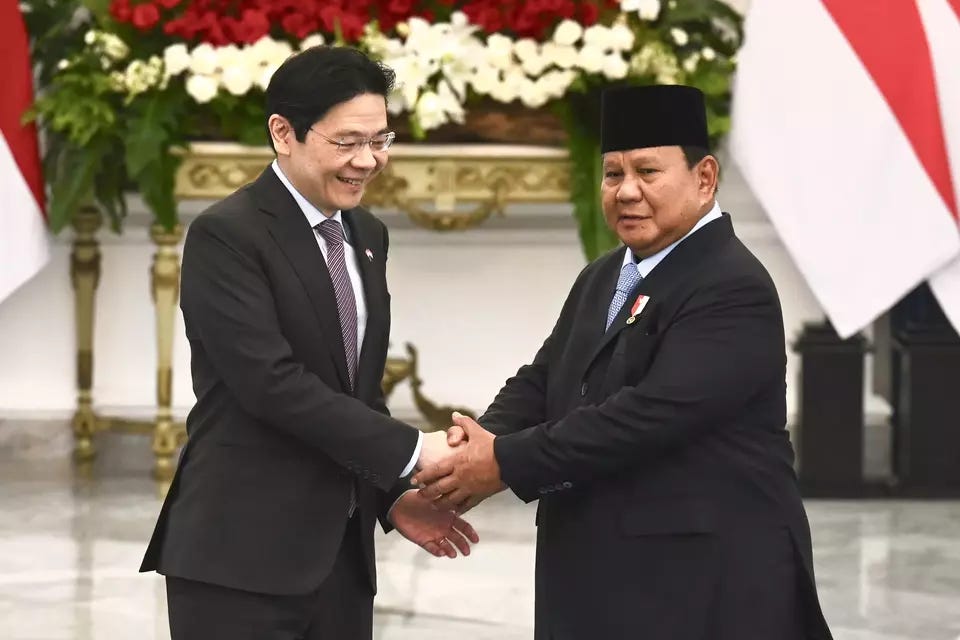
There is a terrible irony unfolding in the steamy corridors of Jakarta’s Merdeka Palace. As Prime Minister Lawrence Wong and President Prabowo Subianto clasped hands on 6 July, sealing 26 agreements across energy, defence and digital infrastructure, they may well have signed not the consolidation of ASEAN but its quiet, bureaucratic death warrant.
For this was no ordinary bilateral retreat. This was a civilisational pivot—the moment when two historically distrustful neighbours decided to bind their fates so completely that the rest of Southeast Asia must now reckon with a gravitational pull it was never designed to withstand.
Consider what has been forged. A cross-border electricity corridor that will channel 3.4 gigawatts of low-carbon power from Indonesian solar projects—including a 200-megawatt facility in Morowali, Central Sulawesi—to Singaporean consumers by 2035. An institutional isomorphism between Danantara, Indonesia’s newborn sovereign wealth fund, and Singapore’s storied Temasek. A Flight Information Region realignment that transfers airspace sovereignty back to Jakarta while keeping Changi’s logistics seamless.
An extradition treaty and Defence Cooperation Agreement that resolve decades of legal deadlock. And a joint pledge to keep the Strait of Malacca—through which one-quarter of global trade flows—open and free under UNCLOS.
All of this, wrapped in what Prabowo called “heart-to-heart, open, and forward-looking” diplomacy.
It is, by any measure, a stunning achievement. Singapore has long been Indonesia’s largest source of foreign direct investment, contributing US$17.4 billion in 2025 alone. The relationship has historically been plagued by nationalist rhetoric, airspace grievances and the “small red dot” narrative that painted Singapore as a disproportionate beneficiary of Indonesian wealth. Now, in a single summit, these wounds have been cauterised.
But here is the question that must haunt every strategic thinker from Canberra to Kuala Lumpur: What happens to the rest of us?
The Singapore-Indonesia axis is becoming something ASEAN was never meant to contain: a dual-core directorate capable of setting regional energy prices, controlling maritime chokepoints and dictating the terms of green finance. This is not integration; it is hierarchy dressed in the language of cooperation.
The ASEAN Power Grid—once imagined as a web of equitable energy sharing among ten sovereign states—is now being built, in practice, as a bilateral artery between Jakarta and Singapore. Wong himself framed the electricity deal as an “important building block” to the broader grid. Yet the governance of that grid, with Danantara and Temasek as gatekeepers, will inevitably reflect the institutional capacities—and interests—of its architects. Smaller ASEAN members, from Vietnam to the Philippines, will find their energy transitions contingent on a system they had no hand in designing.
One expert recently noted that the ASEAN Power Grid’s biggest challenge is “not technical standards” but sovereign risk. When 80 per cent of a proposed cable route passes through Indonesian waters, the message is unmistakable: the periphery must seek permission from the core.
On the other hand, nowhere is this new hierarchy more dangerous than in the Strait of Malacca. The Wong-Prabowo guarantee of free transit passage is, on its face, a triumph of maritime diplomacy. But beneath the legal prose lies a geopolitical powder keg.
The Middle East conflict has already demonstrated how quickly chokepoints can be weaponised. Weeks before the summit, an Indonesian finance official floated the idea of imposing a transit levy on the strait—a proposal inspired by Iran’s manoeuvres in the Strait of Hormuz.
Prabowo’s public commitment to UNCLOS may have calmed those waters for now. But in a future crisis—a Taiwan confrontation, a South China Sea escalation, a great-power blockade—this bilateral guarantee will face an impossible trilemma. Enforce it against a superpower and risk military escalation. Acquiesce and reveal it as an empty promise. Or split, and watch the carefully woven fabric of ASEAN neutrality unravel in real time.
The strait has always been the region’s nomos—the spatial order where sovereignty, commerce and security intersect. Once that order is subjected to great-power coercion, neutrality becomes a luxury only those outside the crosshairs can afford. Singapore and Indonesia, as the gatekeepers, are squarely in the crosshairs.
The deepest wound, however, may be the one ASEAN inflicts upon itself. Institutional convergence between Singapore and Indonesia—the Temasek-Danantara axis, the emulation of public housing models, the interlocking legal frameworks—creates a governance frontier that the rest of ASEAN cannot easily cross.
This is the fragmentation paradox: the very process that binds the core expels the periphery. States unable to meet the core’s standards of creditworthiness, anti-corruption protocols and market discipline will find themselves structurally excluded from its capital pipelines. They will drift toward Chinese Belt and Road loans, or US minilateral security arrangements, or bilateral deals that bypass ASEAN entirely. Each such move feeds a centrifugal spiral, hollowing ASEAN’s claim to centrality.
Indonesia’s adoption of Singaporean models was motivated by a desire to shed its image as a lumbering, patronage-ridden state and assert greater geopolitical weight. Yet the unintended consequence is that it becomes a junior partner in a binary elite that alienates the very neighbours whose solidarity it needs to achieve medium-power status on the global stage.
And then there is the great unspoken: the nuclear era. The Indo-Pacific is entering a period in which Chinese ICBM tests, US deterrence postures and cascading instability from the Middle East fundamentally rewrite the grammar of regional order. In such an era, strategic behaviour is governed not by diplomatic persuasion but by the existential shadow of nuclear destruction—a shadow that compresses time horizons and elevates military preparedness over patient negotiation.
ASEAN was built for the temporality of musyawarah dan mufakat—consultation and consensus. The nuclear era operates in milliseconds. When missile flight times are measured in minutes, the ASEAN Regional Forum becomes a ritual of platitude, disconnected from the real strategic calculations of its members.
Singapore and Indonesia, as the dual custodians of the Malacca Strait and co-architects of the regional energy grid, must factor nuclear coercion into their asset protection calculus. This means hardening critical infrastructure against electromagnetic pulse, planning for continuity of government, and engaging in sensitive intelligence-sharing with extra-regional powers—all activities that, by their nature, cannot be tabled at ASEAN without triggering paralysis.
What we are witnessing, then, is a Hegelian tragedy of the first order. The very mechanisms designed to bind the core—energy corridors, institutional convergence, security guarantees—are, through their success, unravelling the whole. ASEAN does not need to formally dissolve to die. It needs only to become a zombie institution, formally alive but organically dead, unable to perform its original function of insulating Southeast Asia from great-power conflict.
The tragedy is magnified by the fact that the success of Singapore and Indonesia in integrating their architectures makes them the prime targets of great-power coercion—and thus the first to abandon the regionalist project in favour of national survival. What was designed to be the crowning achievement of ASEAN turns out to be the vector of its diplomatic extinction.
As Singapore prepares to assume the ASEAN chairmanship in 2027—the same year the two nations mark 60 years of diplomatic relations—the question is no longer whether ASEAN can survive. The question is whether its most successful members will be the ones to pull the plug, not out of malice, but out of the sheer, terrible logic of self-preservation.
The handshake in Jakarta was warm. The future it portends is cold. And for the rest of Southeast Asia, the chill has only just begun.

Singy has no axis/axes. Singy is Singy (I was fortunate to have obtained SPR at one point, and kick myself to this day for having lost it). // Among the Singy power elite you have basically two sorts: those who care about wealth and power and have amassed loads of it, and the other sort (smaller in numbers I reckon) who actually give a hang about their blue collar and HDB-dwelling brethren. // Singy will play all sides against the middle, and I reckon that’s what you have to do if you’re a SIN (small island nation) with the likes of the US, China, EU, India, and a bunch of others all trying to influence you.