


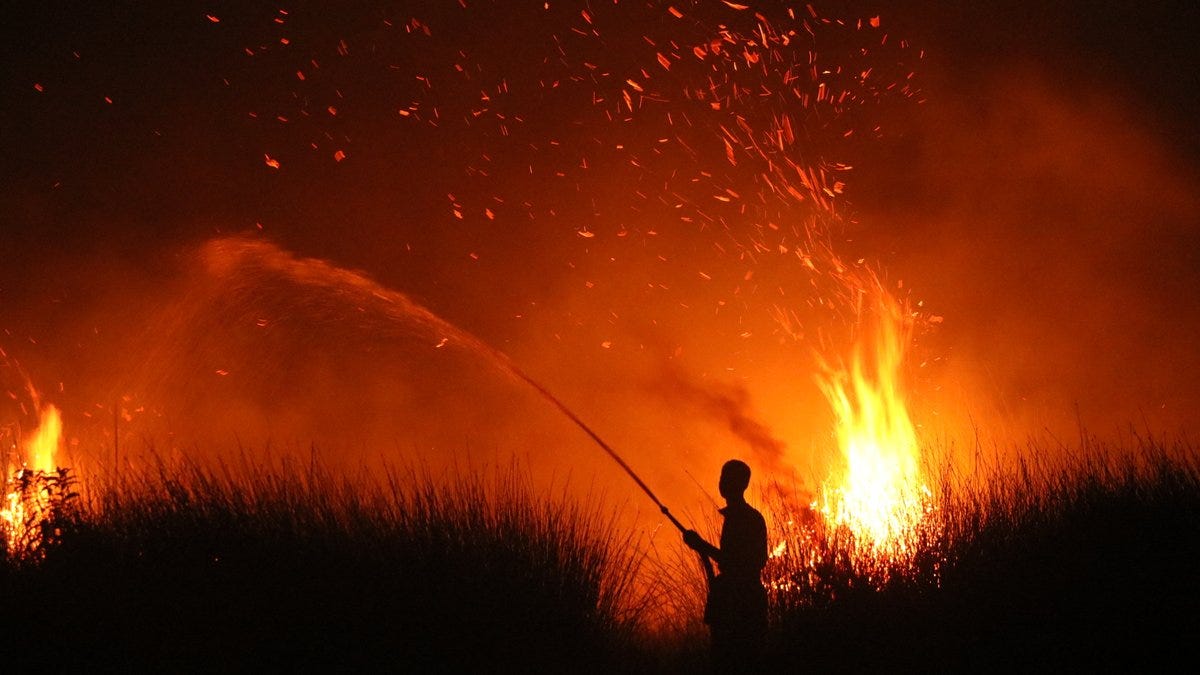
Every dry season, the sky above Kuala Lumpur and Singapore turns the colour of old tea. Schools close. Pharmacies run out of N95 masks. Parents keep children indoors, watching the Air Pollutant Index climb past 200, past 300, past the point where the air itself becomes an act of violence.
And every dry season, the same diplomatic dance begins: expressions of concern, calls for regional cooperation, and the familiar invocation of the “ASEAN Way”. Then the rains come. The smoke clears. Nothing changes. The following year, it returns.
This is not a natural disaster. It is a political outcome, engineered by a system that has decided, year after year, that the profits of palm oil and pulpwood are worth more than the lungs of millions. The transboundary haze is the most visible symptom of a deeper pathology—a regional order in which sovereignty has been weaponised to shield corporate impunity and in which the poorest and most vulnerable pay the price for the enrichment of a connected few.
The numbers are brutal in their clarity. Between January and July 2026, over 202,000 hectares of Indonesian forest and land burnt. In a single week in August and September, those fires released more than 23 million tonnes of carbon—exceeding the emissions from the same period during the catastrophic 2015 crisis. Indonesia’s health ministry recorded over 50,000 cases of acute respiratory infections in two months, with more than five million people across Sumatra and Kalimantan directly exposed to high-risk smoke zones.
In Malaysia’s Sarawak state, the Air Pollutant Index breached 500—a level that triggers a state of emergency, halting all non-essential activity—forcing the closure of 647 schools. Asthma cases in affected Malaysian areas rose by 259 per cent in a single week. Upper respiratory infections jumped 124 per cent. Singapore’s Pollutant Standards Index reached unhealthy levels across all five regions of the island for the first time since 2019.
These are not abstract statistics. They are children breathing at 18 to 30 respirations per minute—far faster than adults—inhaling a proportionally larger volume of toxic particulates into lungs that are still developing. They are elderly citizens with pre-existing heart and lung conditions, for whom a sudden spike in PM2.5 can trigger strokes and cardiac emergencies.
They are delivery riders and construction workers who cannot afford to stay home, accumulating permanent damage while the official index—smoothed by a 24-hour rolling average—lags behind the lived reality of a blinding plume of smoke at nine in the morning.
The root cause is not mysterious. Fire is the cheapest way to clear land for commercial agriculture, and Indonesia’s peatlands—drained over decades by canal networks dug for plantations—are vast reservoirs of highly flammable organic fuel. Once ignited, peat fires burn underground for months, resisting conventional firefighting and releasing up to three times more toxic smoke than ordinary forest fires. And who benefits?
Research suggests that Malaysian and Singaporean investors hold more than two-thirds of Indonesia’s oil palm plantation sector, with some linked to the fires alongside local operators. Profits often flow to Kuala Lumpur and Singapore; the smoke drifts the other way. That is an uncomfortable contradiction.
When accountability is sought from Jakarta, some of the companies in question may also have links to investors in the countries seeking redress. A domestic transboundary haze act in Malaysia could expose Malaysian-linked firms to liability for fires that choke Malaysian citizens. Understandably, perhaps, diplomacy has been preferred over legal confrontation.
Malaysia’s Ministry of Natural Resources and Environmental Sustainability has explicitly rejected a transboundary haze law on the grounds that gathering the necessary land tenure data and corporate ownership trails “involves highly classified foreign state information.” The official explanation is that enforcement is functionally impossible. The unspoken explanation is that enforcement would be politically inconvenient.
Singapore, to its credit, tried. The Transboundary Haze Pollution Act of 2014 made the city-state the first and only ASEAN nation to impose extraterritorial liability on entities causing haze pollution, with fines of up to S$100,000 per day and a cap of S$2 million. It was a bold experiment. It has never resulted in a public conviction.
The act’s jurisdictional reach is constrained by the act of state doctrine, by choice-of-law rules that point to Indonesian law as the lex loci delicti, and by the simple reality that the evidence required—concession maps, land tenure records, corporate ownership trails—sits on servers in Jakarta, classified as state secrets. The sovereign right to classify has become a de facto immunity for corporations operating within Indonesia’s borders.
And so the region turns, once again, to the ASEAN Agreement on Transboundary Haze Pollution. Adopted in 2002, ratified by Indonesia only in 2014, the AATHP is a legal instrument designed not to bind but to comfort. It contains no fines, no sanctions, no dispute resolution mechanism beyond “consultation or negotiation” under Article 27.
ASEAN’s foundational commitment to non-interference means the agreement remains, in the words of the Lowy Institute’s own analysis, “toothless,” providing little incentive for Jakarta to change its approach. The agreement’s 2030 haze-free goal is, by any honest assessment, aspirational fiction.
The Indonesian government’s position has hardened over time. In 2013, President Susilo Bambang Yudhoyono offered an unprecedented apology: “As the president, I apologise and seek the understanding of our friends in Singapore and Malaysia.” By 2015, Vice President Jusuf Kalla was telling neighbours they should be grateful: “For 11 months, they enjoy beautiful clean air from Indonesia and they never thank us. They suffer from the haze for one month and they get upset.”
Today, Indonesian ministries routinely deny that smoke crosses the border at all, even as satellite data from the ASEAN Specialised Meteorological Centre tracks plumes moving across the Malacca Strait. Compensation? Never. Jakarta rejects it on grounds of state sovereignty and points, not unreasonably, to the shared cross-border capital of the plantation owners.
What Indonesia does instead is firefight. Thousands of military personnel and volunteers are deployed to Sumatra and Kalimantan. Helicopters water-bomb. Cloud-seeding operations are permitted. Massive fines are levied against local concessions, and lands are sealed off during active investigations. The Peatland and Mangrove Restoration Agency was established to re-wet drained peatlands. These are real efforts.
But a decade of implementation has revealed systemic failure: the restoration target was reduced from 2.6 million hectares to 1.2 million hectares and still remained unmet. Seventy per cent of canal blocks were damaged. Fifty-two per cent of intervention sites still recorded groundwater tables below safe thresholds. Of the peatlands affected by fire between 2015 and 2019, only three per cent have regenerated into forest; the remainder has become shrubland or been converted to monoculture plantations.
This is not a failure of capacity. It is a failure of political will, structured by a regional order that privileges sovereignty over ecology and capital over community. The atmosphere does not respect borders. Peatland hydrology is a transboundary phenomenon: draining peatlands in Indonesia affects atmospheric chemistry in Malaysia and Singapore, and ultimately contributes toSingapore ande change.
The sovereign state is the wrong unit of analysis for a problem that is fundamentally bioregional. A supranational ecosystem authority with the power to monitor peatlands, enforce fire prevention, and adjudicate disputes would be a radical departure from the ASEAN Way. It may also be the only institutional form capable of addressing the crisis.
Until that reckoning arrives, the haze will continue to return. The vulnerable will continue to suffer first and worst. And the region’s leaders will continue to gather in air-conditioned rooms, expressing concern, commissioning reports, and reaffirming their commitment to a “haze-free” future that never comes. The smoke in the sky is not weather.
It is a choice—made every year, by every government that prefers the comfort of consensus to the courage of accountability.
