


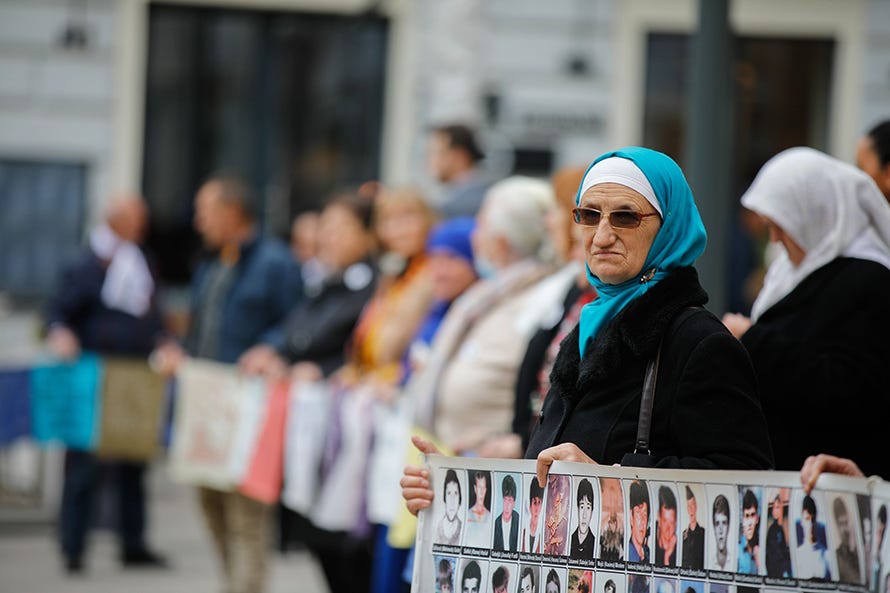
Every year on 11 July, the public sphere across the former Yugoslavia becomes, almost without fail, the arena for the same long-predictable argument. On that date in 1995, forces of the Army of Republika Srpska entered Srebrenica, a predominantly Bosniak enclave in eastern Bosnia that had been declared a United Nations “safe area.” In the days that followed, Bosniak women, children and elderly people were forcibly removed, while thousands of captured men and boys were separated, detained and executed at a series of locations in the surrounding region. Their bodies were buried in mass graves, many of which were later reopened and the remains dispersed in an effort to conceal the crime.
One side repeats that genocide was committed in Srebrenica; the other rejects that legal classification outright. It is as though the entire tragedy of more than eight thousand lives cut short, thousands of bereaved families and a society scarred to its core could be reduced to a single answer: “yes” or “no.”
Yet the most serious scholarship in international law teaches us that the matter is far more complex. Not because it disputes the scale or horror of the crimes, but because legal scholarship itself does not claim that a single word, even the gravest word in its vocabulary, can exhaust the full meaning of a human catastrophe.
The 2001 judgment of the Trial Chamber of the International Criminal Tribunal for the former Yugoslavia in the case against Radislav Krstić marked a turning point in the development of international criminal law. For the first time, an international court concluded that the crimes committed in Srebrenica in July 1995 constituted genocide within the meaning of the 1948 Convention on the Prevention and Punishment of the Crime of Genocide.
In 2004, the Appeals Chamber upheld that legal classification, although it revised the form of Krstić's individual criminal responsibility. Later judgments in the cases of Popović et al., Tolimir, Karadžić and Mladić essentially endorsed and further developed the legal standards first established in the Krstić case. The judgment thus became the foundation upon which the entire subsequent body of jurisprudence concerning Srebrenica was built.
What, Then, Is the Essence of the Hague Judgments?
Among the best-known defenders of the legal reasoning that emerged from the Krstić judgment are Payam Akhavan, professor of international law at McGill University and a former legal adviser to the Office of the Prosecutor at the ICTY; Antonio Cassese, the first president of the International Criminal Tribunal for the former Yugoslavia and one of the most influential modern scholars of international criminal law; and Larry May, an American philosopher of law who, in his writings on genocide and crimes against humanity, defended the Tribunal’s legal reasoning. Their arguments were subsequently embraced in numerous commentaries on the Genocide Convention and international criminal law, and have significantly shaped the way the crime of genocide is interpreted in international jurisprudence today.
What these authors share is the conviction that genocide need not be directed towards the physical annihilation of an entire people. Rather, the 1948 Convention allows the “substantial part” of a protected group to consist of a segment that is geographically concentrated or symbolically vital. Building on this interpretation, Antonio Cassese argued that genocidal intent may be directed at destroying a part of a group whose survival is crucial to the group’s continued existence in a particular territory. Payam Akhavan, for his part, stressed that the Convention was created not only to punish genocide, but also to prevent the destruction of human communities, and that its interpretation must therefore remain sufficiently dynamic to address contemporary forms of mass atrocity.
From the perspective of moral philosophy, Larry May defended the view that the systematic elimination of an essential part of a protected group constitutes an assault on the group’s collective identity itself, even when not every one of its members is physically destroyed. This understanding also underpins the conclusion that the execution of most military-aged men in Srebrenica, combined with the forcible removal of women, children and the elderly, could reasonably be taken as evidence of an intent to destroy the local Bosniak community permanently, as an essential part of the broader protected group.
Genocide and the Question of Whether It Can Be Defined with Legal Precision
At the same time, precisely because the Krstić judgment set a precedent in the interpretation of one of the most narrowly defined crimes in international law, it provoked a powerful scholarly response that went almost entirely unnoticed in the public life of the former Yugoslav republics. For that reason, it deserves rather more attention than the settled positions usually allow. Significantly, some of the most serious criticism came from leading international authorities on criminal law and genocide studies. Among them were William Schabas, one of the world’s most widely cited scholars of the Genocide Convention; Claus Kreß, professor of international criminal law at the University of Cologne and one of the foremost theorists of the International Criminal Court; Katherine Southwick, a Yale-trained legal scholar whose analysis of the Krstić case appeared in the Yale Human Rights and Development Law Journal; and the French historian and physician Yves Ternon, one of the pioneers of modern comparative genocide studies. Although they approached the subject from different intellectual traditions and did not always reach identical conclusions, all agreed that the judgment raised important questions deserving serious scholarly debate.
What all these authors had in common was that none of them disputed either the fact that mass atrocities had been committed in Srebrenica or the immense scale of Bosniak suffering. Their criticism was directed solely at the legal reasoning by which the Tribunal arrived at the classification of genocide. In their view, the judgment expanded the meaning of certain elements of the 1948 Convention far beyond its original text and the intentions of its drafters, particularly with regard to proof of specific genocidal intent, or dolus specialis; the interpretation of the phrase “destruction of a substantial part of the group”; and the gradual narrowing of the legal distinction between genocide and ethnic cleansing. What followed, therefore, was not merely a political quarrel, but a broad academic debate over whether judicial practice had remained within the boundaries of the Convention or had, through interpretation, created a new understanding of the crime of genocide.
Schabas was among the first to stress that the 1948 Genocide Convention had been conceived as a deliberately limited legal instrument. Its drafters consciously rejected the concept of cultural genocide, restricted the categories of protected groups and insisted that the essence of the crime lay in the physical or biological destruction of a national, ethnic, racial or religious group. He therefore warned that ICTY jurisprudence, and the Krstić judgment in particular, had gradually expanded the meaning of the Convention without formally amending it. In his view, the embrace of an ever-broader interpretation of destruction, an increasingly subjective definition of the protected group and an ever less distinct boundary between genocide and ethnic cleansing marked a significant departure from the original conception of Raphael Lemkin and the drafters of the Convention. At the same time, Schabas argued that even after the first ICTY judgments, the most important question had not been definitively resolved: whether there had truly existed an organised plan to destroy the Bosnian Muslims as a group within the meaning of the Convention.
Claus Kreß directed his criticism primarily at the manner in which the International Court of Justice accepted the ICTY’s conclusions in 2007. Although he welcomed some of the Court’s clarifications concerning the protected group and the relationship between ethnic cleansing and genocide, he believed that the Court had failed to provide a sufficiently coherent explanation of why it accepted that genocide had been committed in Srebrenica. In his view, it was not enough simply to invoke the Tribunal’s earlier jurisprudence. The Court was required to address independently the serious legal objections that had already arisen in the scholarly literature. Kreß also emphasised that genocide, by its historical and legal nature, was inconceivable without an organised and coordinated plan of destruction, since it was precisely this context that distinguished genocide from all other forms of mass violence.
In her extensive analysis of the Krstić judgment, published in the Yale Human Rights and Development Law Journal, Katherine Southwick accepted the Tribunal’s factual findings concerning the mass executions and forcible transfer of the Bosniak population from Srebrenica. She nevertheless questioned the legal reasoning by which the Chamber concluded that specific genocidal intent, dolus specialis, had been established, even though such intent is the defining element of the crime of genocide. In her view, the Trial Chamber had not seriously enough considered the possibility that the immediate motive for killing military-aged Muslim men was to eliminate a military threat, secure control over the territory and prevent future armed resistance, rather than to destroy the Bosnian Muslims as a protected ethnic group. Southwick argued that the Court could not simply disregard the question of motive, because the distinction between motive and specific intent is essential to the proper application of the Genocide Convention. If the objective was military or territorial, then, in her interpretation, that fact had to be carefully weighed when determining whether an intent to destroy the group as such had truly existed.
She was equally critical of the way in which the Tribunal interpreted the Convention’s central concepts. In particular, she challenged the conclusion that the killing of military-aged men, combined with the organised removal of women, children and the elderly, could amount to the “destruction of a substantial part” of the protected group. In her view, the Court had stretched the meanings of “destroy” and “in part” too far, relying more heavily on the assumption that the local community would no longer be able to survive than on proof of an intention physically to destroy that community. She pointed out that the organised transfer of women, children and elderly people to territory controlled by the Army of Bosnia and Herzegovina was a circumstance requiring careful legal analysis, since it could support the conclusion that the objective had been expulsion and the permanent removal of a population from a particular territory, which is characteristic of ethnic cleansing, but not necessarily of genocide. In her reading, the Court had effectively accepted that the destruction of a local community could be equated with the destruction of part of an entire ethnic group, although such an interpretation did not clearly follow either from the text of the Convention or from its previous application.
Southwick warned that such an interpretation carried consequences far beyond the Krstić case itself. By expanding the concept of genocide too aggressively, she argued, the law risked gradually erasing the distinction between genocide, ethnic cleansing and crimes against humanity, thereby undermining the consistency and universal application of international criminal law. It was precisely for this reason that she concluded that the legal classification of crimes against humanity would have been more consistent with the Genocide Convention in this case, without in any way diminishing the gravity of the crimes committed, the moral condemnation of their perpetrators or the international community’s duty to respond to mass suffering. Indeed, she proposed the opposite approach: rather than expanding the definition of genocide, international law should broaden the obligation to prevent and punish all mass atrocities, including those in which specific genocidal intent cannot be proven.
Yves Ternon followed a similar line of reasoning, though from the perspective of genocide history. He accepted that Srebrenica was the gravest single atrocity committed during the wars in the former Yugoslavia and spoke of a “genocidal act,” while maintaining that the historical concept of genocide could not be reduced to a single localised massacre, however appalling. In his interpretation, genocide entails the systematic and planned destruction of a substantial part of an entire protected group across a broader territory, irrespective of the victims' sex or age, as in the cases of the Armenians, the Jews or the Tutsi. It was for this reason that he warned that classifying Srebrenica as genocide had opened a “Pandora’s box”: it could gradually blur the boundary between genocide, ethnic cleansing and crimes against humanity and thereby, in his view, weaken the long-term legal precision of the concept of genocide itself.
Peoples and Humanity
A distinctive turn in this debate comes from Madeline Morris, one of America’s most respected scholars of international criminal law. She no longer frames the issue primarily as a question of how the Genocide Convention should be interpreted, but approaches it, from a somewhat different angle, at the level of the moral philosophy underpinning international law itself.
In her view, it is by no means self-evident, either morally or normatively, that a crime committed with the intent to destroy a group defined by race, ethnicity, nationality or religion is necessarily more horrifying than a crime aimed at destroying some other group of human beings, even one selected on entirely arbitrary grounds. Crimes against humanity, Morris argues, already carry the strongest possible moral condemnation and fully express the gravity of such acts.
The attempt to establish a hierarchy of horror among mass atrocities, with genocide elevated above every other category, conceals more than it reveals about the true scale of human tragedy. By placing genocide on a separate and supposedly higher plane, it indirectly diminishes the gravity of crimes against humanity. Morris therefore goes further than most scholars and advances the provocative argument that she would prefer genocide not to exist as a separate criminal offence at all, but to remain within the broader category of crimes against humanity.
It is precisely this perspective that dismantles the seemingly mitigating formula that the Bosniaks killed in Srebrenica were “only” men capable of bearing arms. The ability to carry a weapon is not a crime, nor does it turn a person into a legitimate target once he has been captured, disarmed and placed under another’s control. At the moment of execution, these men were no longer a “military threat.” They were prisoners, stripped of every possibility of resistance.
The phrase “military-aged men” therefore does not explain the crime. It distances us linguistically from what actually occurred. Thousands of individual human lives were reduced to a single abstract category and then destroyed.
Morris’s argument reminds us that the moral weight of a crime does not depend on the legal or sociological category into which its victims are placed. Even had the perpetrators regarded every one of these men as a possible future combatant, deliberately executing prisoners on the basis of such a blanket assumption would still amount to the mass destruction of human beings because of a characteristic collectively attributed to them.
The expression “capable of bearing arms” cannot erase the fact that among them were sons, fathers, minors, elderly men and civilians. Nor can it transform the organised execution of defenceless people into a military operation. It merely demonstrates how easily political language can become an instrument for stripping victims of their humanity.
For precisely this reason, the debate over legal classifications must never become a substitute for confronting human suffering. Madeline Morris is right to warn that the law, in attempting to construct a hierarchy among the gravest crimes, sometimes risks obscuring the sheer magnitude of human devastation. Within that warning lies an essential truth.
Genocide as a Spiritual Category
The word genocide, formed from the Greek genos, meaning people or kin, and the Latin caedere, meaning to kill, is not merely a legal term in Serbian or Bosnian. Its most literal equivalent is the killing of a people. It speaks not only of numbers, statistics or legal categories. It speaks of a decision that a people should be deprived of its own human beings.
That is precisely why the word is more than a legal concept. It is among the most terrifying expressions the human mind has ever devised. Before this Greco-Latin coinage entered courtrooms and legal commentaries, Serbian and Bosnian words such as pokolj (slaughter), massacre, and phrases such as the killing of a people had already entered the human conscience as attempts to name an evil exceeding ordinary notions of crime. Yet no word, however grave, can by itself contain the full depth of what occurs when one human being consciously sets about destroying another. At that point, the matter no longer belongs to law alone. It becomes a question of history, anthropology, theology and, ultimately, of our own conscience.
For the Serbian people, Srebrenica, regardless of its legal classification and of the differing views expressed by international lawyers, remains the gravest crime committed in its name in modern history. Precisely because the twentieth century was, for the Serbs, a century of unimaginable suffering, from the Albanian Golgotha and the First World War to Jasenovac, Jadovno, Prebilovci and countless other places where Serbs learned what it means for a people to be slaughtered, Srebrenica represents a terrible defeat at the very end of that same century, not merely a political defeat, but one spiritual in its deepest essence.
A people that had so often wept over its own pits and graveyards should have understood better than most what it means for a mother to lose her son, for a child to lose his father, and for the earth to conceal for years the bones of those who will never return. This is why Srebrenica is not merely a historical event, but a moral one. It concerns not only the Bosniak victims and their families, but the collective Serbian conscience as well.
Orthodox tradition teaches that every human being is an icon of God. Mass murder, therefore, is never merely the destruction of life. It is an attempt to erase the sacred image of God from the material world. In that sense, the killing of a people signifies not only the destruction of one community, but a wound inflicted upon humanity as a whole. For this reason, no judgment or legal interpretation, whatever its conclusion, can be the final word on Srebrenica. The final word must belong to truth, compassion and repentance.
Only a community capable of recognising in the tears of the “other” the same sorrow that has flowed through its own history, and of silencing every excuse and every hatred before the dead of another people, becomes truly worthy of having its own wounds received with the sincere love and understanding of ordinary human beings. That is worth infinitely more than any global contest over genocide claims and counterclaims.
None of this has anything to do with the political trade in genocide, in which the dead, grief and memory are converted into diplomatic capital, instruments of pressure and weapons against the living. Genuine remembrance does not ask what advantage may be extracted from a victim. It asks how one may stand before the victim without fury, falsehood, self-interest or hatred.
