


Another trumpeted achievement, another heralded occasion of momentous significance. Or it may be nothing of the sort. US President Donald J. Trump is again on the stage pulling on the strings of history. This time, attention has shifted to whether Hamas and other armed groups in the Gaza Strip will disarm, something conditional on Israel withdrawing its forces from the war-torn enclave. And there, we are presented with the first, insoluble problem.
The latest roadmap published by the US-led Board of Peace is intended to advance the rest of Trump’s 20-point peace plan signed by Hamas and Israel in October 2025. It involves the respective cessation by Israel, Hamas and relevant Palestinian factions of “all military operations in accordance with Sharm Sheikh Protocol and the Peace Plan.” According to Nickolay Mladenov, chief envoy of the Board, “intense efforts” involving Egypt, Türkiye, Qatar and the US had been brought to bear on “the Palestinian factions in Gaza to agree to a Roadmap on the full implementation of President Trump’s plan, to hand over civilian governance and to decommission their weapons.”
Once approved by the parties, a timetable and the implementation phase will be prepared within a fortnight, to be extended as necessary by the International Verification Committee (IVC). On completion, the National Committee for the Administration of Gaza (NCAG) is to enter the Strip to assume its responsibilities. According to the plan, Hamas and the other factions are to yield control over civilian governance and security in Gaza to the National Committee in accordance with Trump’s Comprehensive Peace Plan. The NCAG is to “enjoy full independence in carrying out its responsibilities and the factions shall not interfere in NCAG affairs during the transitional period, in accordance with UNS Resolution 2803 (2025).”
The NCAG is also tasked with pursuing “a comprehensive audit of the financial and administrative affairs in Gaza, and protect, recover and administer public assets and resources.” Claims from suppliers, contractors and other parties, up to a total of US$400 million, will be assessed by the Committee, with unresolved financial rights, liabilities or claims addressed “within the context of a wider national process later.”
The Committee will apparently operate “according to the principle of One Authority, One Law, One Weapon,” though the plan, without giving much by way of detail, is clear that “Palestinian laws, relevant international standards and the principles of good governance” shall apply. Police personnel shall be added to “existing police structures” and “undergo a comprehensive vetting.” Those not cutting the mustard can still find themselves in civilian employment “consistent with their earlier experience or retire in accordance with Palestinian law. None of those shall be deprived of their financial rights, particularly due to financial affiliation.”
Once the remaining commitments of the Sharm Sheikh Protocol are completed, along with the entry of NCAG and the International Stabilisation Force (ISF), decommissioning and storing “heavy weapons, military production sites, depots of weapons, and tunnels” will take place, supervised by the authority “in a gradual, sequential and time-bound manner.” The proviso here is that Israel shall withdraw “in phases, from areas under its control in Gaza” as armed militias are decommissioned.
The weapons of the militias are to be decommissioned and stored under NCAG authority in accordance with a timetable. Foolishly, and unrealistically, the deal is weakened by the requirement that no one from those militias is to “be integrated in the security and police services.” Shadows of post-invasion Iraq in 2003, when the US-led forces engaged in an extravagant removal and purging of Baathist personnel, thereby leaving them ripe for future insurrection, are cast.
The ISF is to eventually be deployed in the Strip “to separate the Israeli forces from NCAG-controlled areas.” (At this point, that force will draw upon the reserves of Indonesia, Morocco, Kazakhstan, Kosovo and Albania.) The force will not be in the business of policing “or missions related to the Palestinian society.” Its role, it would seem, is more one of monitoring compliance with the ceasefire, training the Palestinian police complement, and ensuring the protection and delivery of humanitarian aid and essential supplies into the Strip. NCAG is to be supported, at its request, in other non-policing missions. Israeli forces will then complete a phased withdrawal from the Strip in accordance with Trump’s peace plan, “which includes a commitment not to force anyone to leave the Strip.” From then on, NCAG will handle “internal security incidents.” At that stage, reconstruction of the enclave, to be supervised by the Board of Peace and NCAG, is to take place.
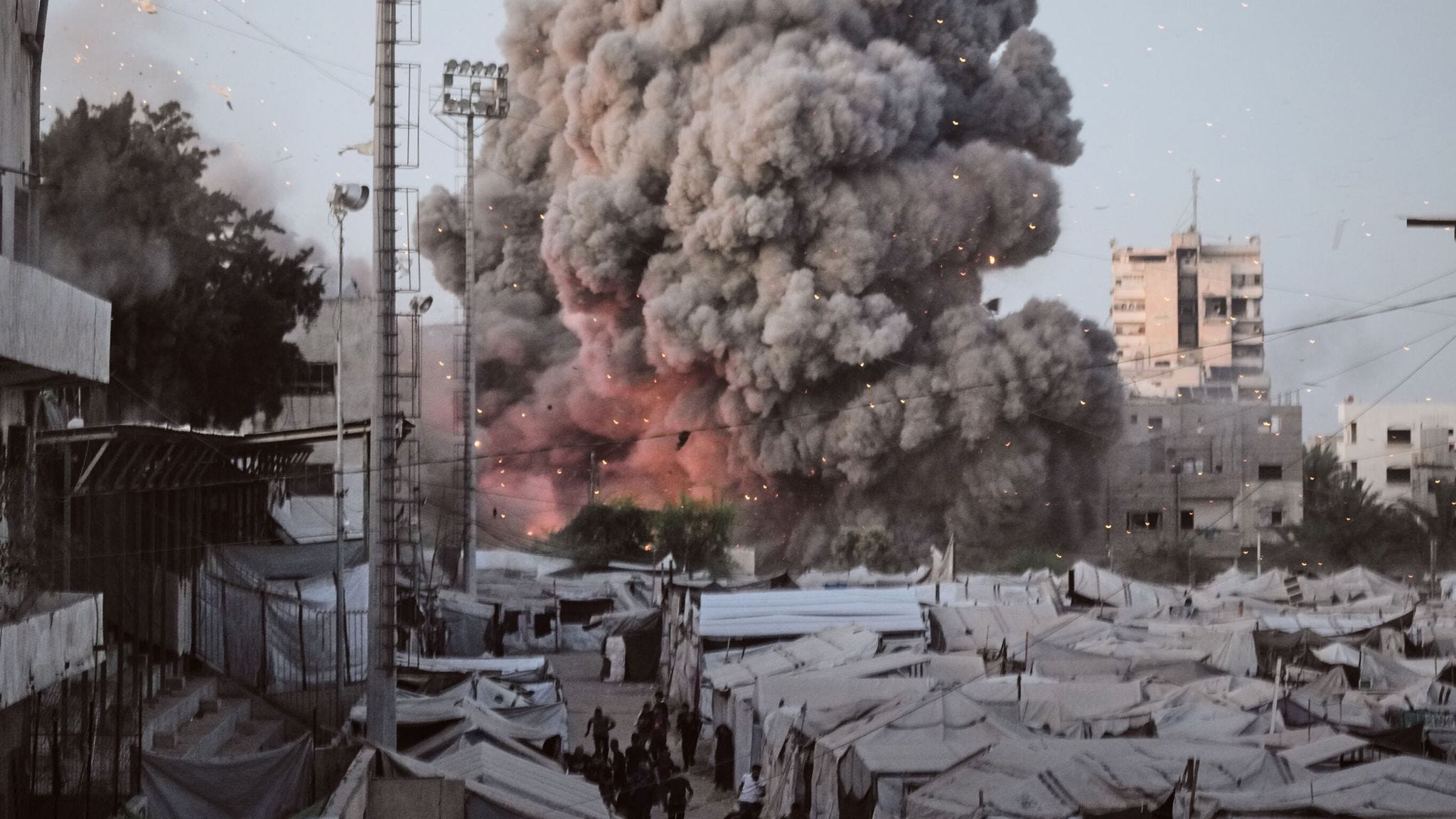
The plan, as with previous iterations on peace regarding Gaza, remains incurably brittle. Since last year’s October ceasefire, Palestinian deaths have risen to 73,000. (The number stood at 67,000 at the commencement of the ceasefire.) The slaughtering approach of the Israeli Defense Forces (IDF) towards those clinging to the Strip has been only slightly moderated. The IDF has also hungrily extended its control to almost 70% of the territory well beyond the Yellow Line stipulated by the ceasefire and destroyed, according to a BBC verify report published last November, upwards of 1,500 buildings.
On 3 August, Mladenov met Israeli Prime Minister Benjamin Netanyahu in what he described as a “[l]ong day in Jerusalem.” This heralded “the start of the hard phase and I have never pretended otherwise.” From here on, the work would be “slow, grinding and technical.” During the course of conversations Mladenov is said to have requested a halt to attacks by Israel on the Strip, which he had lamented in a post the previous day. The weekend following the announcement of the roadmap saw the killing of 25 Palestinians and given the usual justifications: a strike on Deir-al-Balah which left four dead had targeted two Hamas commanders; the strikes on Gaza City and Jabalia had been against “military operatives.”
The Israeli attitude to the latest plans is one of profound and sabotaging scepticism. Doron Spielman, spokesperson for Netanyahu’s office, stated the position on 2 August: “Our assessment is that if we redeploy before Hamas is truly disarmed, it will quickly expand its presence throughout Gaza, rebuild its terrorist infrastructure, once again threaten Israeli communities, and seek to carry another October 7-style attack.” In statement from the same office released on 30 July is clear: the onus is entirely on Hamas to effectively will itself into impotence and subservience through disarming, “including the removal of the weaponry from Gaza and the complete demilitarization of the Strip as a condition for any process.”
Members of the Israeli cabinet are also pre-empting any move on the part of the ISF to move into Gaza. An 3 August letter from the patriotically rabid Finance Minister Bezalel Smotrich and Settlements Minister Orit Strock demanded that Netanyahu convene the security cabinet to bar the entry of ISF troops. The roadmap from the Board of Peace was “dangerous to Israel and completely contradicts the disarming of Hamas and the demilitarization of Gaza.” The plan should be blocked, and the outline amended by the Peace Council “so that it aligns with the goals of the war and the commitments made to Israel.” Another peace plan, celebrated by its proponents yet doomed to a stillborn reality.

Thank you for this piece.
Apparently, peace is not on the list of conditions Israel will tolerate. At least not until every bit of infrastructure and the presence of any Palestinian life has been eliminated.