


For more than a decade, the country existed in a permanent state of suffocation—economically starved, diplomatically isolated, socially fractured. The fall of Bashar al-Assad in late 2024 did not magically heal that trauma. But it did something rarer and more politically consequential: it reopened the future.
What has unfolded since is not a neat democratic transition, nor a simple redemption story. It is a raw, fragile, economically decisive moment whose success or failure will reshape not only Syria, but the political economy of the eastern Mediterranean and the wider Middle East.
The scale of devastation is sobering. Syria’s GDP collapsed by more than 50 per cent compared with 2010 levels. Infrastructure losses alone are estimated by the World Bank at between US$140 billion and US$345 billion, with a central estimate of US$216 billion—nearly nine times Syria’s current GDP. Around 90 per cent of Syrians live below the poverty line. Electricity shortages once left entire cities with only two to four hours of power a day.
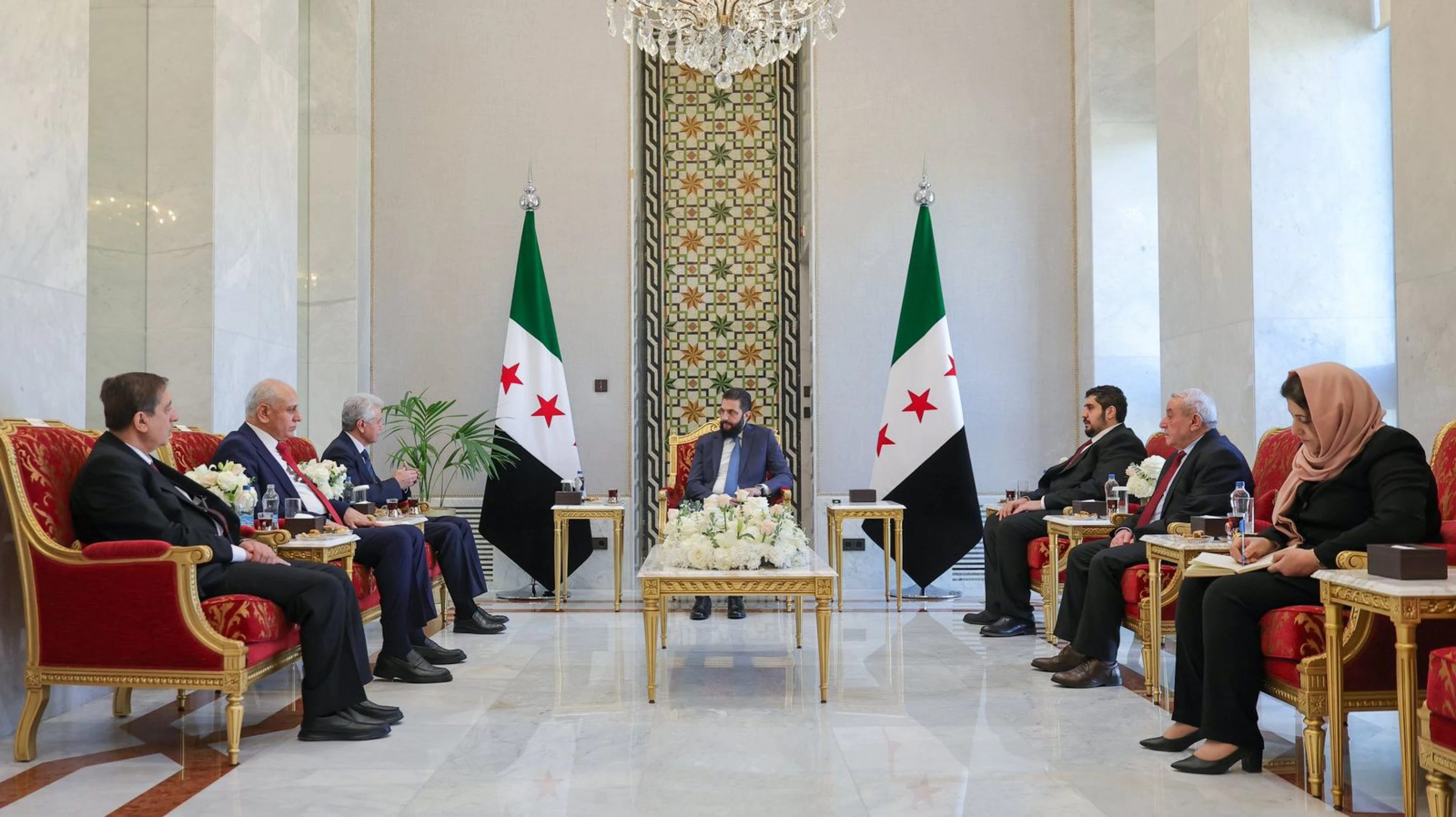
This was not merely a humanitarian crisis; it was a systematic economic unravelling. Yet the past year has also revealed how quickly political oxygen can translate into economic motion. The transitional government under President Ahmad al-Sharaa moved with startling speed: suspending the Assad-era constitution, dissolving its security architecture, and issuing a constitutional declaration that—for the first time in modern Syrian history—formally recognised ethnic pluralism, minority rights and a pathway to elections.
These were not cosmetic gestures. They were signals, directed outward as much as inward, that Syria was prepared to re-enter the international system on different terms.
Markets and capitals noticed. Gulf states stepped in decisively. Saudi Arabia and Qatar cleared Syria’s World Bank arrears and pledged salary support for public servants. Saudi investment agreements alone approached US$6 billion across energy, telecommunications and finance. A UAE firm committed US$800 million to redevelop Tartus port. These are not acts of charity; they are strategic bets on stability. They also reflect a broader regional recalculation: a functioning Syrian economy is now seen as a public good, not a threat.
Perhaps the most consequential shift came from the West. By mid-2025, the United States and the European Union had lifted most post-2011 sanctions, acknowledging what economists and humanitarian agencies had long argued—that sanctions had become an instrument of collective economic punishment rather than political leverage. The repeal of the Caesar Act and the unfreezing of assets reopened Syria’s access to global markets. Currency reform followed, with the redenomination of the Syrian pound and sharp public-sector wage increases.
Early indicators showed growth outperforming projections in late 2025. For a society long trapped in survival mode, even modest stability felt revolutionary.
But economics cannot be separated from social legitimacy. Syria’s transition will not be judged by GDP curves alone. It will be judged by whether growth is shared across sects, regions and generations that have learned to distrust the state. In this regard, the recognition of Kurdish rights through Decree 13—restoring citizenship, recognising Kurdish as a national language—was not a symbolic footnote. It was a foundational act of economic inclusion.
Exclusion, after all, is expensive. Marginalised regions become underproductive regions. Denied citizenship becomes denied capital. The lesson is visible across post-conflict states, from Bosnia to Iraq: political settlements that ignore economic equity simply defer instability.
Syria’s rural economy illustrates this starkly. Nearly half the population depended on agriculture before the war. Conflict and climate change together inflicted more than US$16 billion in crop losses, while repeated droughts now threaten food security. Climate-resilient agriculture—irrigation repair, drought-resistant crops, renewable-powered water systems—is not an environmental luxury. It is a peace strategy. From the Wilson Centre to POMEPS (Project on Middle East Political Science) increasingly frames climate adaptation as central to post-war economic recovery, not adjacent to it.
Energy offers a similar paradox. Years of destruction forced communities to improvise, accelerating decentralised solar adoption. What once looked like collapse now offers a chance to leapfrog. Analysts note that Syria’s reconstruction may produce a cleaner, more flexible energy system than existed before the war—a rare case where conflict inadvertently lowers the long-term carbon cost of development.
None of this erases the risks. Power remains highly centralised. Several cabinet members are drawn from the president’s former movement, fuelling concerns about concentration rather than transformation. Security integration remains incomplete, as shown by clashes with Kurdish forces in Aleppo in early 2026. Trust, once broken, does not regenerate on decree alone. International confidence remains conditional, particularly regarding elections, transitional justice and the demobilisation of armed factions.
Yet perspective matters. Syria is not transitioning in a vacuum. It is doing so amid regional wars, global economic tightening and climate stress. Compared with Libya’s institutional collapse or Iraq’s post-2003 fragmentation, Syria’s trajectory—however uneasy—shows signs of coherence. Unlike the Arab uprisings of the early 2010s, this transition is explicitly economic as much as political. That may be its quiet strength.
For the international community across North and South alike, Syria represents a test that reaches far beyond the fate of a single nation. It is a test of whether the international order still knows how to rebuild rather than merely punish, and whether diplomacy can once again be paired with economic imagination. Syria’s recovery will not be secured through moral distance, conditional sympathy, or the ritual of short-term aid conferences.
It will be shaped by whether allies and partners are prepared to stay—not as patrons, but as participants in a long, uncertain reconstruction of trust, markets and institutions.
For the Global North, the lesson is uncomfortable but unavoidable. Sanctions, isolation and political quarantine did not produce reform; they produced collapse, shadow economies and mass displacement that spilled well beyond Syria’s borders. Refugee flows into Europe, energy insecurity in the eastern Mediterranean, and the entrenchment of transnational militancy were not side effects—they were consequences.
Engagement today is not absolution for past crimes; it is a strategic acknowledgement that broken economies export instability. Treating Syria’s reconstruction as a strategic investment—in logistics corridors, energy grids, climate resilience and human capital—is not charity. It is risk management in an interdependent world.
For middle powers, Syria offers a rare opportunity to lead with patience, credibility and purpose—shaping outcomes not through dominance, but through steady, principled engagement. These states are neither former colonial powers nor immediate neighbours, yet they carry credibility as builders of institutions, regulators of markets, and stewards of inclusive growth.
Technical assistance in public finance, education systems, vocational training and digital governance can quietly reshape outcomes in ways grand diplomacy cannot. This is the diplomacy of systems, not slogans—slow, patient, and profoundly political in its effects.
For the Global South, Syria’s transition resonates as a familiar and deeply felt story—one shaped by recovery after rupture, by dignity reclaimed through development, and by the long struggle to turn survival into sovereignty. It echoes familiar stories of post-conflict recovery under unequal global rules, of economies asked to liberalise before they can stabilise, and of societies judged by standards they had little role in writing.
South–South cooperation—in agriculture, low-cost housing, renewable energy, and post-war urban planning—offers Syria not a model to imitate, but experiences to adapt.
Countries that rebuilt after a conflict with limited resources understand that resilience is not imported; it is cultivated. Major global actors already sense this opening. Investment in infrastructure, ports, manufacturing corridors and the energy transition is no longer just about growth or reconstruction; it has become a quiet language of influence, signalling who is willing to shape the future rather than merely observe it.
Yet influence in Syria will not be measured by contracts alone. It will be measured by whether growth reaches neglected provinces, whether young Syrians see futures at home rather than abroad, and whether economic integration reduces the appeal of militias more effectively than force ever did.
What makes this moment unusual—and fragile—is that Syria is not asking to be rescued. It is asking to be reconnected. Reconnected to markets that reward productivity rather than proximity to power. Reconnected to institutions that discipline authority rather than personalise it. Reconnected to a global economy that recognises that peace is built not only through ceasefires, but through jobs, electricity, water and dignity.
The deeper question, then, is not whether Syria deserves engagement. It is whether the international system still believes in its own capacity to transform conflict into cooperation. The choice facing allies and partners is stark: continue to manage the aftershocks of collapse, or invest—strategically, patiently, imperfectly—in the conditions that prevent collapse in the first place.
Syria’s recovery, if it succeeds, will not belong to Syria alone. It will stand as evidence that the Global North and Global South, often divided by history and hierarchy, can converge around a shared interest in stability with justice. If it fails, the costs will once again travel across borders, across seas, and across generations.
Syria today stands neither redeemed nor ruined. It stands open. The question is whether the international system, having helped suffocate its economy for years, is prepared to help it learn how to breathe—slowly, inclusively, and for the long term. If that opportunity is missed, the cost will not be confined within Syria’s borders. History, in this region, rarely is.
