


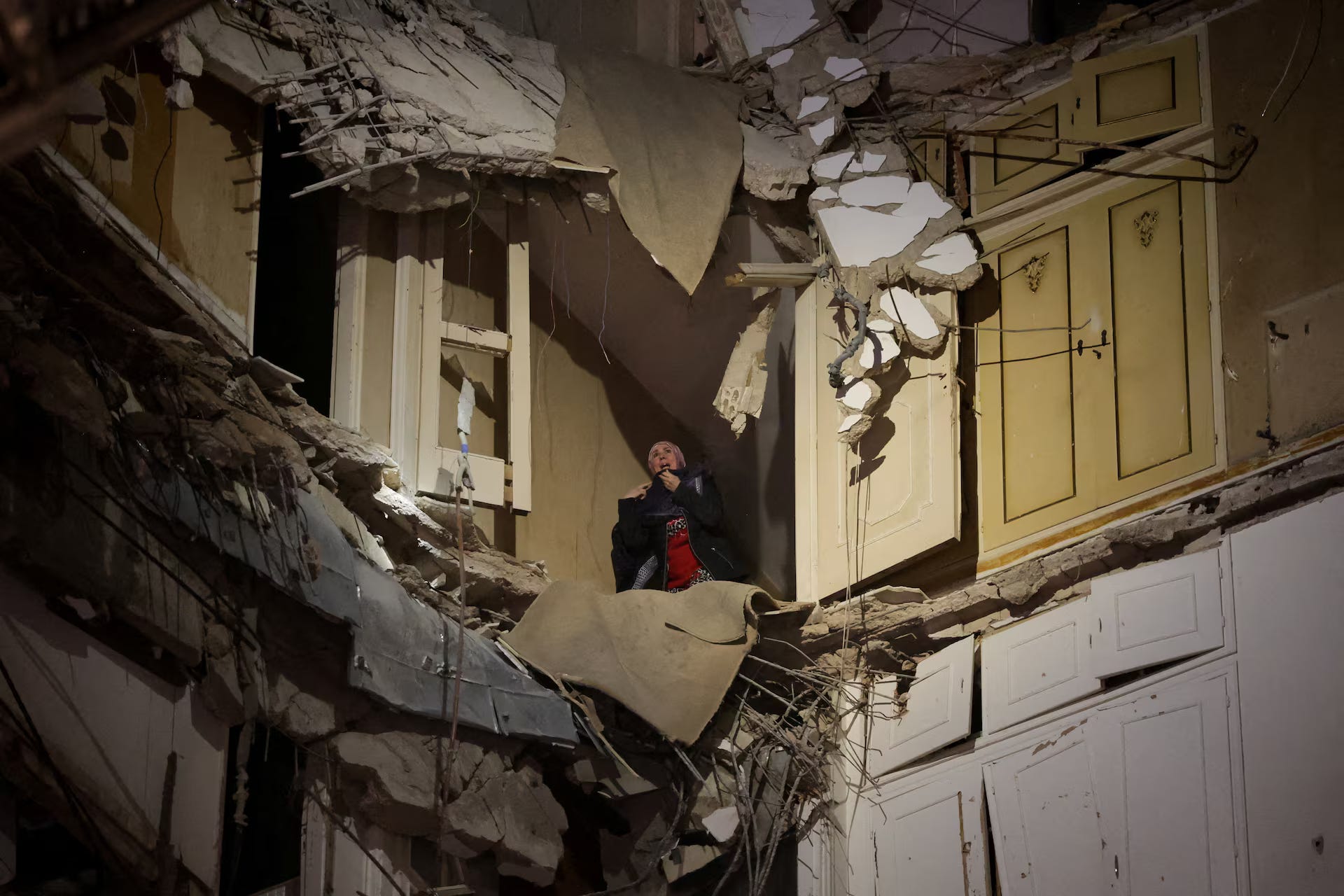
The sky over Beirut did not merely darken on 8 April 2026; it fractured. In the span of ten minutes, more than one hundred Israeli airstrikes tore through Lebanon’s capital and its hinterlands, marking what has been described as the most intense bombardment since the war began. The scale alone is staggering—roughly 160 munitions unleashed across over 100 sites in minutes—but it is the human residue of that violence that now defines this moment: at least 254 killed, over 1,165 wounded, and a country once again pushed to the brink of systemic collapse.
This is not an aberration. It is the continuation of a pattern—one that has evolved from episodic confrontation into what increasingly resembles a permanent condition of war. Gaza, Lebanon, and now the looming spectre of Iran are no longer discrete theatres; they form a contiguous arc of instability shaped by Israeli military doctrine and underwritten, implicitly and materially, by the United States. What unfolded in Beirut is therefore not simply a tactical escalation. It is a strategic declaration that the rules governing war—already fragile—are now optional.
International humanitarian law, long treated as the moral floor of armed conflict, appears to have been swept aside. Civilian neighbourhoods, medical infrastructure, and even funeral gatherings were struck in this latest barrage. The Geneva Conventions are unambiguous on such matters: distinction and proportionality are not aspirational principles; they are binding obligations. Yet the admission that targets were embedded “within the heart of the civilian population” raises a troubling question—whether the threshold for acceptable civilian harm has been recalibrated beyond recognition.
The language emerging from international institutions reflects a quiet but unmistakable alarm. The United Nations described the attacks as causing “significant civilian casualties” and called for urgent restraint. The High Commissioner for Human Rights reportedly characterised the scenes as “nothing short of horrific”. Such phrasing, typically measured, now carries the weight of disbelief. There is an implicit recognition that the tempo and intensity of violence have outpaced the diplomatic vocabulary designed to contain them.
What makes this moment particularly combustible is its timing. The strikes came in the immediate aftermath of a fragile US—Iran ceasefire, brokered with considerable diplomatic effort. That agreement—already strained by competing interpretations—has now been rendered precarious, if not entirely hollow. Israel’s assertion that Lebanon fell outside the scope of the truce, reportedly echoed by elements within Washington, has exposed a dangerous ambiguity at the heart of contemporary diplomacy: agreements that are partial, conditional, or selectively applied risk becoming accelerants rather than safeguards.
Iran’s response has been swift and rhetorically uncompromising. Warnings of retaliation and the suspension of strategic shipping routes signal a readiness to escalate beyond proxy engagements. Within the framework of the so-called “Axis of Resistance,” this moment is being reframed not as a setback, but as a crucible—an opportunity to assert resilience against what is perceived as sustained aggression. In this narrative, endurance itself becomes a form of victory.
That framing should not be dismissed lightly. History suggests that overwhelming force, particularly when it results in widespread civilian suffering, rarely produces the deterrence it seeks. The 2006 Lebanon war, often cited as a precedent, resulted in approximately 1,000 Lebanese civilian deaths and the displacement of nearly a million people. It did not eliminate Hezbollah; it arguably entrenched it. Today’s escalation risks repeating that cycle on a more volatile regional scale.
From a strategic perspective, the doctrine underpinning these strikes appears rooted in deterrence through punishment—the belief that inflicting severe costs will alter adversary behaviour. Yet this logic is increasingly colliding with a countervailing reality: non-state actors embedded within civilian populations are not easily deterred by conventional means. Instead, such tactics often deepen local support, fuel recruitment, and internationalise sympathy.
What emerges with increasing clarity is the urgent need to reimagine deterrence itself—not as the infliction of overwhelming force, but as a framework rooted in credible restraint, mutual vulnerability, and enforceable international guarantees that privilege the preservation of human life over the spectacle of destruction.
There is also a broader geopolitical cost. The perception—widespread across much of the Global South—that international norms are applied selectively is gaining renewed traction. When civilian casualties mount without accountability, the legitimacy of the rules-based order begins to erode. This is not merely a reputational issue; it has tangible implications for global governance. States are less likely to adhere to norms they perceive as inconsistently enforced.
At the same time, Iran’s reported suspension of shipping through the Strait of Hormuz—a chokepoint through which a significant share of the world’s energy flows—casts this crisis far beyond the region, underscoring both its claim to urgent resistance and the stark reality that unchecked escalation and alleged violations of international law now demand an immediate, collective response from the international community.
For policymakers across the international system, this moment presses with a quiet but undeniable urgency that transcends borders and alliances, demanding far more than calibrated statements or ritual expressions of concern; it calls for a profound recalibration of engagement in which the defence of international law is not treated as an abstract ideal, but as a core strategic imperative underpinning global order itself.
Within the United Nations, this requires not only renewed rhetorical unity but institutional resolve—through the Security Council, the General Assembly, and the Human Rights Council—to reaffirm that the protection of civilians is non-negotiable, even amid the most complex security dilemmas.
Notably, the United Nations Security Council has been urged into emergency consultations amid mounting civilian casualties, reflecting a deepening recognition within the international system that the scale and intensity of the strikes cannot be absorbed within existing diplomatic inertia and instead demand immediate, coordinated intervention.
For regional actors, from the Arab League to the Organisation of Islamic Cooperation, and extending to neighbouring states whose stability is inextricably bound to the fate of Lebanon and the wider area, the burden is equally weighty: to move beyond declaratory diplomacy towards coordinated political, humanitarian, and legal initiatives that restore credibility to collective action.
The silence of institutions in moments of acute human suffering does not remain neutral; it echoes, it accumulates, and it ultimately reshapes the moral architecture of international relations. In such a climate, equivocation risks being read not as caution but as consent, eroding the fragile trust upon which multilateralism depends.
What is at stake is not only the immediate cessation of violence, but the preservation of a rules-based order that, once hollowed out, may prove impossible to rebuild—leaving future crises to unfold in an increasingly permissive landscape where power, rather than principle, writes the terms of peace and war.
The path forward is neither simple nor immediately reassuring. De-escalation will require a recommitment to comprehensive ceasefire frameworks—agreements that leave no geographic or political ambiguity. It will necessitate independent investigations into alleged violations of international law, not as punitive measures alone, but as mechanisms to restore a baseline of accountability. And it will demand sustained humanitarian intervention to stabilise a Lebanese state already under immense strain.
Yet beyond policy prescriptions lies a more fundamental question: what kind of international order is being constructed in real time? If the events in Beirut are allowed to stand as precedent, they may signal a shift towards a more permissive environment for high-intensity, civilian-impacting warfare. That is a trajectory fraught with peril.
There is, however, an alternative reading—one that sees in the resilience of affected populations and the growing chorus of international concern the seeds of a different outcome. The narrative of unrestrained power is not uncontested. Each image of devastation, each documented casualty, contributes to a counter-narrative that insists on the primacy of human life over strategic calculus.
In that tension—between power and the law, between might and right—the future of this region, and indeed the credibility of the international system, will be decided.
