


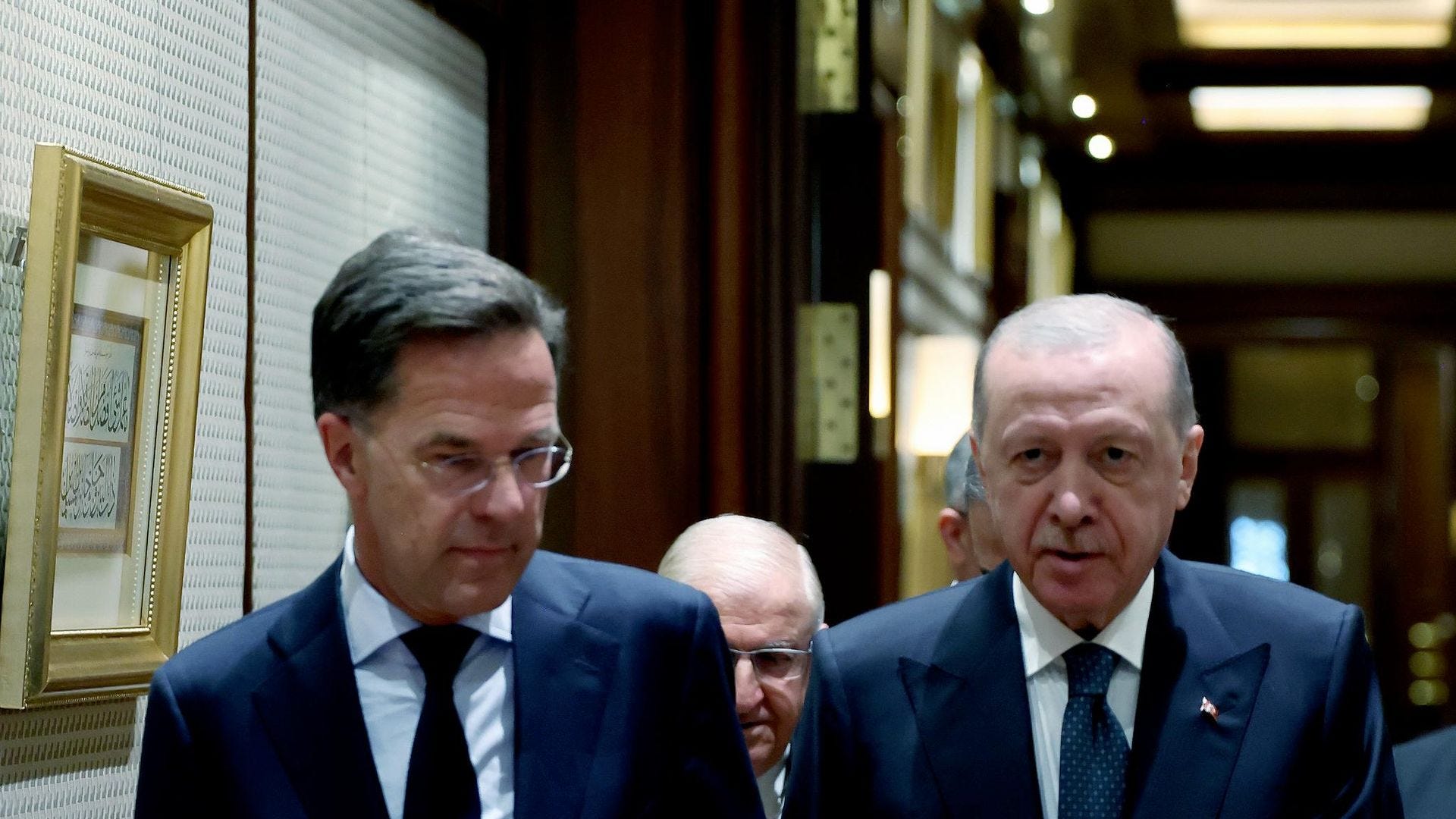
The 2026 NATO Summit in Ankara is not merely another date on the diplomatic calendar. It is the moment the world’s strategic architecture snaps into a new and unforgiving shape.
For seven decades, the North Atlantic Treaty Organisation functioned as a transatlantic spine—Washington the brain, Brussels the nerve centre, and the European flank the muscle. That architecture is now obsolete. In its place emerges something far more concentrated, far more brittle, and far more dependent on a single Eurasian capital than any Western strategist dared imagine.
Türkiye is no longer a flank state. It is the geopolitical fulcrum through which Western deterrence, Black Sea stability, Middle Eastern crisis management, and Gulf security now flow. As NATO Military Committee Chair Admiral Giuseppe Cavo Dragone put it bluntly: “Geographically, Türkiye is on the edge of the alliance, but on many strong and important issues, it is right at the centre.” That sentence—uttered on the eve of history—captures everything.
This is the dawn of NATO 3.0. Turkish Foreign Minister Hakan Fidan has been characteristically direct: “NATO 1.0 was adopted during the Cold War, NATO 2.0 operated from the Cold War until the present summit, and now the NATO 3.0 Strategy will be adopted, taking us into a new phase.” The burden-sharing system that existed from World War II until 2026 is finished. What replaces it is an Ankara-centric system where global crises increasingly require Turkish consent, Turkish corridors, and Turkish leverage.
Consider the raw mathematics of power. Türkiye fields the Alliance’s second-largest army. It controls access to the Black Sea through the Turkish Straits under the Montreux Convention. It anchors NATO’s southern flank, borders multiple conflict zones, and has emerged as a progressively significant defence-industrial partner through expanding indigenous capabilities.
When the US ambassador to NATO declares that allies should be “more like Türkiye”—capable of manufacturing fifty ships simultaneously in domestic shipyards—the strategic signal could not be clearer. Washington is not just tolerating Ankara’s rise; it is actively modelling it.
The defence-industrial corridor tells the real story. At the Hague Summit in 2025, allies committed to spending 5 per cent of GDP on defence by 2035—3.5 per cent on core military expenditure and 1.5 per cent on broader security-related investments. The Ankara Summit is where those promises must become missiles, drones, ammunition, and deployable forces. NATO Secretary-General Mark Rutte has framed it with characteristic bluntness: the summit must move “from money to missiles.”
And who fills the production gap? Türkiye. Polish firms have already signed a $410 million counter-drone and electronic-warfare deal with Turkish defence giant ASELSAN. Baykar, the manufacturer of the famed Bayraktar drones, is discussing building a factory in Poland. NATO’s deputy commander has pointed to Turkish drone innovation—particularly Bayraktar systems—as a leading example of how the alliance is moving away from closed, proprietary military software towards open, adaptable architectures. These are not accessories to European defence. They are its industrial backbone.
The Black Sea dimension is where Ankara’s gatekeeping power becomes existential. Together with Romania and Bulgaria, Türkiye has conducted mine countermeasures operations, ensuring security for the longest Black Sea coastline while controlling the Turkish Straits. It has prevented Russian warships from entering the Black Sea and given Ukraine invaluable military assistance with Bayraktar drones. The Alliance is now formalising a massive €70 billion military assistance package for Ukraine through 2026, leveraging a newly established €60 billion EU loan facility. Yet none of this is possible without Turkish logistical arteries, Turkish airspace, and Turkish diplomatic cover.
The southern flank has finally found its anchor. After years of NATO’s inconsistent engagement with the Middle East, North Africa, and the Gulf, the Ankara Summit outlines something unprecedented: localised counter-drone initiatives, maritime security programmes across the Mediterranean, and overlapping defence frameworks with Gulf partners. Host nation Türkiye, perhaps the ally most affected by instability in the southern neighbourhood, is using its role to push for consistent, sustained engagement.
The Turkish government has served as a bridge between NATO and the South before—the 2004 Istanbul Summit produced the Istanbul Cooperation Initiative with four new Gulf partners. But 2026 is different. This time, Ankara is not just the bridge. It is the destination.
The paradox cuts deep. As one analyst put it, “Ankara does not want to be absorbed into European or American geopolitical priorities, especially when these may conflict with Turkish interests in the Black Sea, the Middle East, or the Eastern Mediterranean.” Türkiye wants more weight in NATO, but on terms that allow it to remain an autonomous regional power. That is the fundamental tension of the new era: the West needs Türkiye more than Türkiye needs the West. The dependency arrow has reversed.
And what of the American withdrawal? Under the Trump administration, the United States is actively pulling back traditional European footprints—including the ongoing withdrawal of thousands of troops from Germany. Washington demands that Europe become the primary conventional first responder. European allies are aggressively expanding core defence investments, racing toward the 5 per cent GDP threshold.
But filling the capability gap requires industrial capacity that Europe, in many critical areas, no longer possesses. That capacity resides in Ankara.
This is the dissolution of the old Atlantic security axis. The geographic centre of gravity has shifted southward and eastward. The Black Sea, the Eastern Mediterranean, and the Caucasus are the new front lines. These are not Atlantic spaces; they are Eurasian spaces. A NATO whose principal operational theatres are the Danube Delta, the Bosphorus, and the Syrian border is a NATO whose Atlantic character has become vestigial.
The implications for global strategists are profound. The world is transitioning from a multipolar system to a nodal system—one where a single capital concentrates strategic functions that were once distributed across continents. Ankara now sits in the structural hole between the Western alliance, the Russian sphere, the Iranian axis, the Gulf cluster, the Israeli-Western security complex, and the Turkic world. No other capital connects these clusters simultaneously.
This is not Turkish imperialism. It is structural necessity. The West’s strategic withdrawal and Türkiye’s successful exploitation of the resulting vacuums have produced a new strategic grammar. The question for policymakers in Canberra, London, Washington, and Brussels is no longer whether to engage Ankara, but how to manage dependence on a single Eurasian node whose political trajectory remains profoundly uncertain.
The Ankara Summit is not the end of history. It is the beginning of a new geography of power—one where the old maps no longer apply, and where the centre of gravity speaks Turkish. The Atlantic era is over. The Eurasian era has begun. And its capital is Ankara.
