


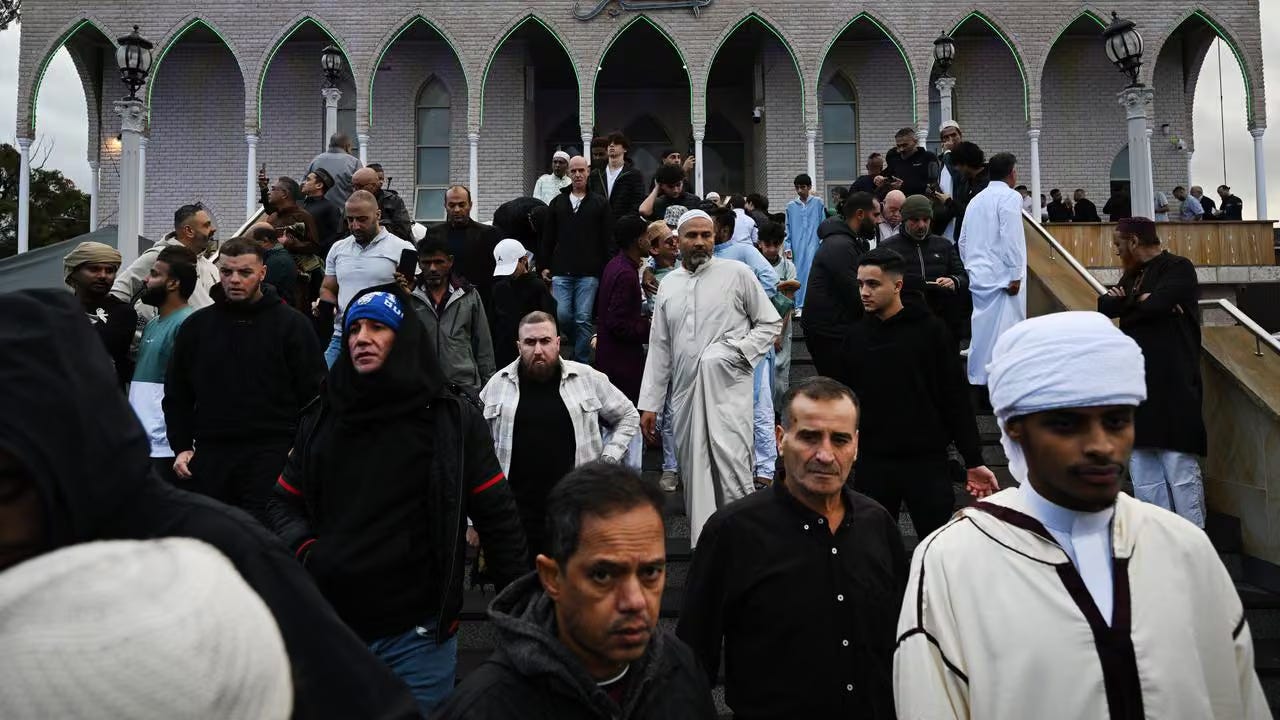
For global strategists and policymakers, the Australian experience offers a stark warning: when a nation’s security architecture, media ecology, and urban geography converge to treat one community as perpetually suspect, the social contract itself begins to unravel.
The statistics are devastating. Since October 2023, the Islamophobia Register Australia has documented a 530 per cent increase in anti-Muslim incidents. Following the Bondi terrorist attack, reports surged by more than 740 per cent and have remained at an elevated level of 453 per cent. More than 1,500 cases have been reported. Muslim women—particularly those wearing the hijab—bear the overwhelming brunt, constituting 75 per cent of all reported victims. One in three Australians now holds negative views toward Muslims, the most negatively rated community in the country.
Yet these numbers, as alarming as they are, represent only the visible tip of a much deeper structural crisis. Islamophobia in Australia is not a collection of isolated hate incidents. It is a multilayered system—a confluence of media narratives, political rhetoric, counter‑terrorism laws, urban geography, and colonial legacies—that together produce an environment in which Muslim visibility becomes a liability and Muslim belonging remains perpetually conditional.
Since 2001, Australia has enacted more than 100 counter‑terrorism laws—a legislative velocity unmatched by any other Western democracy. The definition of a “terrorist act” in the Criminal Code, with its emphasis on ideological or religious motivation, has contributed to the perception that terrorism is uniquely associated with Islam.
The consequence is systemic: the religious‑motive frame cascades through legislation, counter‑terrorism practice, and operational guidance, amplifying media narratives that equate Islam with violence and fuelling public suspicion even where no risk exists.
Muslim Legal Network (NSW) submissions to the Independent National Security Legislation Monitor have documented how this framework has resulted in disproportionate surveillance, policing, and stigmatisation of Australian Muslim communities. The application on the ground, as Victoria’s Muslim Legal Network observes, has overwhelmingly targeted Muslims. When a young Muslim engages in violence, the label “terrorist” is applied instantaneously. When a non‑Muslim commits an identical act, the frame shifts to mental illness or lone‑wolf aberration.
This is not a flaw in the system; it is the system operating as designed. Counter‑terrorism law, in practice, functions as a racialised legal architecture—one that encodes suspicion into the very grammar of Australian jurisprudence.
In July 2026, One Nation leader Pauline Hanson sat with Tommy Robinson—a convicted British far‑right activist—and blamed the end of the White Australia policy for Australia’s migration “problems.” She accused Muslims of “ripping off” the NDIS and claimed Muslim women were having children because “Allah will provide”—adding, “Well, the Allah that is providing is the taxpayer.” Special Envoy Aftab Malik warned her words “could have violent consequences” and invoked Christchurch. Prime Minister Albanese accused Hanson of “undermining social cohesion.”
Home Affairs Minister Tony Burke declared: “I never thought … anyone who’d been elected to parliament would be calling for White Australia.” Yet on the same day, the government rejected Malik’s recommendation to review counter‑terrorism laws for discriminatory effects against Muslims—preserving the very architecture that makes Hanson’s rhetoric politically viable.
Australian Muslims are not primarily known through lived encounter but through mediated representation. Academic analyses of Australian news outlets reveal a pronounced imbalance: Muslims are disproportionately framed through the lenses of national security, conflict, and cultural incompatibility.
The “War of Words” study commissioned by the Islamophobia Register Australia documents how coverage systematically positions Muslims as threats while erasing their contributions as neighbours, professionals, and citizens.
This is not merely biased reporting; it is an epistemic regime—a system of knowledge production that filters reality through a grid of predetermined categories. The Muslim is always‑already a potential terrorist. Even “positive” stories are framed through this lens: the “good Muslim” who condemns terrorism, the “moderate Muslim” who assimilates, the “empowered Muslim woman” who rejects the hijab. The underlying binary remains intact.
The Scanlon Foundation Research Institute’s Mapping Social Cohesion Survey reveals the consequences: social cohesion in Australia is at its lowest level since measurement began in 2007. The proportion of adults with negative views of Muslims has climbed to 35 per cent, up from 27 per cent in 2023. This is not organic public opinion; it is manufactured consent, produced by a media ecosystem that profits from polarisation.
Sydney’s so‑called “Latte Line”—an invisible socioeconomic boundary running from the airport northwest through Parramatta—divides the city into two radically different realities for Muslim Australians. In Western Sydney’s Lakemba, Bankstown, and Auburn, Muslim identity is normalised: halal butchers line the streets, mosques are visible and active, and women in hijab move through public space without attracting hostile attention.
Cross the Latte Line into the corporate zones of the CBD, the beaches of the Eastern Suburbs, or the leafy streets of the North Shore, and the experience transforms. The hijab becomes a provocation, the beard a threat, the Arabic language a reason for suspicion. Muslims report a sharp rise in discomfort—heightened surveillance in retail spaces, social ostracisation, and public verbal assaults.
This spatial conditional belonging is the very architecture of urban apartheid—not formal legal segregation, but an insidious informal geography where safety is geographically contingent, and belonging is perpetually conditional.
When councils reject mosque applications, they rarely cite religion. Instead, objections are framed in the neutral language of planning regulations: “traffic congestion,” “parking shortages,” “noise pollution,” and “loss of suburban amenity.” The Bendigo Mosque battle, which escalated to the Victorian Civil and Administrative Tribunal and the Supreme Court, demonstrated how far‑right groups weaponise the planning process to inflict psychological trauma and financial exhaustion on minority communities.
This bureaucratic encryption makes discrimination extraordinarily difficult to challenge. The law requires proof of discriminatory intent, but the neutral language of planning provides perfect cover. This is how systemic Islamophobia perpetuates itself without ever needing to speak its name—through institutional processes that appear neutral but systematically disadvantage Muslim communities.
Domestic Islamophobia in Australia is fundamentally tied to the nation’s alignment with global Western military alliances. Australia’s participation in the wars in Iraq, Afghanistan, and Syria, and its broader alignment with US‑led interventions, requires the state to manufacture domestic consent. This consent is manufactured, in part, through the demonisation of the enemy—who is invariably framed as Muslim, Arab, and fanatical.
Every Australian military deployment is accompanied by a surge in domestic Islamophobia. Hate incidents spike. Media rhetoric intensifies. Political discourse hardens. This is a structural feedback loop: foreign policy produces domestic prejudice, and domestic prejudice, in turn, legitimises foreign policy. The state can claim moral authority abroad only by generating hostility toward the communities linked to those foreign conflicts.
The Albanese Government’s appointment of Special Envoy Aftab Malik and its acceptance of 35 of 54 recommendations from his landmark report represent significant milestones. The government has committed to establishing an Islamophobia Education Taskforce, funding mental health supports for affected communities, expanding AFP Community Liaison Teams, and criminalising membership in hate groups.
Yet critical gaps remain. The government explicitly rejected the Envoy’s recommendation to overhaul counter‑terrorism laws—a decision that perpetuates the structural bias at the heart of Australia’s security architecture. The Islamophobia Register Australia has warned of a “fractured relationship” between the Muslim community and the federal government, noting that “Islamophobia needs to be treated with a level of urgency that we have not seen yet.”
For global strategists and policymakers, the Australian case is a cautionary tale. It demonstrates how multiculturalism can be celebrated symbolically while being undermined materially by laws, institutions, and narratives that treat one community as perpetually suspect. It reveals how counter‑terrorism law can function as racialised governance, how media can manufacture fear, and how urban geography can enforce exclusion.
The cost is not merely moral; it is material. Researchers estimate Australia loses more than 3 per cent of its GDP annually—approximately $37 billion—because of racial discrimination. Muslim Australians experience stark underemployment despite high educational attainment, with an employment rate of just 32.5 per cent compared to 45.7 per cent for the general population. This is not just injustice; it is national self‑impoverishment.
The choice before Australia—and before every nation grappling with the rise of identity‑based exclusion—is whether to confront these uncomfortable truths and undertake the difficult work of reconstruction, or to continue the cycle of symbolic inclusion and structural exclusion until the contradictions become explosive.
The future is not predetermined. But the architecture of exclusion, once built, does not dismantle itself. It requires courage, honesty, and a willingness to reimagine what it means to belong. The reward is immense: a nation that genuinely belongs to all its people, where no one is required to erase their identity to be safe, and where the diversity of faiths and cultures is not a threat to be managed but a gift to be cherished.
