


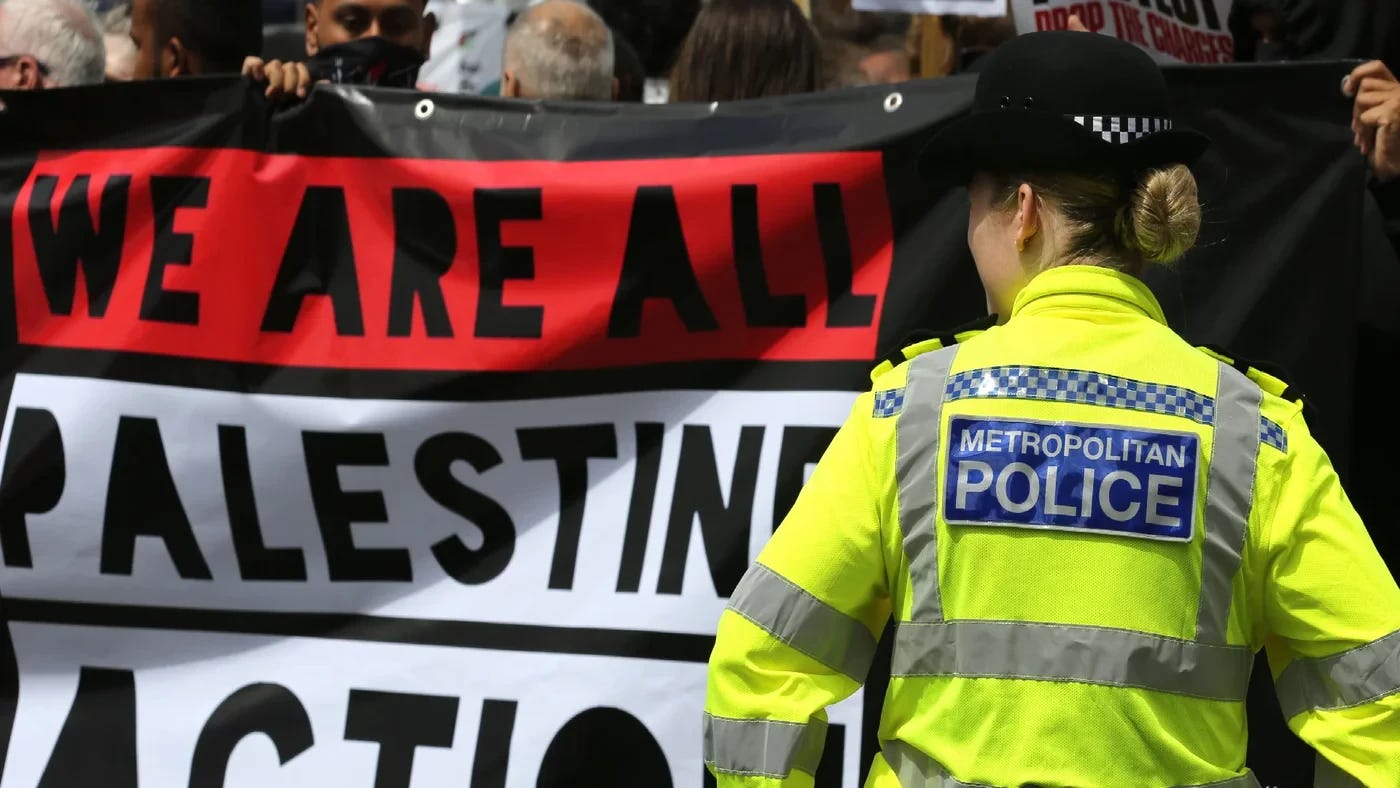
The moment the British government began proscribing political movements as terrorist organisations, rather than just militant groups, it was inevitable that saying factual things, making truthful statements, would become a crime.
And lo behold, here we are.
The Terrorism Act 2000 has a series of provisions that make it difficult to voice or show any kind of support for an organisation proscribed under the legislation, whether it is writing an article or wearing a T-shirt.
Recent attention has focused on Section 13, which is being used to hound thousands of mostly elderly people who have held signs saying: “I oppose genocide, I support Palestine Action.” They now face a terrorism conviction and up to six months in jail.
But an amendment introduced in 2019 to Section 12 of the Act has been largely overlooked, even though it is even more repressive. It makes it a terrorism offence for a person to express “an opinion or belief that is supportive of a proscribed organisation” and in doing so be “reckless” about whether anyone else might be “encouraged to support” the organisation.
It is hard to believe this clause was not inserted specifically to target the watchdog professions: journalists, human rights groups and lawyers. They now face up to 14 years in jail for contravening this provision.
When it was introduced, six years ago, Section 12 made it impossible to write or speak in ways that might encourage support for groups whose central aim was using violence against people to achieve their aims.
The law effectively required journalists and others to adopt a blanket condemnatory approach to proscribed militant groups. That had its own drawbacks. It made it difficult, and possibly a terrorist offence, to discuss or analyse these organisations and their goals in relation to international law, which, for example, allows armed resistance—violence—against an occupying army.
But these problems have grown exponentially since the Conservatives proscribed Hamas’ political wing in 2021 and the government of Keir Starmer proscribed Palestine Action in 2025, the first time in British history a direction-action group targeting property had been declared a terrorist group.
Now journalists, human rights activists and lawyers face a a legal minefield every time they try to talk about the Gaza genocide, the trials of people accused of belonging to Palestine Action, or the hunger strikes of those on remand over attacks on weapons factories supplying killer drones to Israel.
Why? Because saying truthful things about any of these matters—if they could lead a reader or listener to take a more favourable view of Palestine Action or the political wing of Hamas—are now a terrorist offence. Any journalist, human rights activist or lawyer making factual observations risks 14 years behind bars.
Few seem to have understood quite what impact this is having on public coverage of these major issues.
A month and a half into the hunger strike by eight members of Palestine Action—the point at which people are likely to start dying—the BBC News at Ten finally broke its silence on the matter. That was despite the hunger strike being the largest in UK history in nearly half a century.
There are clear political reasons why the BBC had avoided this topic for so long. It prefers not to deal with matters that directly confront the legitimacy of the government, which funds it. The BBC is effectively the British state broadcaster.
But in a naturally spineless organisation like the BBC, the legal consequences have clearly weighed heavily too. In a recent short segment on the hunger strike, BBC correspondent Dominic Casciani carefully hedged his words and admitted to facing legal difficulties reporting on the strike.
In these circumstances, news organisations make one of two choices. They simply ignore factual things because it is legally too dangerous to speak truthfully about them. Or they lie about factual things because it is legally safe—and politically opportune—to speak untruthfully about them.
The so-called “liberal” parts of the media, including the BBC, tend to opt for the former; the red-tops usually opt for the latter.
The government itself is taking full advantage of this lacuna in reporting, injecting its own self-serving deceptions into the coverage, knowing that there will be—can be—no meaningful pushback.
Take just one example. The government has proscribed Palestine Action on the grounds that it is a terrorist organisation. It has justified its decision by implying, without producing a shred of evidence, that the group is funded by Iran, and that its real agenda is not just criminal damage against arms factories but against individuals.
Any effort to counter this government disinformation, by definition, violates Section 12 of the Terrorism Act and risks 14 years’ imprisonment.
Were I to conduct an investigation, for example, definitively showing that Palestine Action was not funded by Iran—proving that the government was lying—it would be a terror offence to publish that truthful information. Why? Because it would almost certainly “encourage support” for Palestine Action. There is no fact or truth exemption in the legislation.
Similarly, the government has suggested that the current “Filton Trial”—which includes discussions of events in which a police officer was injured during a struggle over the sledgehammers being used to destroy the Elbit factory’s weapons-producing machinery—demonstrates that Palestine Action was not just targeting property but individuals too.
Were I to try to make the case that the alleged actions of one individual—only one person is charged with assault—prove nothing about the aims of the organisation as a whole, I would be risking a terrorism conviction and 14 years’ imprisonment. Which is one, very strong reason not to make such an argument.
But in the absence of such arguments, the reality is that social media is awash with posts from people echoing outrageous official disinformation. This spreads unchallenged because to challenge it is now cast as a terrorism offence.
In truth, since proscription, any statements about the political aims of a deeply political organisation like Palestine Action occupy a grey area of the law.
Is it a terrorism offence to point out the fact, as I have done above, that Palestine Action targeted Elbit factories that send killer drones to Israel for use in Gaza. In doing so, may I have “recklessly” encouraged you to support Palestine Action?
Can I express any kind of positive view about the hunger strikers or their actions without violating the law?
The truth is that the law’s greyness is its very point. It maximises the chilling effect on those who are supposed to serve as the public’s watchdogs on power: journalists, human rights groups, lawyers.
It allows the government—through complaint police forces—to selectively pick off those dissenting individuals it doesn’t like, those without institutional backing, to make examples of them. This is not conjecture. It is already happening.
The abuse of the Terrorism Act discourages research, analysis and critical thinking. It forces all journalists, human rights activists and lawyers to become lapdogs of the government. It creates a void into which the government can spin events to its own advantage, in which it can avoid accountability and in which it can punish those who dissent. It is the very antithesis of democratic behaviour.
This ought to appall anyone who cares about the truth, about public debate, about scrutiny. Because they have all been thrown out of the window.
And in proscribing Palestine Action, the government has set the most dangerous of precedents: it can outlaw any political group it chooses as a terrorist organisation and thereby make it impossible to defend that group.
That is what authoritarian governments do. That is exactly where Britain is now.

As I read your article was thinking of this case from 1996. They must have had legal advice to leave the video in the aircraft so that it could be used as evidence. I used to belong to a Union choir and this was one of our favourite sings of resistance.
Four Strong Women
A song by Maurie Mulheron ©Maurie Mulheron 1996
Chorus:
It took a hammer, an act of love
To turn that jet Hawk into a dove
It took some courage, it took some strength
To stop that fighter from dealing death
Into the hangar, into the plane
Now use your hammer to stop the pain
There's steady breathing as your work starts
Four strong women, four beating hearts
You sang of justice, you rang the bell
You drove your hammer through Timor's hell
You won your freedom but you won more
You stopped a death plane from making war
Four strong women with hammers high
Beating ploughshares for a peaceful sky
They know the struggle, they know the cause
Whoever profits keeps making wars
Coda: Four strong women, four beating hearts
Notes
Many thanks to Maurie Mulheron for permission to add this song to the Union Songs site.
Maurie writes:
This song celebrates the actions of four British women, Andrea Needham, Joanna Wilson, Lotta Kronlid and Angie Zeltner, who are members of the peace group, Ploughshares. In January 1996, they broke into the high security hangar owned by British Aerospace in Lancashire. Their purpose was to disarm one of the newly built Hawk jets. These jets were due for delivery to the Indonesian Government who use the jet Hawk against the villagers of East Timor.
The four women had researched the plane well, learning its control panel layout and serial number. Months were spent monitoring the security and general operations of the British aerospace site at Warton until they were sure that they had located the exact plane destined for Indonesia.
Once they had made a positive identification, Jet ZH 955, they made their last minute preparations. They quit their flats, said their farewells, bought some tools - bolt-cutters, crowbars and small hammers, and made their way to the airfield.
After an agonising period waiting for the right moment, the four women broke into the hangar and set about destroying the war machine. They developed a steady rhythm, once they realised that the security was not coming. Over a period of about an hour the women methodically destroyed the plane's weapons system with their hammers. As Andrea Needham explains, "I have to admit I thought it might be a kind of religious experience but it felt like work - a job. It was like, here is a weapon that will hurt people, so this is what we have to do to stop it."
When they finished, they placed banners and streamers over the plane, sang songs of peace and dropped small seeds (of hope) everywhere. As well, they placed a video in the cockpit of John Pilger's documentary on East Timor which has footage of eyewitness accounts of the planes in action.
Eventually they were arrested and charged. They faced heavy prison sentences. At their trial they argued from a difficult position: that their crime was justified because its intent was to prevent a larger crime, genocide, from occurring.
As the John Pilger documentary had been found at the scene of the crime, the women were able to show the video to the jury. On the sixth day of the trial, the jury turned in a majority verdict of not guilty. Their defence had been accepted.
British Aerospace were stunned. On the steps of the courthouse, crowded with supporters, journalists and photographers, a company representative stepped forward to serve an injunction ordering the women not to trespass on the company's property. Angie Zeltner took the papers and, grinning broadly, promptly tore them up. Four strong women!
For more information, see the article "If I Had a Hammer" by Jane Wheatley in HQ magazine, (September/October 1996) and pages 313-322 of John Pilger's "Hidden Agendas" (Vintage, 1998).
Ploughshares has a web site: http://www.gn.apc.org/tp2000/
email:mailto:reforest@gn.apc.org
This is a digital effect, created by the digital environment, which blurs the fact that any of it really matters. Digital conditions = no privacy, due to no firm concept of a private self. Only a private invidivudal or orgaization could resist; or care if there is oppression of private response to public action. The fact that people accept this IS the state of mind itself.
This would not be possible if everyone reading didn't have a camera staring at their face and a microphone listening to them breathe. The equal and opposite effect here in the States is "the Epstein files." That's all OK! The conduct, the publising the files, all of it. Woo hoo! A million MORE pages! What will we see??
Talk about a parade of “there is no private” but nobody gets it! All those leaders and big wigs…forgetting they were on TV! But the effect in people, when they see “a million pages of the Epstein files,” is, “I am doomed to having no private self.”
This is why scandal is so pernicious and repressive. Epstein is just “big brother is watching you.” Orwell wrote that in 1947, in the radio era at the cusp of TV, depicting the two-way telescreen in every room. That is the two-way TV — the computer and the iPhone.
And now we see what Big Brother is Watching You gets. It's illegal to STATE THE FACTS (that's a covid throwback to when stating the facts itself was "offensive." Covid was a stage of the digital revolution.)
Digital = No Privacy. No power to respond because there is no private self to respond. So brilliant of Orwell to have seen that. He knew if it goes in one direction, that implies both directions, and that implies a total breakdown of private versus public. Suddenly your apartment is on TV.
In 1955 if someone figured out the TV had a camera in it looking back at them, dad would have taken it to the backyard and smashed it with a baseball bat. There was still a little concept of the private self left. They were not totally out of body llike we are in the digital age.
To care about what you've written about here, Jonathan, you have to know who you are.
https://planetwavesfm.substack.com/