


Bosnia and Herzegovina is hardly the only country in the world where politicians manage to utter diametrically opposed sentences while meaning exactly the same thing. It does, however, possess its own peculiar blend of the infernal and the jahannamic, to borrow the Islamic word for hell that is part of Bosnia’s everyday political vocabulary.
Milorad Dodik, the dominant Serb nationalist politician in Bosnia and Herzegovina, recently declared, with characteristic predictability: “Not all Muslims are terrorists, but all terrorists are Muslims.” Bakir Izetbegović, the most prominent leader of the main Bosniak nationalist party, responded: “We can live with Serbs, Croats, Jews… every nation has its bad seeds.” One might imagine that a clash of civilizations was unfolding before our eyes. Then comes the concluding line: “Anyone who does not love Bosnia and Herzegovina should go somewhere they like better.” And the performance is over.
One man drives you out with a club; the other with a counterfeit smile of welcome. The first slams the door like someone who has just carried out a pogrom against Ashkenazi Jews in imperial Russia and is now magnanimously allowing the survivors to leave their homes “humanely.” The second opens the door with impeccable courtesy and explains that perhaps you ought to depart because your heart does not contain the required amount of love. The essence, however, remains unchanged: someone must always be placed beneath everyone else, or else shown the way out.
Serb politics in post-Dayton Bosnia and Herzegovina, the constitutional order established by the 1995 peace agreement that ended the war, may best be described as monumental arrogance combined with boorish swagger. It barges into the house in mud-caked boots and shouts that it will forcibly build a wall through the living room, although it knows perfectly well that it possesses neither the legal authority nor the practical means to do so.
Bosniak politics is, admittedly, somewhat gentler in manner. It rarely pounds its fist on the table. Instead, it first explains that the table belongs to everyone, that it is European, multiethnic and civic, and then assigns you a seat from which you are forbidden to move even the ashtray without permission. Should you object, you are immediately branded a Chetnik, a term that originally referred to Serbian nationalist and royalist armed formations but is now routinely used in Bosnian political discourse as a catch-all accusation of Serb chauvinism, extremism or disloyalty.
Dodik will curse you in the crudest possible terms, tell you that you do not belong, and order you back to Asia. The Bakir Izetbegović school of politics will embrace you, offer you a cup of ka(h)va—the parenthetical h alluding to Bosnia’s endlessly politicized variants of the word for coffee—and, accompanied by a flawless rendition of “Bosno moja divna gizdava” (“Bosnia, My Beautiful and Proud One”), assure you that you, too, are a master of your own country.
You will then be handed, in that “home of your own,” a set of house rules containing seven hundred and eighty-four articles. The first declares that the house belongs to everyone. The second establishes a precise definition of what “belonging to everyone” is permitted to mean. The third explains that anyone who interprets it differently probably does not love the house. The fourth states that anyone who does not love the house is perfectly free to leave. The fifth emphasizes that such a departure would be entirely voluntary. The sixth guarantees that the departing guest will be seen off with applause from the enlightened urban citizenry. The seventh forbids you ever to say publicly that you have read the previous six articles, because you are, after all, a master in your own home. Are you not? How dare you claim otherwise? Off to Serbia with you, you enemies of civilization, you unworthy wretches!
For decades, the canon of Serb politics in Bosnia and Herzegovina has ignored and despised almost every manifestation of intelligence. Instead, it survives beneath the tents of disreputable provincial fairs, where national strategy is proclaimed through a half-broken loudspeaker while drunken and drug-addled grotesques dressed in Second World War costumes dream of the next epic reckoning.
History and politics are debated there through a musical repertoire in which “Đenerale, nek je tvojoj majci hvala” (“General, Blessed Be the Mother Who Bore You”), a hymn to the Bosnian Serb wartime commander Ratko Mladić, alternates endlessly with “Ne volim te, Alija” (“I Do Not Love You, Alija”), aimed at Bosnia’s wartime president Alija Izetbegović, and with assorted refrains about the River Drina, foreign mujahideen, knives and the slaughter of “Turks”—the latter being a traditional nationalist slur for Bosnian Muslims, regardless of the fact that they are neither Turkish nor foreign.
Bosniak politics is, admittedly, somewhat different. It never says: “This is exclusively a state of the Bosniaks—Vlachs, get out!” The word Vlachs, once an ethnic and social designation with a complex Balkan history, is used here in its modern derogatory sense for Serbs. But no, such vulgarity would be quite beneath it. Instead, it declares: “This is a state of all its citizens.”
Immediately afterwards, however, it discreetly adds a footnote in very small print: “Provided that ‘all’ is understood to mean those who are obligatorily prepared to agree, down to the smallest detail, exclusively with our interpretation of the state, history, patriotism, language, public holidays and political reality—from the proper understanding of medieval Bosnian statehood all the way to the correct recipe for hurmašice, a syrup-soaked Bosnian pastry.”
When the Serb-Bosniak political story is viewed as a whole, it becomes clear that the average Suljo or Đorđe—stereotypical stand-ins for an ordinary Bosniak and an ordinary Serb—is not really choosing between two competing visions of Bosnia and Herzegovina. He is choosing between two different techniques of mass political and psychological abuse.
One is an unbearable roar that tries to drown you out through sheer vulgarity. The other is a form of passive-aggressive moral blackmail designed to persuade you that you have only yourself to blame for not feeling perfectly at home. The first tells you that you are not wanted. The second spends hours proving that you enjoy complete equality, naturally, right up to the moment when you begin asking entirely logical questions.
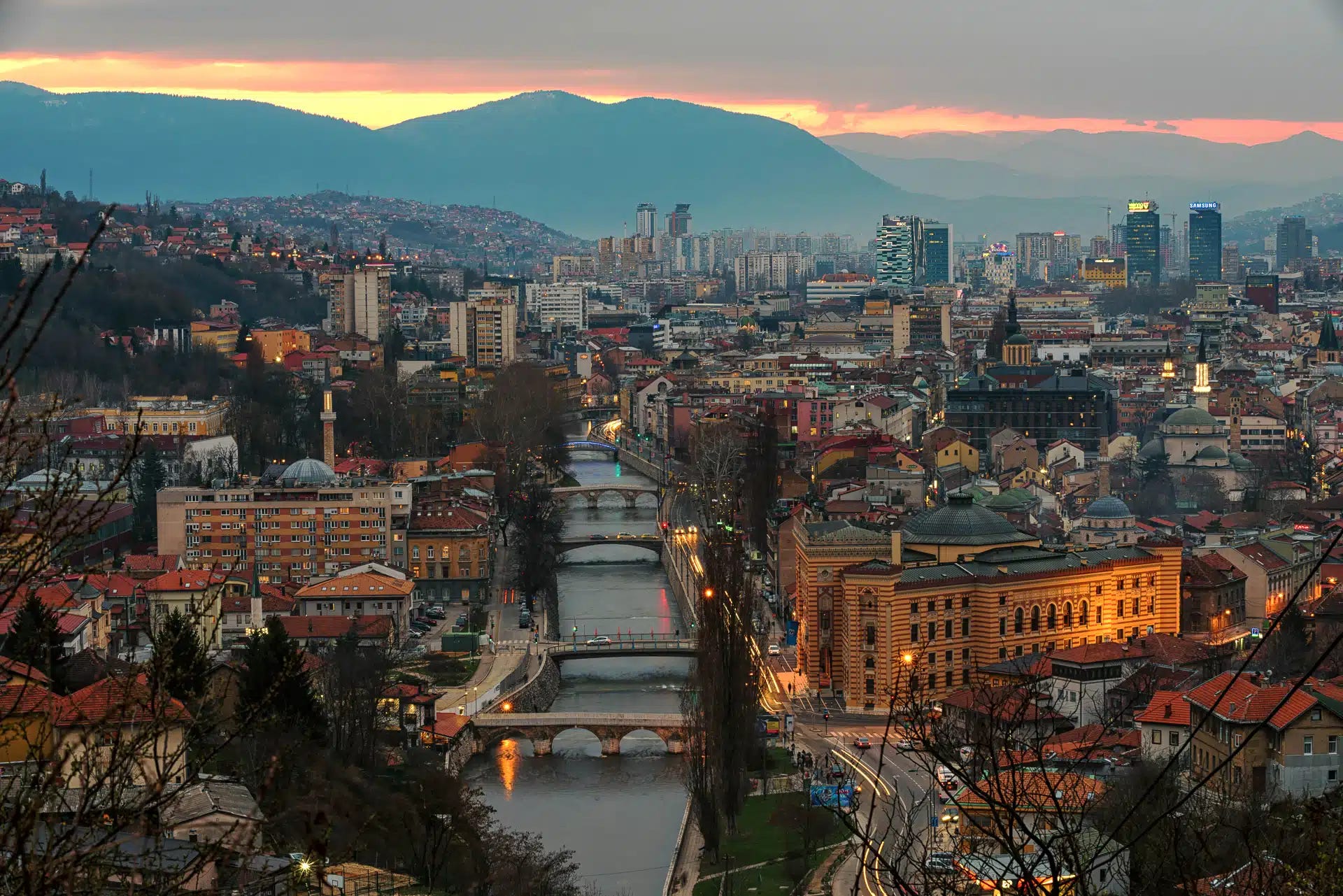
The author of these lines has lived long enough in both Sarajevo and East Sarajevo to know very well that this single urban area, divided between two separate administrative systems, functions with remarkable ease once one moves beyond television studios, party headquarters and the factories engaged in the industrial production of nationalist hysteria. So remarkable, in fact, that any malicious consumer of the full spectrum of inflammatory media would find ordinary life there deeply disappointing.
People work together, trade with one another, drink coffee, buy apartments, rent business premises, drive their children to sports practice, fall in love, marry and build families across municipal, entity and ethnic boundaries. This includes, however inconveniently for the official narratives, the mayor of East Sarajevo, as well as Bakir Izetbegović's daughter.
Genuinely ethnically motivated incidents are so rare that, were this reality widely acknowledged, many political careers built entirely upon the cultivation of resentment and poisonous moralizing would collapse beyond repair. Such incidents do not, as a rule, emerge organically from everyday life. They are hatched in political incubators whenever there is a need to erect yet another monument to an old hatred, administer a fresh dose of nationalist adrenaline, or stage another pre-election spectacle of collective paranoia.
In that spectacle, the poor are once again cast in their traditional role as cannon fodder, though the part comes, as always, without even the courtesy of a minimum fee.
This is precisely why, when the Serb-Bosniak political story is considered as a whole, it becomes clear that it is neither a tale of ancient hatred nor a clash of civilizations, but an intolerable combination of shouting and passive-aggressive moral blackmail in a country that has long been treated as a colony.
At times, it seems to me that, if every Serb were to disappear overnight, the Bosniak parties would urgently have to import new ones, merely so that there would still be someone to whom they could explain that everyone is equal. Likewise, if every Bosniak vanished, Serb politics would probably establish a commission and spend years searching for the last surviving Muslim, simply to blame him once more for everything that has happened since the fall of Constantinople in 1453.
Now imagine a dystopian future in which an ordinary man, Serb or Bosniak, has taken advantage of lower property prices and bought an apartment in East Sarajevo, the predominantly Serb-administered part of the city. One morning, he tries to cross through Vraca, the urban boundary between East Sarajevo and Sarajevo proper, and make his way to work.
Somehow, he reaches Vrbanja Bridge, one of central Sarajevo’s best-known bridges and a symbolic crossing point in the city’s wartime geography, where two guards stop him.
The first shouts: “Where do you think you’re going, you traitor, running off to the balijas?” The word balija is a crude ethnic slur for Bosniaks and Muslims.
The second guard embraces him warmly.
“Of course you may pass. Nobody is stopping you. You simply have to sign this form confirming that it never even occurred to you that anyone might be stopping you. Should you claim that we are preventing you from crossing, then naturally you cannot cross, because you clearly fail to understand just how free you are.”
The man asks whether he might simply be allowed to go to work. He has a mortgage instalment to pay and children to educate.
Both guards stare at him in genuine astonishment.
“What work?” they reply, almost in unison. “Can’t you see that History is being made here?”
Or, in the peculiarly Bosnian orthographic version of the same national dispute, that (h)istory is being made: even the spelling of the word must first pass through an ethnic checkpoint.
