


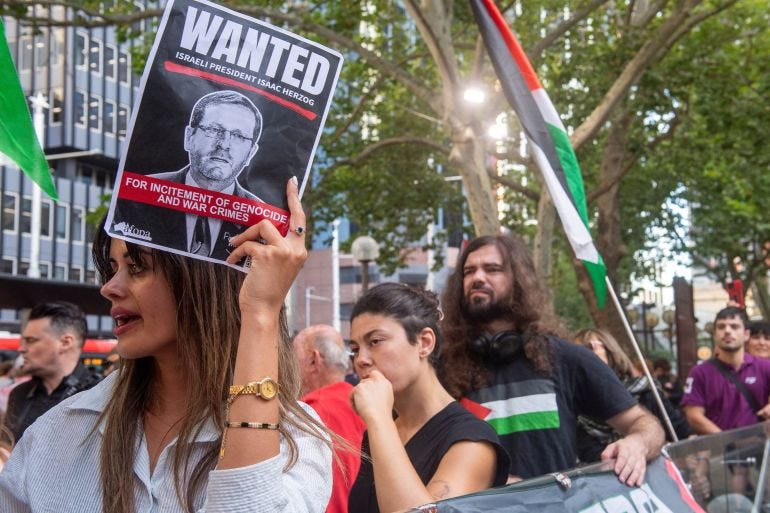
The visit was meant to heal. Instead, it has reopened wounds that Australia is still struggling to close.
In the long shadow cast by the October 2023 Gaza war and the Bondi Beach massacre that traumatised the nation in December 2025, Australia finds itself confronting an uncomfortable question about power, principle and the kind of country it wishes to be. The decision to host Israeli President Isaac Herzog as a state guest was framed as an act of solidarity and reassurance, a gesture designed to calm fears and strengthen social cohesion.
Yet gestures, in diplomacy, are never neutral. They speak loudly, sometimes more loudly than words.
This moment matters because it arrives at a time when the global system itself is under strain. International law, once dismissed as abstract, has re-entered political life with force. The International Court of Justice has found that Israel’s military operations in Gaza plausibly risk genocide, triggering obligations on all states under the Genocide Convention. The International Criminal Court has gone further, issuing arrest warrants against Israel’s prime minister and defence minister for alleged war crimes.
A United Nations Commission of Inquiry has concluded that Israeli leaders have incited violence against a civilian population, meeting legal thresholds for crimes against humanity.
These are not marginal claims advanced by activists at the fringes. They come from the core institutions of the international order that Australia has spent decades championing. Canberra has long argued that small and middle powers survive in a world governed by rules rather than raw force. Yet rules lose their meaning when exceptions are carved out for friends.
Hosting a head of state while such findings stand unresolved is not business as usual. It is a political statement, whether intended or not. It suggests that international legal scrutiny can be acknowledged rhetorically and ignored in practice. For a country that has urged accountability in cases from Ukraine to Myanmar, that inconsistency carries a cost measured not only in reputation, but in credibility.
The discomfort deepens when attention turns to President Herzog himself. In the aftermath of the 7 October attacks, his declaration that responsibility lay with ‘an entire nation’ was heard far beyond Israel’s borders. A UN inquiry later assessed that statement as direct and public incitement to violence against a protected group, a crime under international law regardless of rank or office. Australian law, too, criminalises incitement to genocide, even when committed abroad.
Words matter in war. They shape what becomes thinkable, and then permissible. In Gaza, where more than 70,000 Palestinians have been killed and entire neighbourhoods erased, language that collapses civilians into combatants has proved lethal. Hosting such language without challenge risks normalising it.
Diplomatic immunity may shield visiting dignitaries from arrest, but it does not shield governments from judgment. Immunity is a technical doctrine; legitimacy is a moral one. They are not the same. When Australia rolls out the red carpet under these circumstances, the signal sent is not subtle: some allegations are inconvenient, others are ignorable.
At home, the implications are just as serious. The Bondi attack exposed how fragile social trust has become. In its wake, leaders urged restraint and empathy, warning against imported conflicts poisoning Australian streets. A Royal Commission was established to examine antisemitism and social cohesion precisely because the stakes are so high. Against that backdrop, an official visit that has already prompted mass protests, heightened police power and open dissent from within parliament appears less like a unifying act and more like an accelerant.
History offers a cautionary tale. When US President Lyndon Johnson visited Australia in 1966 at the height of the Vietnam War, violent protests erupted in Sydney. The visit was meant to affirm alliance loyalty; instead, it exposed deep national fractures. Half a century later, the parallels are unsettling. Security planning replaces civic welcome. Appeals for calm compete with anger in the streets. Diplomacy becomes theatre, not dialogue.
International comparisons sharpen the dilemma. South Africa, shaped by its own history of apartheid, has broken with Israel, expelled diplomats and taken the genocide case to The Hague. Germany, despite its profound historical bond with Israel, has seen fierce domestic backlash against meetings with Israeli leaders under ICC warrants. Canada and the United Kingdom, traditionally unwavering allies, now face sustained public debate about the limits of solidarity when grave crimes are alleged.
Australia does not stand apart from this reckoning. It stands within it.
From a foreign policy perspective, the choice is stark. Realists may argue that alliances and intelligence ties demand continuity. Yet even hard-headed strategists acknowledge that ignoring mass atrocity corrodes the very order that keeps alliances stable. Liberal institutionalists warn that selective adherence to law weakens the institutions Australia relies on to amplify its voice. Constructivists would note that national identity is forged not only by interests, but by the stories states tell about themselves. A country that claims to stand for fairness cannot indefinitely act as though fairness is optional.
None of this requires abandoning Israel or denying the trauma of 7 October. It does require recognising that solidarity with a people is not the same as endorsement of a state’s actions. Humanitarian support, diplomatic engagement and pressure for ceasefires remain available tools.
A state visit, however, is the highest form of political validation. Once offered, it cannot be disentangled from context.
There is still time to reconsider. Withdrawing or postponing the visit would not be an act of hostility. It would be an affirmation that Australia’s commitment to international law is more than ceremonial. It would acknowledge the pain of all communities affected by this conflict, rather than privileging one narrative over another. And it would align Australia with a growing global insistence that power does not excuse impunity.
In moments like this, foreign policy is not an abstract exercise conducted in briefing rooms. It is a mirror held up to national values. The world is watching how democracies respond when law collides with loyalty. Australia’s response will echo far beyond this visit, shaping how its words are heard the next time it calls for justice, restraint and a better world.
