


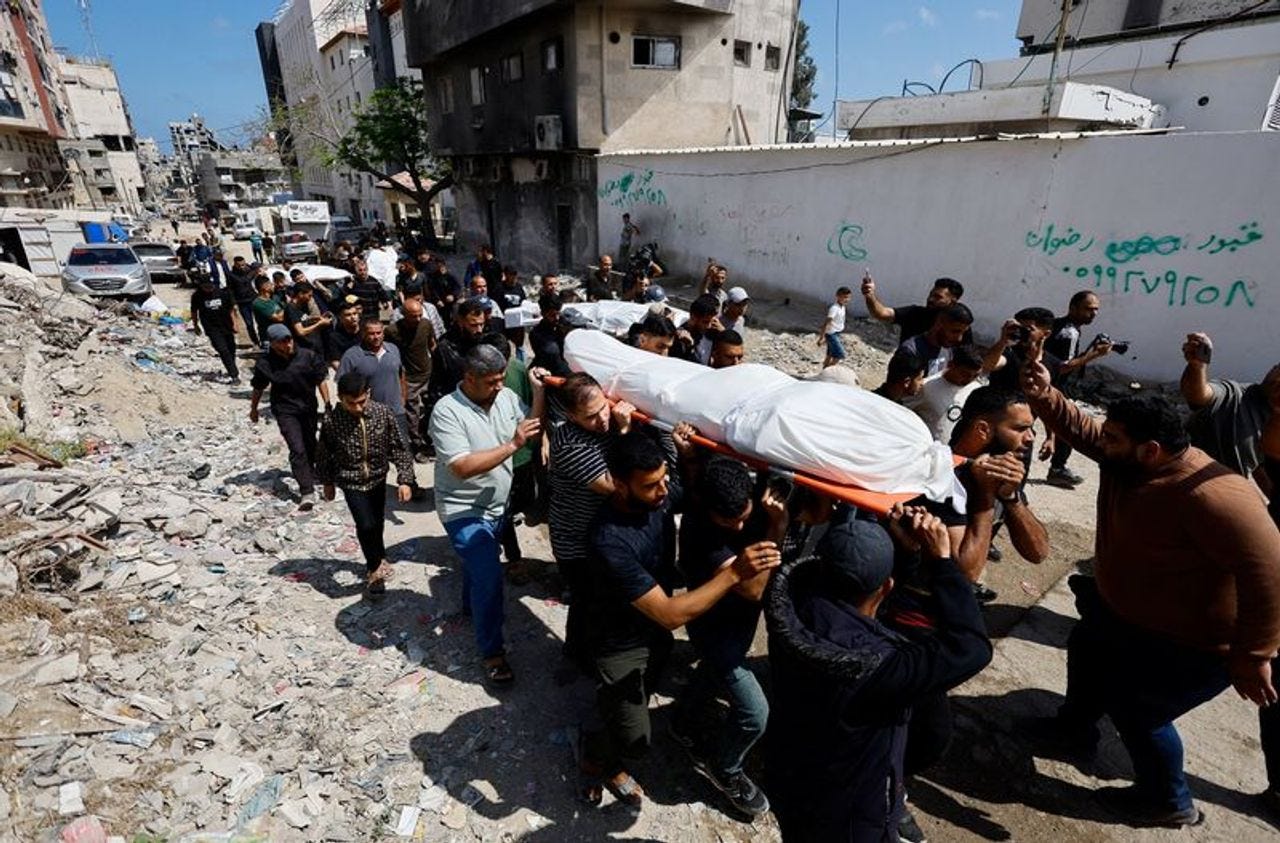
Eid al-Adha has long stood as one of humanity’s rare moral pauses—a sacred interval where sacrifice symbolises mercy rather than destruction, where prayer interrupts politics, and where even conflict was historically expected to yield to the dignity of holy time. Across Gaza this year, that ancient rhythm was shattered beneath Israeli airstrikes.
The scenes emerging during the opening days of Eid were not merely scenes of war. They were scenes of desecration. In Gaza City’s Rimal district, Israeli strikes tore through crowded streets and residential buildings as families prepared sacrificial meals and searched for livestock for the annual qurbani ritual.
Palestinian health officials reported at least 12 civilians killed across the first days of Eid, including children, while dozens more were wounded amid collapsing homes and marketplaces. Reuters and AP reporting confirmed that among the dead was Hamas military figure Mohammed Odeh alongside members of his family, illustrating once again the devastating fusion of combatant targeting and civilian death in one of the world’s most densely populated enclaves.
Yet casualty figures alone fail to capture the deeper rupture unfolding across Gaza and southern Lebanon. This was not simply a military escalation. It was the transformation of sacred time itself into a battlespace.
International humanitarian law contains no explicit prohibition against warfare during religious holidays. That legal vacuum has become Israel’s shield. But legality and legitimacy are no longer travelling together. Across much of the Muslim world—and increasingly across the Global South—the bombardment of Gaza during Eid is not viewed as unfortunate collateral damage. It is experienced as an assault on communal dignity, spiritual identity, and the last remaining fragments of civilian humanity.
The symbolism is politically explosive. For Palestinians enduring blockade, famine conditions, and relentless displacement, Eid represents more than ritual. It represents continuity itself—a fragile assertion that culture and faith can survive amid siege.
On the eve of Eid al-Adha, Israel unleashed more than 100 airstrikes across Lebanon, killing at least 31 people while simultaneously announcing plans to expand ground operations and seize more territory. The ceasefire existed only on paper; in reality, bombardment, displacement, and occupation were accelerating in full view of the world.
UNICEF and WHO assessments already describe Gaza as suffering catastrophic levels of psychological collapse, particularly among children enduring perpetual displacement and bombardment. Aid agencies report that nearly 98 per cent of Gaza’s cropland is now unusable, while only around 1.5 per cent remains cultivatable. Water systems function at barely survivable levels. Markets central to Eid traditions have either been destroyed or rendered inaccessible through fear of attack.
Then came the bombs. The strategic message transmitted by such attacks extends far beyond Israel’s never-ending claims of “self-defence” and “human shields”ouble, increasingly projecting to much of the world an image of permanent war used to normalise the systematic destruction of Palestinian civilian life.
It tells an entire population that no moment is sacred enough to spare, no religious observance worthy of restraint, no civilian rhythm immune from military calculation. One international law analysis observed that attacks during holy periods carry an “added insult and sacrilege”ouble, reinforcing the psychological message that civilians are never truly safe—not even during God’s days.
Israel’s government frames these operations through the language of existential security. Prime Minister Benjamin Netanyahu and senior defence officials insist Hamas and Hezbollah exploit holy days tactically, embedding within civilian areas precisely because they assume Israel will hesitate. Israeli military doctrine increasingly argues that delay itself carries lethal consequences—allowing militants to regroup, relocate hostages, or reposition rockets and tunnel infrastructure.
Israel’s political leadership continues invoking 7 October as an open-ended justification for a security doctrine in which military escalation increasingly overrides humanitarian restraint, international criticism, and the protection of Palestinian civilian life. But outside its closest allies, that rationale is losing persuasive power at extraordinary speed.
The Gaza war has become a defining test of whether the so-called rules-based international order possesses any remaining moral coherence. Western governments responded to Russian strikes on Ukrainian civilian infrastructure during Christian observances with immediate moral clarity. Yet those same governments continue qualifying criticism of Israeli operations with endless references to Israel’s “right to self-defence”ouble, even as entire Palestinian neighbourhoods collapse during Islam’s holiest days.
That contradiction has become impossible to contain diplomatically. Think tanks such as ODI and human rights organisations, including Human Rights Watch have warned that selective outrage over civilian suffering is rapidly corroding the legitimacy of international law itself. Across Africa, Asia, Latin America, and the Middle East, the perception hardening is stark: humanitarian norms are universal only when geopolitically convenient.
The geopolitical consequences are profound. Gaza no longer requires diplomatic framing by outside powers; the scale of destruction and civilian suffering has become a global indictment in its own right. Israel’s own actions have already shattered the credibility of the Western moral narrative across much of the world.
The images emerging from Gaza during Eid al-Adha—bombed markets, starving civilians, children killed in festive clothes, mosques surrounded by rubble—have created their own geopolitical indictment without assistance from foreign propaganda machines. Across the Global South, outrage is not manufactured by Moscow, Beijing, or Tehran. It is being generated by the visible reality of destruction itself.
States that once cautiously explored rapprochement with Israel are now facing mounting public outrage as the war increasingly transcends conventional security narratives and becomes identified globally with mass civilian suffering and collective punishment. The issue is no longer framed solely around Hamas or border defence. It is increasingly perceived as the systematic destruction of Palestinian civilian life during moments considered spiritually sacred across the Muslim world.
That perception has been reinforced not by rhetoric from adversaries, but by Israel’s own military conduct. When airstrikes land during Eid prayers, when displaced families searching for sacrificial animals instead search for bodies beneath concrete, when UN agencies warn that Gaza’s agricultural system has nearly collapsed and famine conditions deepen during one of Islam’s holiest periods, the political consequences become inevitable. The narrative writes itself.
The deeper strategic crisis for Israel is that the war is blurring the line between military necessity and collective punishment in the eyes of global audiences. Repeated references to “human shields” and operational urgency no longer offset the emotional and visual impact of mass civilian suffering. The result is a widening legitimacy gap between Western official discourse and global public sentiment.
This is particularly dangerous because legitimacy—not simply military strength—underpins durable geopolitical influence.
Across the Global South, many governments and populations increasingly view Western responses to Gaza as evidence that international law operates selectively. Russian attacks on Ukrainian civilians triggered sweeping sanctions, moral outrage, and legal mobilisation. Israeli attacks producing comparable civilian devastation are met largely with qualified concern and repeated affirmations of Israel’s right to self-defence. That contrast has become impossible to diplomatically contain.
The consequences now stretch far beyond reputational damage to Israel. What is fracturing in Gaza is the moral architecture of the post-1945 international order itself. The devastation unfolding during Eid al-Adha has transformed Gaza from a regional conflict into a global test of whether humanitarian principles genuinely possess universal meaning—or whether those principles collapse when strategic allies stand accused.
For much of the world, the issue is no longer confined to borders, militancy, or counterterrorism. It is about whether an entire civilian population can endure mass displacement, famine conditions, destroyed hospitals, shattered mosques, and relentless bombardment during sacred religious days while the guardians of the “rules-based order” continue speaking the language of restraint without enforcing it. During Eid, that contradiction acquired a deeply emotional and civilisational weight impossible to diplomatically contain.
Even beneath the projection of overwhelming military dominance, Israel’s long-term strategic position may be eroding in ways airpower cannot reverse. Military superiority can destroy neighbourhoods, assassinate commanders, and pulverise infrastructure. It cannot erase memory. It cannot extinguish grief carried across generations. Every strike landing during Eid reinforces a perception that Palestinian suffering is not an unintended tragedy of war but an accepted and permanent condition within it.
And history shows that such memories outlive every battlefield calculation. The child who watched Eid prayers drowned out by explosions will not remember future legal arguments about proportionality or operational necessity. What will endure is something far more visceral: the memory that sacred days became days of mourning under Israeli fire.
This is how conflicts metastasise across generations. The article’s most unsettling insight lies precisely here: once warfare absorbs sacred symbolism, compromise becomes exponentially harder. Political disputes can be negotiated; theological humiliation rarely can. Analysts cited in the report warn that attacks on holy days strengthen absolutist narratives on all sides, empowering extremists while weakening moderates who still argue for diplomacy.
History offers grim warnings. Conflicts infused with sacred grievance—from the Crusades to sectarian civil wars—become uniquely resistant to political resolution because they cease being merely territorial. They become existential struggles over identity, memory, and divine legitimacy.
That danger now shadows Gaza. The profound irony is impossible to ignore. Eid al-Adha commemorates Abraham’s willingness to sacrifice in obedience to God—a story revered across Islam, Christianity, and Judaism alike. Yet during a festival rooted in shared Abrahamic heritage, Israeli bombs reduced homes, markets, and prayer spaces to rubble. The moral contradiction reverberates far beyond the Middle East. A state founded partly upon the historical trauma of persecution now stands accused globally of inflicting collective punishment during another faith’s sacred season.
For global strategists and policymakers, this moment carries consequences extending beyond Gaza itself. The erosion of restraint around sacred time signals something larger than battlefield escalation. It signals the collapse of moral limits once believed essential to civilisation itself.
And when holy days become acceptable kill zones, the damage spreads far beyond the ruins left behind.

Could these ghastly outrages have anything to do with so many countries reporting increasing growing evidence of antiZionism?? Call it antisemitism if you want to distort reality to the maximum.