


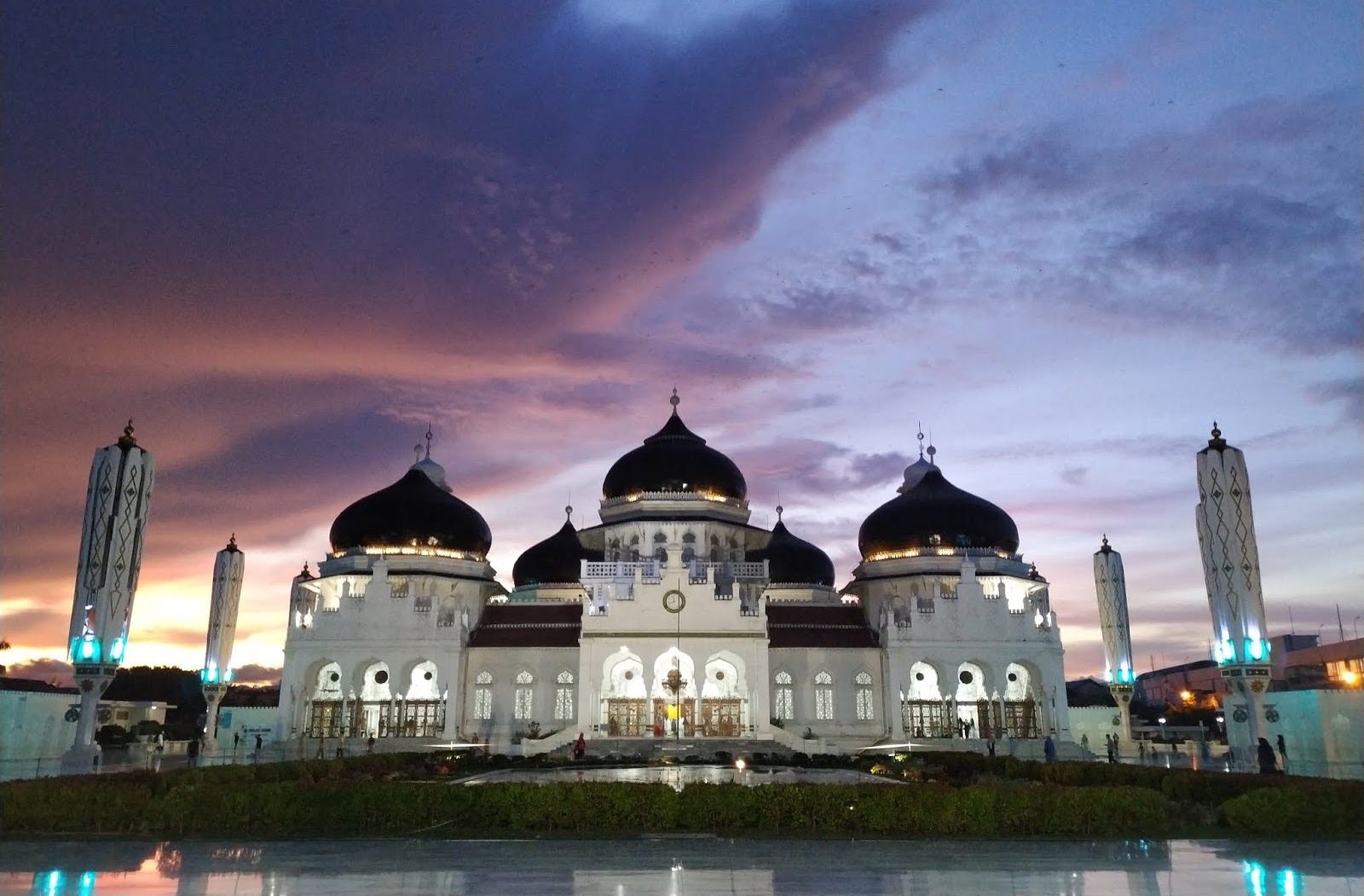
On the morning of 15 August 2026, the 21st anniversary of the Helsinki peace accord that ended three decades of bloody conflict in Aceh, something broke. At the Masjid Raya Baiturrahman—the very mosque that once symbolised Acehnese resilience—a young man climbed the gate and replaced the Merah Putih with the Bulan Bintang flag of the Free Aceh Movement.
Then the crowd surged toward the Governor’s Pendopo, tore down the Garuda Pancasila from its rooftop, dragged Indonesia’s sacred national emblem through the streets, and stomped on it in front of the District Military Command. Tear gas was fired. Stones flew. A motorcycle and a car were set ablaze. And the world watched as a nation’s symbolic core was savagely ruptured.
This was not a protest. This was Fanonian violence—a raw, visceral act of iconoclasm that declared, before God and country, that the emperor’s armour is rotten. The Garuda was not just a piece of metal torn from a roof. It was the metaphysical anchor of Indonesia’s civil religion, the totem of a nation of 270 million people bound together by the fragile fiction of Bhinneka Tunggal Ika.
When that totem was dragged through the mud of Banda Aceh, the fiction collapsed. And the world must understand: this was not the work of separatist provocateurs alone. This was a generational verdict on Jakarta’s betrayal of the Helsinki promise.
Twenty-one years ago, the Memorandum of Understanding signed in Helsinki offered Aceh a new covenant: peace in exchange for autonomy, dignity in exchange for reconciliation. Special autonomy funds flowed. The guns fell silent. But the promise of kesejahteraan—of prosperity and justice—never reached the roots of Acehnese society.
Today, poverty persists. Unemployment stalks the young. Industries have not absorbed the workforce. The cost of living has soared while wages stagnate. The unresolved Qanun on the Aceh flag—a flag that Jakarta has blocked for 21 years—remains a festering wound in the legal identity of the province.
The Helsinki generation, born into peace, has grown up into economic precarity. And on the 21st anniversary—the age of legal majority—they passed judgement on a peace that failed them.
Academics and observers on the ground have made this clear. Muhammad Alkaf, a political observer from IAIN Langsa, described the riot not as separatism but as “an expression of long-suppressed public frustration.” The Bulan Bintang, he notes, “still carries a sacred mythology as a symbol of resistance.” Jusuf Kalla, the architect of the Helsinki peace himself, acknowledged the “internal dissatisfaction” driving the unrest. Even he could not deny that the peace he brokered has not delivered what it promised.
But the rage in Aceh is not an island unto itself. It is the eruption of a deeper, systemic crisis—a crisis of kemuakan rakyat, the people’s disgust. Across Indonesia, the middle class is being crushed. A 12 per cent VAT hike hikes the cost of everything. Mass layoffs sweep through manufacturing, textiles, and technology. The cost of university education has become prohibitive. Wage deductions for housing savings squeeze already-tight budgets.
And while ordinary Indonesians struggle to afford rice and cooking oil, the political elite flaunts luxury, pours billions into the lavish new capital of Nusantara, and consolidates dynastic power while the Corruption Eradication Commission is systematically weakened. The state demands reverence for its symbols while delivering austerity, corruption, and repression. And when the state fails to honour its side of the social contract, the symbols of that contract become targets.
The desecration of the Garuda is the logical conclusion of this failure. It is the people’s way of saying: the flag you force us to salute every Monday morning in school now represents a broken promise. The Garuda you demand we revere now wears the face of the executioner.
For the Acehnese who lived through the DOM—the brutal military operation of the 1990s that killed thousands and traumatised a generation—the Garuda is not a symbol of unity. It is the symbol of the coloniser. Dragging it to the Kodim and stomping on it was not vandalism. It was a ritual exorcism of trauma, a symbolic reversal of the violence that the Indonesian state inflicted on Aceh for three decades.
Compare this to the dynamics in Kalimantan, where the “Borneo Raya” discourse remains largely cultural and discursive. There is no single, unifying trauma, no potent ethno-religious identity like the Acehnese Islamic consciousness to mobilise the masses. The rage in Kalimantan is a critique of resource extraction and ecological degradation—real, urgent, but diffuse.
In Papua, the Bintang Kejora flies as a symbol of ongoing armed resistance, but the conflict there is racialised and resource-driven, a slow-burning insurgency that has not yet exploded into the kind of symbolic warfare witnessed in Aceh. What makes Aceh 2026 unique is that it is a post-peace-agreement relapse—a betrayal of a formal treaty that was supposed to end the conflict forever.
When a peace agreement reaches legal maturity, and its promises remain unfulfilled, the rupture is not just political. It is existential.
The Indonesian state now stands at a crossroads. It can respond with repression—tighten the screws, criminalise dissent, label the videos “hoaxes,” and enforce reverence for the flag through fear. The TNI has already signalled a “measured” approach, mindful of the lessons of the DOM era when brutality only swelled the ranks of the resistance.
But repression without reform is only a temporary salve. It buries the grievance alive, and the grievance will resurrect itself, again and again, until the state confronts its own failures.
Or the state can do the harder thing: embrace the terrifying but potentially liberating reality of its own diversity. Recognise the Qanun Bendera Aceh. Establish a truth and reconciliation commission for Aceh and Papua. Redirect the billions spent on the IKN to regional infrastructure and genuine welfare. Accept that the Merah Putih is not the only flag that can fly over the archipelago—that unity in plurality is not a weakness but a strength.
This is the path of asymmetric federalism, of recognising that Aceh, Papua, and Kalimantan have distinct historical, religious, and ecological identities that cannot be erased by a centralising impulse.
But the signs are not encouraging. The IKN project in Kalimantan represents the opposite direction: re-centralisation, a Javanese-dominated mega-project that ignores the very regions it claims to unite. The unresolved Qanun is not a legal technicality; it is a constitutional betrayal. And the silence from Jakarta in the wake of the Garuda’s desecration speaks volumes about a regime that would rather defend symbols than deliver justice.
The fifth principle of Pancasila—Keadilan sosial bagi seluruh rakyat Indonesia, social justice for all the people of Indonesia—does not work when the people cannot afford to eat. It does not work when the state extracts wealth from the periphery to fund the centre and then demands reverence for its symbols. It does not work when the promise of peace becomes an illusion of prosperity. The desecration of the Garuda is not the end of Indonesia. But it is a warning.
The sovereignty of the archipelago is bleeding from within, and unless the centre confronts its own failures, the periphery will keep tearing down the totems of a nation that no longer feels like theirs.
The world is watching. And the world should understand: this is not a story about a flag. This is a story about a nation at war with itself—a war fought not with bullets, but with symbols, memories, and the unbearable weight of broken promises.
The Garuda lies in the dust of Banda Aceh. The question is whether Indonesia will let it stay there, or whether it will finally rise—not as a symbol of domination, but as a symbol of justice for all.
