


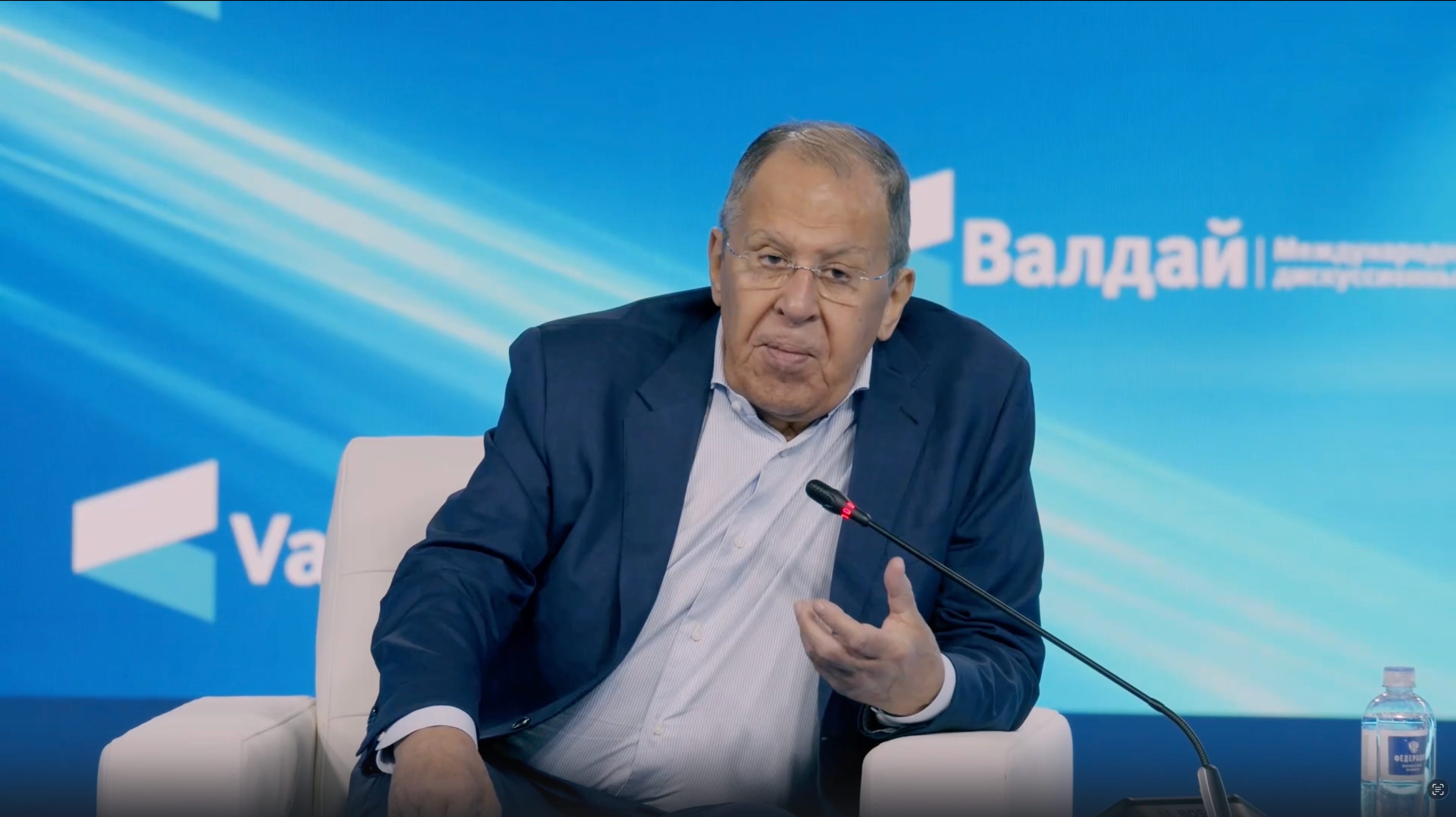
At my second participation in the annual conference of the Valdai Discussion Club, regularly held in Sochi, I left as an active professor and returned as a retired one. I marked this transition with a glass of wine in the company of a friend—a gentle and graceful way to turn a new page in life, beneath the magnificent peaks of the Caucasus and in an atmosphere of intellectual exchange.
From the very moment of arrival, it was clear—even more so than last year—that Russia is a country at war, and that we, the participants, might find ourselves in the line of potential danger because of President Putin’s scheduled address. The security and air-defense measures surrounding Krasnaya Polyana were visibly in place, which, rather than providing a sense of safety, created a subtle unease. The return journey was even more interesting: immediately after Putin’s speech, which was broadcast worldwide, drone attacks disrupted air traffic, so I reached home only after a long odyssey and much waiting. Had I been able, I would have jotted down my first impressions at once, but exhaustion took its toll.
By the next morning, however, the air was already filled with reports, comments, and analyses—mostly about what the President of the Russian Federation had said. The echoes have not stopped since. Friends from Russia tell me that even within Russian society there have been waves of differing opinions and certain dissatisfaction with some of his remarks. Knowing the Valdai procedure, I had brought with me a list of questions in my notebook, in case I was granted the rare opportunity to speak. That is akin to winning the lottery, since—let’s be honest—those who may pose a question are preselected with great care. Having spoken the previous year on peace negotiations with Ukraine (not exactly a warmly received topic, especially said a year too early), and coming moreover from a small and almost insignificant country whose relations with Russia are practically frozen, I stood no chance. Still, I later published my list of questions on my Substack page. Some readers reproached me for not analyzing Putin’s speech, but I referred them to the Kremlin’s website or YouTube, where the entire four-hour session, including discussion, can be watched.
Until now, I have said little about the conference itself—what I learned and understood from it. Reading others’ reflections, both those who attended and those who watched online, reminded me of the old Indian parable about the blind sages and the elephant. For those who have forgotten: six blind men were brought before an elephant and asked to describe what kind of creature it was. Each examined a different part of the body and therefore each gave a different description. Likewise, our impressions of Valdai depended on what we “touched.”
We were not blind or deaf, though: over 140 foreign and domestic participants gathered, ranging from professors, diplomats, and think tank members to former military officers, politicians, and journalists. The hosts announced participants from 42 countries, including the U.S., Canada, Britain, Norway, Italy, and Germany—representing the Western world—alongside a significant number from the BRICS and the Global Majority. Though I am not a feminist by conviction, I could not help noticing the limited female presence, especially among panelists and moderators. One of the most intriguing sessions for me was “The Individual and Time: The Role of Personality in Political History”—which, in English, was titled “Man and Time.” I later pointed out to the organizers that the title (and content) completely ignored the role of women in history. Some male commentators jokingly reduced women to “wives and mothers” of great men.
The point is that people with different backgrounds listened differently, heard different things, and drew very different conclusions. Reading some of their accounts, I wondered whether we had even attended the same conference. Each heard what they wanted to hear—or were disappointed not to hear what they had hoped for (I include myself among them).
Putin’s speech, at least for me, must be understood in the broader context of the Valdai Club—a think tank that serves as a soft instrument of Russian foreign policy. Appropriately, the conference began with the presentation of its annual report. The conference’s official theme was “A Polycentric World: Instructions for Use,” but the report bore a far more provocative title: “Doctor Chaos, or How to Stop Worrying and Love Disorder.” Personally, I would have preferred “Doctor House,” the brilliant but cynical TV doctor who always found diagnoses and cures for his dying patients. His rule was simple: never fully trust the patient—“everybody lies.”
The reference, of course, was to Stanley Kubrick’s 1964 satire Dr. Strangelove or: How I Learned to Stop Worrying and Love the Bomb, produced in the shadow of the Cuban Missile Crisis. The Valdai authors’ irony was transparent: the world may no longer live under the threat of the Bomb, but it certainly lives under the reign of Disorder. Kubrick’s dark humor lay in the acceptance of absurdity—the idea that people must learn to live with perpetual instability as the price of safety, for nuclear deterrence supposedly guarantees peace. The Valdai report echoed this paradox: in today’s world of dramatic change, chaos should not inspire fear but understanding, management, even acceptance as a structural condition of international life.
Doctor Chaos, then, is a figure who explores and rationalizes a world where international law no longer holds and institutions sink into irrelevance. The report presents chaos as both destructive and liberating—signaling the collapse of the old Western-centered order, yet opening space for new possibilities of emancipation and redefinition. “Loving disorder” thus means accepting uncertainty and rejecting the Western mantra of a “rules-based order,” which is merely a euphemism for Western hegemony. Doctor Chaos—perhaps Russia, or BRICS—stands in defiance of hypocrisy and the pretense of order maintained by powers that long ago violated it for their own supremacy.
Philosophically, this marks a reversal of Kubrick’s original message. His Dr. Strangelove was a critique of madness disguised as rationality—of the drive for absolute security leading to mutual destruction. Valdai’s report, conversely, proclaims that restoring the “Western order” is absurd and that embracing disorder is the new rationality. Kubrick mocked those who learned to “love the Bomb”; Valdai invites us to “love the world as it is”—unmanageable, yet real—not with blind optimism but with open eyes.
A key debate followed: is there still room for optimism, or are we doomed to “deidumism”—the love of pessimism itself? No clear answer emerged. One notable session portrayed the West as the world’s minority—only 14% of global population—metaphorically “the Sick Man of the Bosporus.” The discussion returned repeatedly to defining multipolarity: where it stands, how fast it evolves, and in what direction. Yet this felt like philosophers merely interpreting the world, while, as Marx reminded us, the real task is to change it.
That realization was, for me, the most important—and most troubling—takeaway from the entire, intellectually rich but mentally exhausting program. Hardly anyone dared to move beyond geopolitical realism or even pessimism. Few tried to imagine alternatives to chaos. This struck me as a step back from last year’s debates, when BRICS, China, India, Brazil, and Africa were discussed with more energy. A Chinese colleague from Beijing wrote on his blog that China seemed almost absent from this global forum, despite active Chinese panelists. An American participant, Peter Slezak, criticized the collapse of international institutions such as the UN, WTO, and WHO, joking that “if the Chinese want them, they can have them.” The laughter that followed probably did not amuse the Chinese, nor those still loyal to the UN Charter—including, interestingly, Putin himself, who invoked it in his speech.
Coming from the field of peace studies, and representing the Transnational Foundation for Peace and Future Research, I found it hard to accept the intellectual call to “love disorder” amid wars and genocides. Such resignation seemed passive, even defeatist. The panel on modern warfare and militarization was particularly alarming: speakers talked excitedly about drones and AI but never uttered the word disarmament and demilitarization. It became too much for me, and I left to get some fresh air. The conclusion was inescapable: the world seems to have returned to the era before the League of Nations—to a time when the “right to war” was considered legitimate once again.
At one session, an American scholar joined via Zoom only to show how ardent a MAGA admirer of Trump “the Peacemaker” he was. I reacted instinctively, though silently. Later, a South African colleague who noticed my body language approached me, and we instantly bonded. The problem wasn’t that such a voice was invited (Russians, after all, have a latent desire to keep contact with the West, however much they deny it)—but that no one responded critically to his statements, provoked nausea in some of us.
Yes, Russia is a country at war—visible even in our serene enclave beneath the Caucasus, where people from all over the world sought dialogue and cooperation. That, indeed, is Valdai’s greatest value: real conversations, both official and informal. It is a rare experience—especially when, for many, traveling to the West has become risky. (I wore a keffiyeh throughout the conference, as an act of solidarity and a cry for Gaza—though the topic was not discussed.)
In my view, Russia wants to embrace the new era but still longs for the time when the West was open to it. This was even reflected in a Freudian slip by the well-known geopolitical thinker Sergey Karaganov, who declared that Russia had broken with the West and was now a Eurasian power—only to conclude, “As a European myself…” These are hard times of transition, both internally and externally.
Later conversations with colleagues confirmed my impressions. The more grounded ones smiled gently and told me I was naïve to expect peace initiatives at such a forum. My response was: if not intellectuals, then who should dare to open new horizons, even at their own risk? My reflections here are not only about Valdai—they mirror the broader atmosphere in which the global intelligentsia has sunk: censoring, cancelling, or self-censoring itself. Today’s commentators and academics prefer “realist analysis” stripped of moral or normative dimensions, as if values were naïve utopias.
During the conference, Norwegian scholar Glenn Diesen published a piece (based on his own panel moderation on world order and multipolarity) concluding that there is no room for utopia—only for geopolitical pragmatism. It seems as if many intellectuals today aspire to be heirs of Kissinger: pragmatic, calculating, and comfortably cynical. Anything that goes beyond that worldview is utopia (and nonsense).
I could write much more, especially about the political segments of the program. Putin’s speeches are always meant for both domestic and foreign audiences. One cannot ignore the phenomenon: in an age of kakistocracy—where world leaders can barely read two coherent sentences without a teleprompter—Putin’s calm, articulate delivery, reciting Pushkin no less, appears almost extraterrestrial. The contrast inevitably inspires admiration. The same goes for Lavrov, though age has caught up with him—this year, unlike the last, he only gave brief opening remarks and opened the Q&A session. Surrounded by kakistocrats, the yearning for intelligent leadership makes such moments sound like music to the ears. But one must listen carefully, between the lines—not an easy task after a long day and late hours.
Putin’s opening speech reflected his intellectual depth—and the logic of Doctor Chaos. His first sentences foreshadowed an unpredictable world in which everything is possible, since there are no “instructions for use.” (At that moment, I wondered what he thought of his Chinese counterpart’s Global Governance Initiative based on five principles … but that is another discussion.)
His recitation of Pushkin’s poem The Anniversary of Borodino carried a message more powerful than any policy statement. It was not cultural diplomacy; it was a declaration of defiance—a reminder of Russia’s historic endurance in the Battle of Borodino, where Kutuzov repelled Napoleon at a terrible cost but saved Moscow. The symbolism was clear: resistance and readiness to stand against any superior force.
Putin connected this to the rise of patriotism among youth, even visible in a revival of traditional folk attire. Yet many criticized his casual remark about U.S. Tomahawks supplied to Ukraine—“it will change nothing on the battlefield.” For some, his conciliatory tone toward “friend Donald” was too soft; they demanded a firmer stance and strict deterrence. But as I said, Russia is at war, and few of us truly know what happens behind the scenes.
Still, the most striking moment for me was not geopolitical but human: the migration panel and the rare mentions of Gaza. The Turkish panelist on multipolarity said it best: “Gaza is the true test of our commitment to a fairer, multipolar world. If we stay silent, the ground on which a better world could grow will perish—humanity itself is dying there.” The second was the brilliant Iranian scholar Marandi, who asked Putin about the flotilla recently attacked by Israel and about Trump’s so-called peace plan for Palestine. Marandi sat behind me; I did not see his face after Putin’s reply—but mine was pale, and I felt the pain of realpolitik toward a small, suffering nation.
My own contribution this time was modest: I was neither speaker nor moderator, and my raised hand was never noticed. But I wore my keffiyeh whenever I could—as a reminder not to forget the elephant in the room, which remained largely invisible, though detected by the entire world.
