


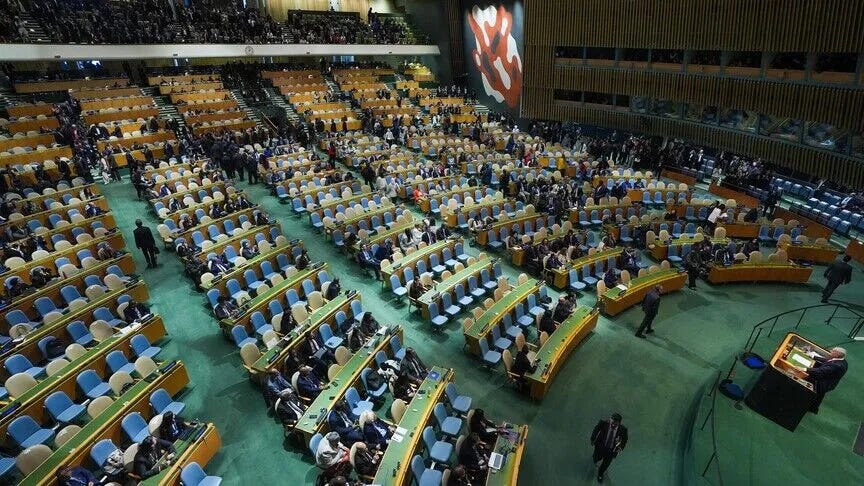
On a September morning in New York, the United Nations General Assembly became a theatre of the absurd and the sublime. As Israeli Prime Minister Benjamin Netanyahu ascended the podium, diplomats from approximately 77 nations rose from their seats and walked out, leaving behind a sea of empty chairs that would become the most photographed furniture in modern diplomatic history.
Among the departing were Turkey, Iran, Pakistan, Saudi Arabia, Indonesia, Malaysia, Egypt, and Algeria. The images circulated globally: a speaker addressing a half-empty chamber, holding up props, declaring genocide allegations “the biggest lie of the century,” while the visible architecture of the room itself pronounced a different verdict.
Yet the walkout was not total. A small cluster of Muslim-majority states remained seated: the United Arab Emirates, Bahrain, Morocco, Albania, Azerbaijan, Mali, and Guinea. Their occupied chairs became the object of fierce contestation. Were they complicit? Pragmatic? Sovereign? Cowardly? The question of why they stayed is not merely a question about diplomatic tactics.
It is a question about the nature of sovereignty, the ethics of presence, and the very meaning of political community in a world where the ummah is invoked but never enforced.
Out of roughly 57 member states of the Organisation of Islamic Cooperation, nearly 80 to 85 per cent boycotted or walked out. The walkout was a collective rebuke delivered in the most formalised institutional space in global politics. But the staying nations were engaged in something more radical than protest. They were deciding, in the Schmittian sense, that the exception did not exist for them—that the normal diplomatic order of bilateral relations, strategic partnerships, and institutional protocol continues even when the moral foundations of that order are contested.
The UAE and Bahrain, as Abraham Accords signatories, have staked their regional positioning on diplomatic realism. Their logic is that cutting communication strips them of leverage. By maintaining active diplomatic presence, they position themselves as essential mediators capable of negotiating humanitarian access, ceasefires, and future reconstruction.
For Azerbaijan, the calculus is starker. The country relies on Israel for approximately 69 per cent of its major weapons imports and maintains a strategic partnership that counterbalances Iran and Russia. Staying seated was not merely about arms imports—it was a signal to Tehran that Baku would not be intimidated into abandoning its strategic partnerships.
The UNGA walkout thus became a theatre for bilateral conflicts that have nothing to do with Palestine, revealing the impossibility of a unified Muslim position on the question that has defined the ummah for generations.
The analytical reality beneath the symbolism is brutal. The Responsibility to Protect doctrine, adopted in 2005 after Rwanda and Srebrenica, has played no significant role in debates about Gaza. Research shows that global efforts to address the humanitarian catastrophe have been ineffective because of the politicisation of R2P—the doctrine’s inherent faults compounded by the power politics of key actors on the Security Council. The walkout states understood this. Their protest was not an invocation of R2P; it was a recognition that the doctrine is dead.
The International Criminal Court issued arrest warrants for Netanyahu in November 2024, charging him with war crimes and crimes against humanity. But enforcement depends entirely on the voluntary cooperation of states. The Court possesses no police force, no enforcement authority. Western states, particularly France, invoked Article 98 of the Rome Statute to declare that Netanyahu enjoys immunity on their soil.
The same France that welcomed the ICC warrant for Vladimir Putin in legally identical circumstances found itself unable to comply with the warrant for Netanyahu. The difference was not legal but political. The ICC is not a world court; it is a treaty body whose enforcement depends entirely on the political will of states. When that will is absent, the court becomes a paper tiger.
The International Court of Justice issued provisional measures in South Africa v. Israel, finding that the rights claimed by South Africa were “plausible.” The plausibility standard is deliberately lower than proof—a threshold designed to allow urgent action when evidence of genocidal intent is not yet conclusive but the risk of irreparable harm is immediate. Israel has transparently ignored the orders.
The final judgement on genocide may take years. This creates a liminal juridical space where the possibility of genocide is judicially cognisable but not yet actualised in law. The plausibility standard, designed to enable urgent action, has become a mechanism for deferring action indefinitely.
The entire episode exposes the tragic friction between what the world is—an anarchic system of self-interested states—and what it ought to be—a morally unified human community where human life outweighs capital, alliances, and veto power. Kant’s cosmopolitanism demands that all human beings belong to a single moral community, regardless of borders.
Under this view, the world has a strict, non-negotiable duty to protect fellow humans, and universal human rights transcend state sovereignty. But the staying nations operated on a different philosophical calculus. They asserted that sovereignty is the precondition for any meaningful humanitarian action. Neither sublation resolves the contradiction. Both merely restate it in different forms.
What does the walkout tell us about the relationship between theory and the moral life of international politics? The answer is that moral action is analytically irreducible. The walkout was at once a realist signal, costless solidarity for domestic publics, a liberal act within institutional norms, a postcolonial gesture, and an ethical protest refusing complicity. It exceeds any single theoretical lens because it is a lived reality, not a theoretical construct.
The empty chair remains. It remains as a protest, as a memory, and as a hope. It remains as a reminder that the choice to walk out is always available and that the choice to stay is always a choice. History has a way of judging those who stayed when they should have left. The empty chair is not a failure; it is a promise that the struggle for justice continues and that one day—perhaps in the distant future—the international order will be reconstituted on foundations of justice rather than power.
