


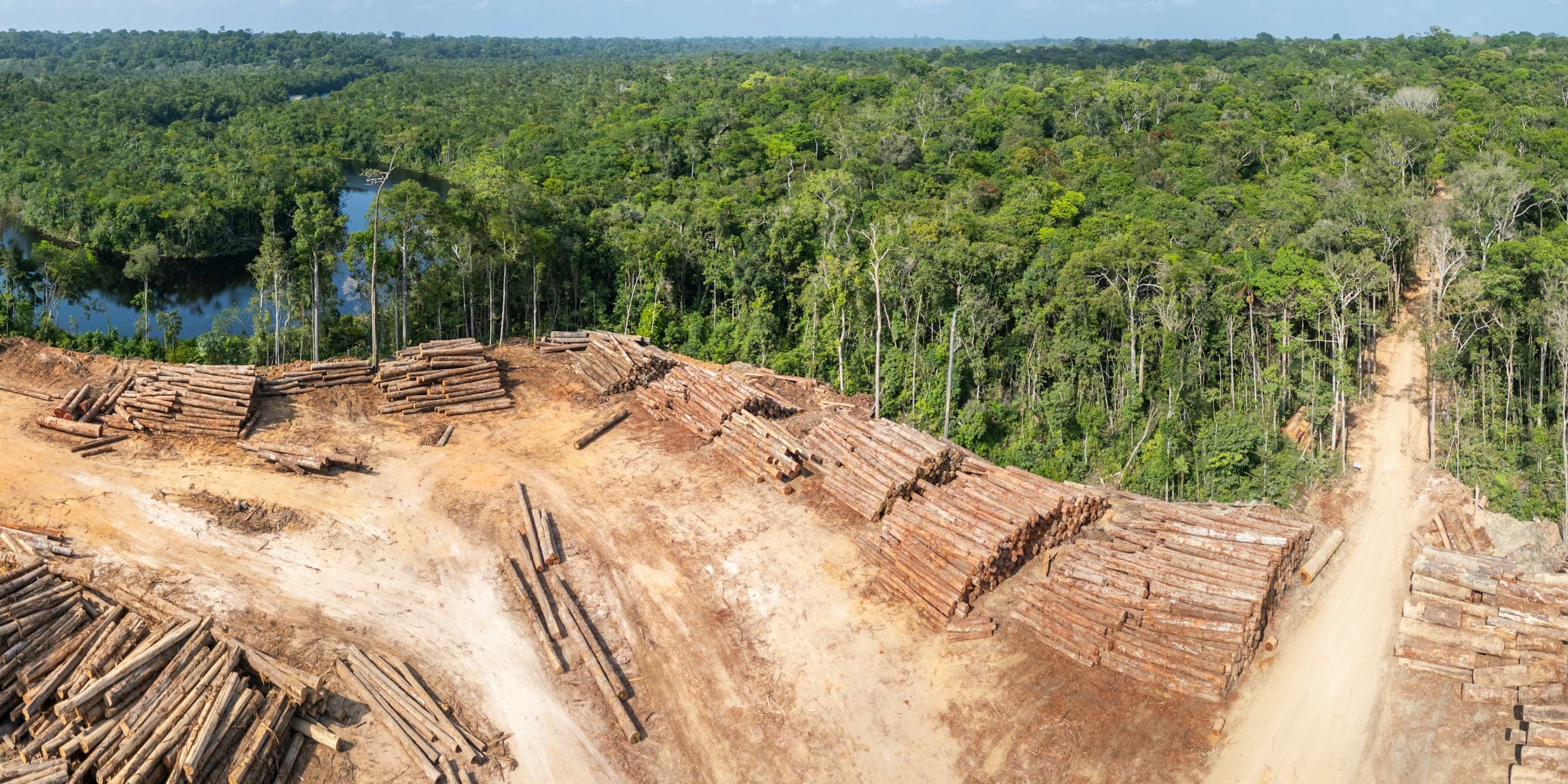
Deforestation is the deliberate destruction of the environment, often for profit. Forest clearance defines the amputation and demolition of a forest from the land. Regularly, this land is converted to non-forest agricultural use—a funny word: agriculture. One wonders where the “culture” is in industrial monoculture plantations drenched with pesticides, herbicides or, worse, Frankenstein plants that are genetically modified.
To poison soil for profits—and yes, peak soil is behind us. It is downhill from here on—deforestation means the “conversion”—the code word for annihilation—of a forest into industrial farming, ranches, or land to be used for housing and factories.
Despite capitalism’s best efforts, just about 31% of the Earth’s land is still covered by forests. Yet this is about one-third less than the forests that covered Earth before the expansion of agriculture. Worse, about half of all deforestation occurred during the last century.
Slowly, we are converting planet Earth into a Mars-like dustbin where madmen like Elon Musk want to live. Even potato-shit farmer Matt Damon, in The Martian (2015), left as soon as he could. Yes, this might well be our future here on Earth.
On Earth, about 2,400 trees are cut down each minute. We are making rapid steps towards Mars-like living—or, better, dying. Recent estimates of deforestation have varied regarding the extent of deforestation in the tropics.
In 2025, nearly 90% of global deforestation was caused by “agriculture”—as if agriculture had hands to do it. Profit-driven cropland expansion and pasture creation were the primary drivers. Meanwhile, forests are also being converted into plantations for coffee, palm oil—found in almost everything we eat—rubber, etc.
But wait, it gets worse. Livestock grazing also drives deforestation. Further drivers are the timber industry—legal and illegal logging—urbanisation and, of course, mining. Among the many effects of deforestation are the acceleration of global warming and an increased risk of wildfires in the dried-up landscapes that are left behind.
Beyond all that, deforestation foremost results in habitat destruction which, in turn, not only leads to biodiversity loss but also moves us ever closer to the sixth mass extinction. Deforestation leads to the extinction of animals and plants, changes to the local climate, and the dislocation of Indigenous communities who once lived not just “in” but “with” a forest. Once Indigenous people and trees are removed—thanks to Caterpillar and Stihl, for example—such regions suffer from desertification and soil erosion.
In addition to this, deforestation also diminishes the uptake of carbon dioxide from the atmosphere. This reduces a forest’s ability to mitigate the impact of global warming. The role of forests in capturing and storing carbon is rapidly declining. Making this all the more serious is the fact that, since 1990, 420 million hectares of forest have been destroyed. From 2015 to 2020, the rate of deforestation was 10 million hectares per year.
Based on the link between deforestation, global warming, and the expected changes for agriculture, the global food system is in danger. Roughly 12,000 years ago, when Earth’s climate stabilised, farming became possible. Once the climate becomes unstable again because of global warming, serious problems are to be expected.
These are the problems we all will have to face during our present-day Capitalocene—global warming turbocharged by capitalism. One possible attempt to address this is the EU’s regulation on the protection of forests—known as the EUDR. The regulation is officially known as Regulation (EU) 2023/1115 on deforestation-free products (EUDR).
The idea behind the EUDR—the European Union Deforestation Regulation—is perhaps twofold: first, the EU knows that neither the mythical “free market” nor the neoliberal ideology of “industry self-regulation” is working. Secondly, the EUDR is designed to ensure that only goods traded in Europe are processed and sold without destroying or damaging forests.
The majority of large companies in the EU support the objectives of the EUDR—nobody, not even corporate bosses, wants to be seen as destroying forests. To self-vanish from the crime scene, corporate bosses have outsourced this to faraway places under the motto “out of sight, out of mind'. This has worked rather well for decades.
Yet the EU’s EUDR will make it hard for corporate bosses to declare their love for forests in Sunday speeches while, on Monday, destroying them for a handsome profit under slogans like “drill, baby, drill.”
In other words, the EU regulation targets “deforestation-free supply chains.” To achieve this, the European Union Deforestation Regulation follows three objectives:
European consumer goods—often made and/or sold by multinational corporations—should no longer contribute to deforestation or damage forests.
Within the European Union, the consumption and production of relevant materials should not generate more than 32 million tonnes of CO₂.
All forms of deforestation and forest degradation through the expansion of agriculture should be prevented.
In practice, this means that “only” medium-sized and large companies in the EU trading in raw materials or products such as soybeans, palm oil, timber, cocoa, coffee, beef or natural rubber fall under the EUDR. They must adhere to the EUDR from 30 December 2026.
To make their supply chains transparent and verifiable, the EU is limiting corporate secrecy, often hidden behind the common excuse of “commercial confidentiality.” Companies are required to certify the origin of their products through documentation to ensure traceability. Hiding behind shiny corporate brochures and standard business ideologies like corporate social responsibility becomes ever harder for the overpaid corporate public relations men in dark business suits.
Meanwhile, the EUDR applies not only to individual products but to all batches. Companies are obliged to conduct a risk assessment for affected raw materials and goods. This includes an analysis of deforestation risks. Companies also need documentation and must observe their reporting obligations in relation to their duty of care.
Only after all these conditions—for each batch—are met can goods be sold inside the European market. Companies breaching these rules will face fines. This might sound harsh, but there are many cases where corporations pay such fines from the office till for biscuits, facing only minuscule levies.
The obligations of the EUDR apply from mid-2027 even for small enterprises. Naturally, corporate vandals will complain about more administration that is difficult to meet. Yet without the corporate vandalism inflicted on the Earth’s environment over decades, no EUDR would have been needed.
In other words, it is no more than the EU’s attempt to protect the environment from corporations before they kill Earth. It is just as a New Yorker cartoon once said:
Text within this block will maintain its original spacing when published
Failed to render LaTeX expression — no expression found
Meanwhile, environmentally destructive corporations continue to complain that the EUDR is highly complex, bureaucratic and, in many cases, not feasible. In Germany, for example, the vast majority of companies have already prepared themselves for the EU deforestation regulation. This contradicts the corporate claim that the EUDR is not feasible when most companies have already done their bit.
Meanwhile, the EUDR applies to 57% of German companies with up to 250 employees and to 85% of companies with more employees. All in all, the EU’s regulation on deforestation and supply chains (EUDR) has the global goal of reducing deforestation and forest degradation.
It demands that many companies in, for example, the paper and food industries are obliged to make their supply chains more transparent and verifiable. The aim is that products for which no deforestation certification can be shown can no longer access the rather lucrative—and profitable—EU market with its millions of consumers.
The EUDR applies to medium and large companies in the EU after 30 December 2026 and to small businesses from 30 June 2027. The regulation requires these undertakings to guarantee the forest-destruction-free origin of their products. Perhaps Greenpeace was not wrong when it told European companies: “Stop complaining, start complying!”

why when we are literally drowning, up to our collective necks in garbage, we are obsessing over ‘Climate’ — what was gained and what was lost by having shifted the discourse away from pollution, emissions, toxic spills, the War Machine, big Pharma/Argo, the polluters, extractors, plunderers ... to ‘climate’?!
Who profits?