


‘There is no “clash of civilization.” There is a clinically dead civilization kept alive by all sorts of life-support machines that spread a peculiar plague into the planet’s atmosphere.’
— The Invisible Committee, 2007
Our civilisation has already imploded—it’s just that most of us haven’t realised it yet. Capitalism has outgrown its formula, and now feigns a life it doesn’t have thanks to repeated bouts of monetary alchemy triggered by highly manipulated “emergencies.” What is happening now belongs to the same pattern I have described over the last few years: the deployment and management of crisis as the survival strategy of hyper-financialised capitalism. We can be fairly certain that the global “energy crunch” linked to the attacks on Iran will end with another colossal injection of cash created out of thin air, probably on the back of a deflationary crisis. As in 2008, a recession would push oil lower and legitimate another round of QE, or whatever they decide to call it this time. Most likely, this will be playing out by the US midterms. It’s the Covid playbook reloaded. The ultra-rich will get even richer while the rest are left with more immiseration, suffering, and surveillance.
But the crisis is not only economic: as capitalism unravels, it raises its level of violence and terror to unprecedented heights. Modern Western civilisation has long rhymed with extermination—this much the 20 century made clear—and Gaza followed by the escalation in Iran now carries that same familiar flavour. No matter how strategically planned, this unmediated violence signals not strength, but a dying system’s death rattle: our civilisation is clinically dead, though not yet buried.
At this juncture, any strictly social contestation that refuses to see that what we’re facing is not the crisis of a society but the extinction of a civilization becomes an accomplice in its perpetuation. It’s even become a contemporary strategy to critique this society in the vain hope of saving the civilization. So we have a corpse on our backs, but we won’t be able to shake it off just like that. Nothing is to be expected from the end of civilization, from its clinical death. Such a thing can only be of interest to historians. It’s a fact, and it must be translated into a decision. Facts can be conjured away, but decision is political. To decide for the death of civilization, then to work out how it will happen: only decision will rid us of the corpse.— The Invisible Committee
One need only listen to the language of those who govern. The first sign of a collapsing system is the collapse of its language. The brutality now accepted in political speech reveals the debt-soaked capitalist disorder in the midst of its own collapse—tragicomically scrambling for solutions that won’t bring it back to life.
For the first time in history, we see the head of a state that considers itself civilized speaking openly like a murderer, saying of the religious leader of a country he has attacked: “we will kill him,” and of the inhabitants of that country: “we will massacre them.” Neither Hitler nor Stalin ever spoke like this. And yet not only is this man not blamed and removed from office, but the heads of state of the so-called Western democracies approve of him, implicitly accepting that politicians today publicly express themselves in ways that perhaps even murderers would not dare to use among themselves. — Giorgio Agamben, 5 March 2026
The symbolic framework itself is rapidly disintegrating. We cannot return to the familiar signifiers of the past—not only because they belong to a vanished moment, but because the seeds of today’s collapse were already inscribed in them. Those reassuring cultural formulas—modernity, progress, prosperity—were fragile constructions. They concealed contradictions they could never resolve. Now those contradictions are literally exploding.
This is happening at the epicentre of the capitalist system, and it has been unfolding in a steady crescendo over the past six years. The capitalist hegemon, the United States, embraces terror as a weapon of last resort to conceal its own internal decomposition. For years, culture wars and identity politics served as a substitute for class struggle—a way to signal virtue while the material conditions of the many deteriorated. Now, after the Gaza genocide and the attack on Iran, that substitution becomes patently obscene. All the progressive formulas with which liberal institutions have bamboozled us for years no longer make any sense to anyone paying attention.
Those formulas were never benign gestures toward inclusion. In their institutional form—corporate diversity statements, statemandated pronoun policies, depoliticised climate campaigns—they functioned as a compensatory symbolic economy. They offered the semblance of ethical progress at the very moment material inequality, imperial war, and ecological devastation accelerated. They were the velvet glove over the iron fist.
Now the fist has dropped the glove entirely. Now the same institutions that lectured the world on respect and sustainability openly execute massacres. The charade collapses. The language of universal relativism is revealed as perception management. To continue speaking it as if nothing had changed is complicity with the very terror that makes that language obscene.
A clear eye perceives the gap between the micropolitics of recognition and the macropolitics of annihilation. The demand for a new politics begins precisely here: in the refusal to let the exhausted signifiers of the old order survive the collapse that has unmasked them.
In moments of relative stability, power cloaks itself in the language of law, procedure, legitimacy. But when a system enters its terminal phase, these mediations break down. Sovereign power appears in its raw form: the power to threaten, to kill, to annihilate. The masks fall away. What remains is the simple logic of domination. Political language degenerates, abandoning diplomacy for the crude idiom of violence. The state no longer pretends to justify its actions—it simply proclaims and executes them.
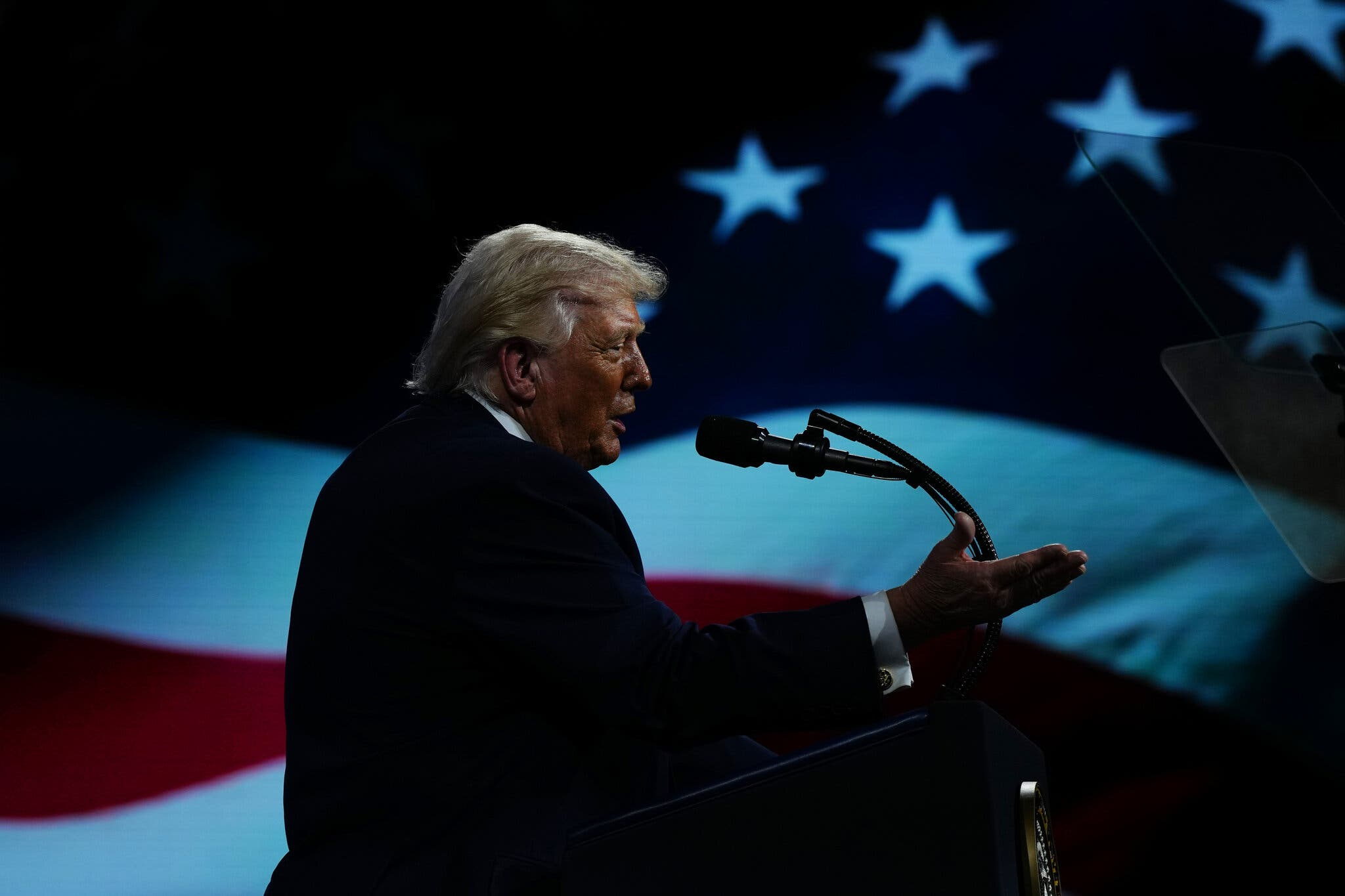
It is this collapse of symbolic mediation that gives the present moment its disturbing clarity. When Trump says he will bomb Iranians “back to the Stone Age where they belong,” he exposes the underlying truth of a system that, having exhausted its economic and political legitimacy, can sustain itself only through the spectacle of force. Violence erupts openly, announced from podiums and broadcast worldwide. Evil turns, again, into banality.
The language we speak is our world. Our identities are woven from signifiers that attach to us from early childhood—words that graft onto the body and slowly shape us. We are speaking beings—parlêtres, as Lacan put it (a being stitched to the world by words)—bound before we ever choose. Those threads are now snapping.
There is nothing outside the symbolic. The world becomes intelligible only insofar as it is mediated by signifiers that give it structure and meaning. When that structure falters, reality itself begins to lose coherence. The terminal crisis we’re in cannot be resolved by nostalgia or by clinging to the exhausted vocabulary of the economy and its ideologues. If the old symbolic order is collapsing, the task before us is twofold: to dissect this collapse, recognise it for what it is—and to invent another social space. To produce new signifiers capable of organising a radically different relation to the world—before all the language left is a scream.
