


From Historical Necessity to Questions of Reassessment and Renewal
The left in most countries of the Middle East and the Global South living under authoritarian regimes suffers from a shared structural problem, manifested in the severe and chronic weakness and fragmentation afflicting mass organisations, particularly trade unions, professional federations, feminist organisations, and student unions.
These regimes have, in similar contexts, generated oppressive conditions that pushed left-wing forces to adopt tightly centralised organisational forms under the weight of repression and persecution, producing an approach based on building clandestine and sometimes semi-public trade unions and mass organisations closely bound to political parties, at the expense of their independence and their capacity to embrace broader social constituencies.
Comparative experiences in these contexts reveal that when the left tightens its grip on its mass organisations and turns them into extensions of its party structure, it may gain internal ideological coherence and influence, yet it risks losing something far more precious: the genuine social weight capable of mobilising people at decisive moments.
Fairness requires acknowledging that the model of the party-affiliated union and mass organisation was not wrong in all circumstances. It played a pivotal role in certain historical phases that cannot be denied, particularly during periods of left-wing growth and mass ascendancy, when organisational centralisation was a necessity imposed by repressive realities and by the need to maintain cohesion and protect cadres. The affiliated unions and federations of those phases were able to serve as effective incubators for union and mass work under conditions of extreme hardship.
Yet time has changed fundamentally, and with it the mechanisms of mass thinking and organising. People today, especially the new generations raised on a culture of instant access to information, horizontal organising, and direct participation in decision-making, no longer accept being mobilised in service of a specific party agenda, however sincere its intentions. Real popular power today is not built through organisational decree; it is built through rootedness in people’s daily lives and through honest and effective representation of their interests, regardless of their intellectual or political affiliations.
This reading seeks to stimulate serious debate around the necessity of reviewing the model of the “affiliated union and loyalist mass organisation” and to explore an alternative model resting on three complementary pillars: first, building genuinely independent progressive trade unions, federations, and mass organisations grounded in international conventions rather than party programmes; second, the active participation of left-wing individuals within these organisations as persons committed to the concerns of their sectors rather than as representatives of their parties; and third, building broad coordination and alliance frameworks among the various left forces that transcend secondary ideological differences toward a unified project of change.
This paper will examine the Iraqi case as a lived and direct experience rather than an abstract theoretical model, drawing from it lessons and questions relevant to similar contexts in the region and the Global South. In Iraq specifically, this problem manifests acutely. Left-wing forces were compelled throughout most of their history to operate under successive dictatorial regimes, most notably the Baathist regime that ruled the country from 1968 to 2003, generating an organisational legacy whose shadow still falls on the present day.
Yet the new conditions that followed the political transformations and the fall of that dictatorship, and the existence of a relative margin of freedoms and public activity despite the authority of religious and nationalist militias, now call for a calm and constructive reassessment of this approach and for serious thinking about more open and independent organisational models capable of embracing broader social constituencies and representing their interests with greater depth and honesty.
This reassessment gains added importance when we recall the bitter experience with politically manipulated yellow unions (that is, unions created or controlled by dictatorial regimes to serve their own purposes) during the dictatorial periods in Iraq and across the region, where they were transformed into tools of control and subjugation rather than representations of people’s interests.
This legacy remains alive in collective memory. The ruling authorities in Baghdad and the Kurdistan Region continue to follow the same pattern with their loyalist official unions, making the presentation of an alternative model grounded in genuine independence, collective leadership, internal democracy, and intellectual pluralism an urgent necessity for restoring popular trust and expanding the sphere of influence.
From Organic Affiliation to Independence
After 2003, most left-wing organisations were keen to maintain and establish their own unions, federations, and organisations. This frequently led to a proliferation of organisations and unions within the same sector and, in some cases, resulted in duplicated organisations within a single party as a consequence of internal splits or competition over mass roles, producing a mass landscape characterised by dispersed energies, multiple names, and diminishing real effectiveness on the ground.
This reality calls for calm and constructive reflection on the price that mass organisations have paid from their representational standing as a result of this organic affiliation. A union tightly bound to a particular organisation finds it genuinely difficult to embrace workers of all their intellectual, national, religious, and political diversity, so its sphere of influence narrows and becomes confined to a specific stratum.
Likewise, feminist organisations that are organically tied to a particular party find it genuinely difficult to attract women from different political and intellectual backgrounds, however sincere the intentions of their leaders. Student unions gradually become arenas for party rivalries, where students lose their independent space and may feel they are being recruited politically rather than acting as participants in a movement that truly represents their interests.
The proposal here is not to abandon mass work or withdraw from it, but to elevate it toward more independent and more broadly representative models. Participating in building a single strong independent progressive union that encompasses tens of thousands surpasses in its social and rights-based value dozens of small scattered organisations, because a large independent union possesses the weight and credibility that enables it to effectively defend the interests of its members and confront violations with a louder voice and deeper impact.
Left-wing individuals who work within these unions as persons committed to the concerns of their sectors can acquire deeper social and political influence than they would gain through leading affiliated organisations of limited impact, and all of this ultimately serves the left project itself.
A personal experience I lived through in the summer of 1992 reveals the depth and roots of this problem. When we gathered with a number of left-wing comrades and unemployed workers to build a union for the unemployed in the Kurdistan Region, the first disagreement that arose among us was not about the organisational structure or working mechanisms, but rather about the founding declaration itself. Some comrades proposed a declaration saturated with left-wing ideological language such as imperialism, socialism, and the like.
I disagreed with them and held that what we were seeking was to build a union for all the unemployed, from every idea and orientation, not a union for the unemployed of the left alone. We faced a fundamental choice: do we build a broad mass organisation that expresses the interests of all, or do we build an ideological facade that narrows its own base before it even sets out? That question, raised in the summer of 1992, remains at the heart of the problem we are discussing today.
Weak Coordination, Fragmentation, and Their Impact on Mass Struggle, Unions, and Federations
The problem of fragmentation in unions and mass organisations cannot be addressed in isolation from a deeper and more influential phenomenon: the state of weak coordination and joint work that has weighed on the course of left-wing forces and burdened them at pivotal junctures. The mass fragmentation we observe in the union and organisational landscape reflects, in part, a prior political and organisational fragmentation, manifested in the multiplicity of left-wing organisations and the divergence of their positions on certain issues. This divergence is natural and legitimate in itself, yet when it turns into tension and conflict that undermines joint work, it casts its heavy shadow over the entire mass space.
Since the end of the last century, Iraqi left-wing forces have faced the challenge of reaching a minimum level of joint coordination at decisive moments. Differences over political positions, ranging from dealing with the occupation to stances on the political process to evaluations of left-wing experiences, sometimes shifted from a productive intellectual debate that welcomes disagreement into a tension that made field cooperation difficult despite the many points of convergence.
The mass impact of this reality was tangible: internal tensions weakened the left’s ability to present itself in a unified manner before the people who were counting on it as the bearer of a project of change.
This reality was directly reflected on mass and union organisations. When left-wing forces drift apart in their positions, unions and federations do not escape the effect of that drift, finding themselves sometimes before rivalries that disperse their energy and divert them from their original task of defending the rights of their members. Rather than directing efforts toward confronting violations and demanding rights, those efforts are sometimes drained in internal conflicts among left-wing forces themselves and in disputes that serve neither workers nor their interests.
The absence of coordination also generated a pattern of competition within the same mass sphere rather than expansion toward new social sectors that left-wing forces had not yet reached. The result was that the mass landscape remained limited in scope despite the multiplicity of organisations, because this multiplicity did not always lead to distributing work and addressing different strata; instead, it led to overlap and repetition in the same territory.
There is a painful paradox worthy of reflection: the left raises the banner of unity among the toiling masses, yet this organisational approach has inadvertently led to the dispersal of struggle and shared efforts and the weakening of the union and mass movement on the ground.
In this context, the strategic value of building genuinely independent mass organisations and unions becomes clear, because they constitute the space in which left-wing individuals belonging to different organisations can work side by side around clear common interests and points of convergence. Independent unions and federations impose their own logic, grounded in the defence of rights, and this logic transcends ideological differences when it comes to confronting arbitrary dismissal, reclaiming an acquired right, raising wages, or demanding more rights and equality.
The experiences of union and mass movements in similar contexts reveal that joint work within independent unions and federations gradually consolidates a culture of cooperation and builds collective popular power on the ground, which in turn has a positive effect on the climate of relations among left-wing forces themselves.
Lessons from Effective Union Experiences
Historical and contemporary experience reveals that effective independent progressive unions have often been a pivotal factor in social and political change and that their strength did not derive from their affiliation with this or that party but from their genuine rootedness in their worker and popular bases.
In Tunisia, the Tunisian General Labour Union (UGTT), despite the reservations that exist, played a central role in bringing down the dictatorship in 2011, provided an institutional framework for national dialogue in its aftermath, and succeeded to a meaningful degree in converting popular protests into organised demands. Its popular weight, rooted in broad sectors of workers and professionals, was precisely what granted it the negotiating capacity that all political parties combined were unable to match.
In South Africa, the Congress of South African Trade Unions (COSATU) formed a fundamental pillar in the struggle against the apartheid system and demonstrated that strong independent unions can simultaneously serve as a front for defending labour rights and a platform for the struggle for human dignity, liberation, and equality without being absorbed into any particular political party.
In Brazil, an independent trade union movement emerged in the late 1970s in the automobile manufacturing sector, led by workers in São Paulo’s factories in confrontation with the military dictatorship, demonstrating that organised strike action is an eminently political instrument when backed by a progressive union genuinely rooted in its popular base. This union movement subsequently gave rise to the Workers’ Party, which reached power, in a rare model of building genuine political power from grassroots union work.
In India, unions of miners and textile workers historically linked the daily labour struggle over wages and working conditions to broader social change, demonstrating that a union capable of embracing popular masses in all their religious, ethnic, and class diversity can transcend the narrow economic demand and transform itself into a force for deep social change.
Regarding contemporary experiences in Western democracies, the Danish left offers a model worth reflecting on, though it too is not without considerable reservations. In Denmark, left-wing and socialist parties no longer have the option of building their own or loyalist unions, given that the main trade union confederation is an independent and powerful entity. This has made working within independent unions and actively participating in their structures the practical path for advancing radical and progressive orientations from within, through persuasion, practice, and field struggle across various sectors. This trajectory has produced unions of genuine popular weight, while left-wing forces within them acquire deeper social and political influence than they could ever have gained by merely leading small loyalist organisations affiliated with their parties.
What these experiences collectively reveal is that effective independent unions and mass organisations do not merely defend immediate rights; they are also capable of building, over the years, an organisational culture and institutional capacity that makes them a lever for change at decisive moments. This is precisely what the Iraqi left lacked during the October 2019 uprising and beyond and what should constitute the compass of left-wing mass work in the coming period.
International Conventions as a Practical Foundation for Building Independent Democratic Unions and Federations
An important opportunity emerges here that has not been sufficiently utilised: directing efforts toward building genuinely independent trade unions, professional federations, and workers’ organisations, alongside mass, human rights, and feminist organisations that ground their work in international human rights, labour rights, and women’s rights conventions rather than in the political programmes and orientations of left-wing organisations in this domain. This approach acquires added importance in the countries of the Global South whose unions and mass movements suffer from severe structural weakness, as these conventions provide a solid foundation and a moral and legal legitimacy that transcends local boundaries and grant the union struggle a universal dimension that is difficult to target with accusations of political or ideological bias.
Foremost among these references is the Universal Declaration of Human Rights, which guarantees in its twenty-third article the right to work, to free choice of employment, and to just and favourable conditions of work and explicitly recognises the right of all to form and join trade unions. Complementing this framework is the International Covenant on Economic, Social and Cultural Rights, ratified by Iraq, which explicitly obliges states to guarantee trade union freedoms and protect workers from violations.
The core conventions of the International Labour Organization form the most solid practical pillar in this context, particularly Convention No. 87 on Freedom of Association and Protection of the Right to Organise, which guarantees workers without discrimination the right to establish and join organisations without prior authorisation from the authorities; Convention No. 98 on the Right to Organise and Collective Bargaining, which protects workers from any interference in union affairs; Convention No. 29 on Forced Labour; Convention No. 105 on the Abolition of Forced Labour; and Convention No. 111 on Discrimination in Employment and Occupation, which prohibits all forms of discrimination in the work environment.
On the specific question of women’s rights, the Convention on the Elimination of All Forms of Discrimination against Women (CEDAW) represents the most comprehensive and binding reference, recognising women’s full political, economic, social, and cultural rights without reservation. It is complemented by the Beijing Declaration and Platform for Action, considered to this day one of the most comprehensive international documents addressing women’s issues and the requirements of their empowerment.
What deserves emphasis is that what these conventions contain corresponds in its essence to what all left-wing forces advance as demands in the area of labour rights, mass rights, and women’s rights, while at the same time deepening them and providing them with an international legal framework. Grounding the struggle in these references not only provides a strong legal and ethical framework for union, mass, and feminist struggle but also contributes to reducing the sensitivity around accusations of party politicisation within unions, federations, and mass organisations, because the demands are transformed from general ideological slogans into internationally recognised rights that can be defended before society and the authorities alike.
The Rentier Economy and the Complexities of Union Organising
To the foregoing must be added the structural challenge posed by the rentier nature of the economy in Iraq and the Kurdistan Region, a feature shared by most oil-producing states in the Middle East, which makes independent union organising a matter of considerable complexity requiring rigorous scientific thinking. Where a large proportion of the workforce depends on state and public sector salaries, a direct relationship of dependency with the authority is established that constrains the space for independent organising and weakens the internal motivation toward it.
Official figures reveal the depth of this dependency: oil revenues accounted for approximately 89% of Iraq’s total public budget during the first seven months of 2024, while data from the first half of 2025 indicated that oil constituted approximately 92% of the country’s total revenues, making Iraq one of the most economically dependent on a single resource in the world and narrowing the space for any genuine union independence in confronting a state that holds both tools of punishment and reward.
In productive economies, workers move toward union organising because their negotiating power with private employers requires organised collective action. In the rentier economy, a different logic prevails: the relationship becomes one between a citizen and a state that distributes rent, which transforms labour demands from a struggle over clear contractual rights into endeavours surrounded by concerns about job security and livelihood stability.
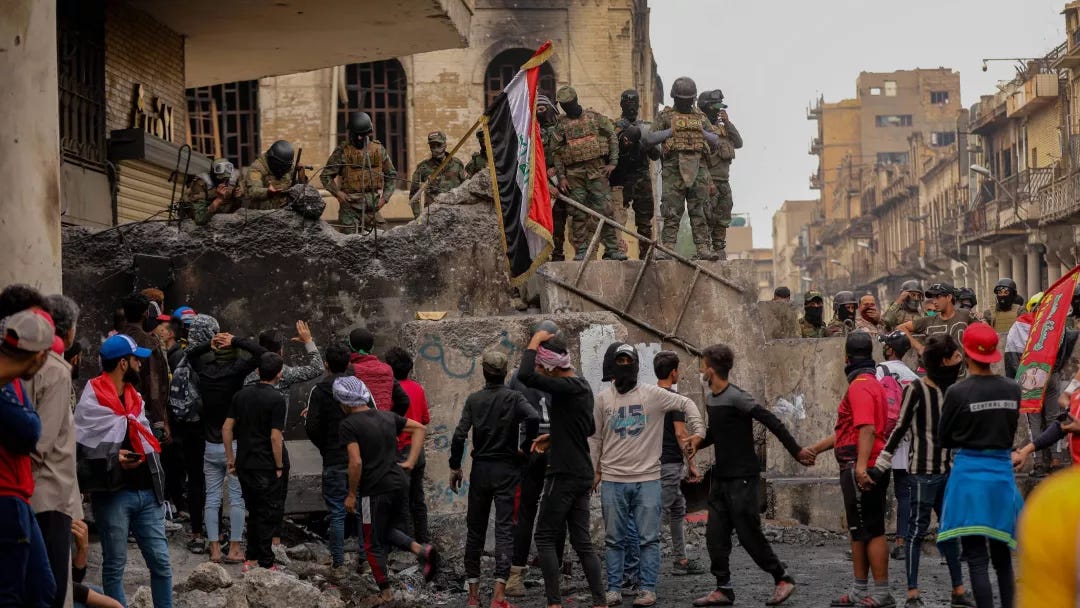
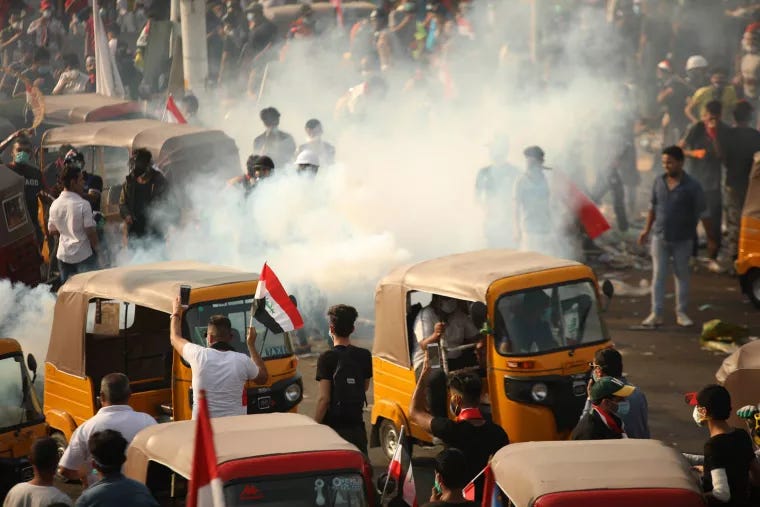
Perhaps the most telling example of this is what occurred during the October 2019 uprising in Iraq, that vast popular uprising that shook the entire political order, when existing unions were unable to convert the momentum of the streets into organised labour strikes that would halt the production process and compel the government to respond. This was because the majority of protesting workers were government employees directly tied to state salaries, who found themselves facing a painful equation: either protest and bear its professional consequences, or remain silent and preserve their only source of income.
In the Kurdistan Region, this pattern manifests with even greater intensity. We have witnessed repeated waves of protests over delayed salary payments, yet these protests remained spontaneous, intermittent, and unable to transform into an organised and sustainable union movement. The fundamental reason is that the Kurdish worker who demands their rights simultaneously knows that they are wholly dependent on the very government they are protesting against, making independent union organising a personal risk that the individual finds it difficult to bear alone.
This reality has revealed an urgent need for unions that gradually build awareness that the union right is not a rebellion against the state but rather a guarantee of the worker’s dignity in the face of any authority and that present collective protection is an alternative to individual fragility.
This reality calls on the left to develop distinct union policies that take into account the specificity of the rentier environment, rather than replicating models born in different economic contexts. These policies require focusing on gradually building social awareness that union and mass rights are not a concession granted and withdrawn by authority; they are an inherent right guaranteed by international conventions and required by full citizenship.
They also require broadening the concept of organising to include demanding transparency in the distribution of rentier wealth and accountability for those who manage it, demands that concern everyone and can transcend political barriers to build broader social solidarity.
International Donor Organisations and the Question of Independence
No reading of the landscape of union and mass fragmentation is complete without reference to the role of international donor organisations. Fairness requires acknowledging first that international funding and global expertise have contributed to supporting genuine union, human rights, and mass activity in various phases and that many organisations have benefitted from this support in building their capacities and expanding their presence.
Yet there is another side to this picture that warrants frank critical reflection, particularly regarding organisations tied to Western capitalist governments that ultimately reflect their countries’ policies and strategic interests in the region, interests that do not necessarily align with those of the working classes and popular masses that these organisations claim to support.
Many of these organisations have directed their funding in ways that serve an agenda of promoting a particular model of “civil society”, a model that focuses on reform within the existing class system and avoids challenging core economic structures, while marginalising unions and federations with a clear class orientation and radical labour and mass demands.
This has led to the emergence of organisations designed to serve the requirements of reports and projects more than the needs of their popular bases, organisations that end with the end of the funding cycle and leave behind no solid institutional structure.
At a deeper level, this funding pattern has contributed to redrawing the map of struggle priorities, with resources and human energies that could have been directed toward building a strong independent union and mass movement being channelled instead toward temporary activities and projects.
This was sometimes accompanied by the reinforcement of the phenomenon of personalisation in unions and organisations, where the relationship came to exist between the funder and specific individuals rather than between the funder and the organisation as a collective institution.
This weakened participatory structures and turned the leadership of some organisations into personal privileges linked to access to external funding networks, rather than being an expression of the trust of the popular base.
This is not a call for absolute hostility toward all international cooperation. There is genuine international solidarity with labour, union, mass, and feminist movements, embodied by independent international labour and human rights organisations such as the International Trade Union Confederation and various human rights and feminist organisations.
It is a call for critical class awareness in dealing with Western government funding and for holding firm to the principle that the priorities of the union and mass movement must emerge from the needs of workers and the people rather than from the conditions of funders and that decision-making independence is a non-negotiable condition regardless of the value of the funding on offer.
New Awareness and the Necessity of Reassessment: Toward a Unified Popular Left
The absence of strong and independent unions, federations, and organisations has weakened the left in ways that go beyond what is visible on the surface. When decisive moments arrived in the history of popular protests and uprisings, the left found itself in a painful organisational vacuum: no unions capable of converting demonstrations into organised strikes that would compel the ruling authorities in Baghdad and Erbil to respond, no unified student movement with genuine institutional power, and no influential feminist organisations capable of translating popular anger into sustainable demands. In place of all that, dozens of small competing organisations with limited coordination and recurring organisational conflicts.
The past decades have witnessed fundamental transformations in the way people think and organise that no serious political force can ignore. The digital revolution has redrawn the map of power and influence, enabling horizontal networks and independent initiatives to achieve wide-field presence in record time. Protest movements, from the squares of Iraq to social justice movements across the world, have demonstrated that flexible horizontal organising is capable of generating enormous mobilising energy that excessively centralised structures cannot match.
To this must be added a deep shift in the value systems of new generations toward intellectual pluralism, transparency, and rejection of excessive centralisation. Young people today have grown up in a culture of instant access to multiple sources of information, possess high critical and comparative capacity, and place transparency in decision-making and accountability in the use of resources as basic conditions for granting their trust to any organisation.
We have also witnessed a clear rise in models of collective participatory leadership; successful experiences in contemporary social movements demonstrate that distributed leadership emerging from within groups is more sustainable and less fragile than the model of individual pivotal leadership.
In light of all these transformations together, people, especially young men and women in protest squares, no longer trust the facade of unions and organisations affiliated with parties. They prefer horizontal forms of organising and independent initiatives that respect their intellectual independence, allow genuine participation in decision-making, and engage with diversity as a wealth rather than a burden.
There are growing segments, particularly among young people, that display increasing discomfort with traditional party work. This phenomenon deserves serious reflection and study in order to understand its roots and analyse it rigorously, rather than meeting it with rejection and condemnation, and this imposes on the left the necessity of developing more democratic, collective, and flexible forms of organisation.
This new logic may open before the left a genuine opportunity for intellectual and organisational renewal and the broadening of its social base. The choice is no longer between building a loyalist facade or abandoning mass work; it is between continuing in fragmentation or transitioning toward building and supporting strong independent progressive unions and federations in which left-wing individuals of all orientations work together.
The path to genuine unity on the ground passes through two complementary tracks, neither of which can stand without the other:
First Track: Union and Mass Work. Collective participation in building strong independent progressive trade unions, federations, and mass organisations that bring everyone together regardless of their intellectual, national, or religious affiliations around their common interests and vital demands. Within these independent organisations, left-wing individuals can contribute the best of what they have: the values of social justice, solidarity, and the struggle for human dignity and equality.
Second Track: Political and Organisational Work. Coordination and joint work at the party and political level through diverse alliance frameworks, at the level of the country or provinces or around specific demands, are gradual steps toward building a broad, unified, multi-platform progressive left framework that encompasses all left-wing and progressive forces alongside unions, labour organisations, and mass movements according to current points of convergence. Changing the situation in Iraq and the Kurdistan Region requires mobilising all those energies in a single coherent project.
It deserves emphasis that this paper does not claim to offer a ready-made roadmap or a complete organisational prescription. The practical steps, the mechanisms for getting started, and the details of implementation in different contexts are, at their core, matters that require an open collective dialogue among left forces, the trade union movement, and mass organisations themselves.
The primary purpose of this reading is to stimulate this dialogue and nourish it with serious questions, in the hope that it leads to an intellectual and practical debate that contributes to developing the vision and building shared answers.
That is the meaning of genuine mass work in our era: to serve workers of hand and mind; build and unite their power; and participate in changing their lives for the better, and to embody the values of the left in daily practice rather than in political discourse alone.
The real strength of the left lies not only in its intellectual propositions and political positions but also in its capacity to build independent, far-reaching, progressive institutions rooted in people’s daily lives, capable of defending their interests and rights and converting their social energies into a genuine force for change that opens the path toward the socialist alternative.
