


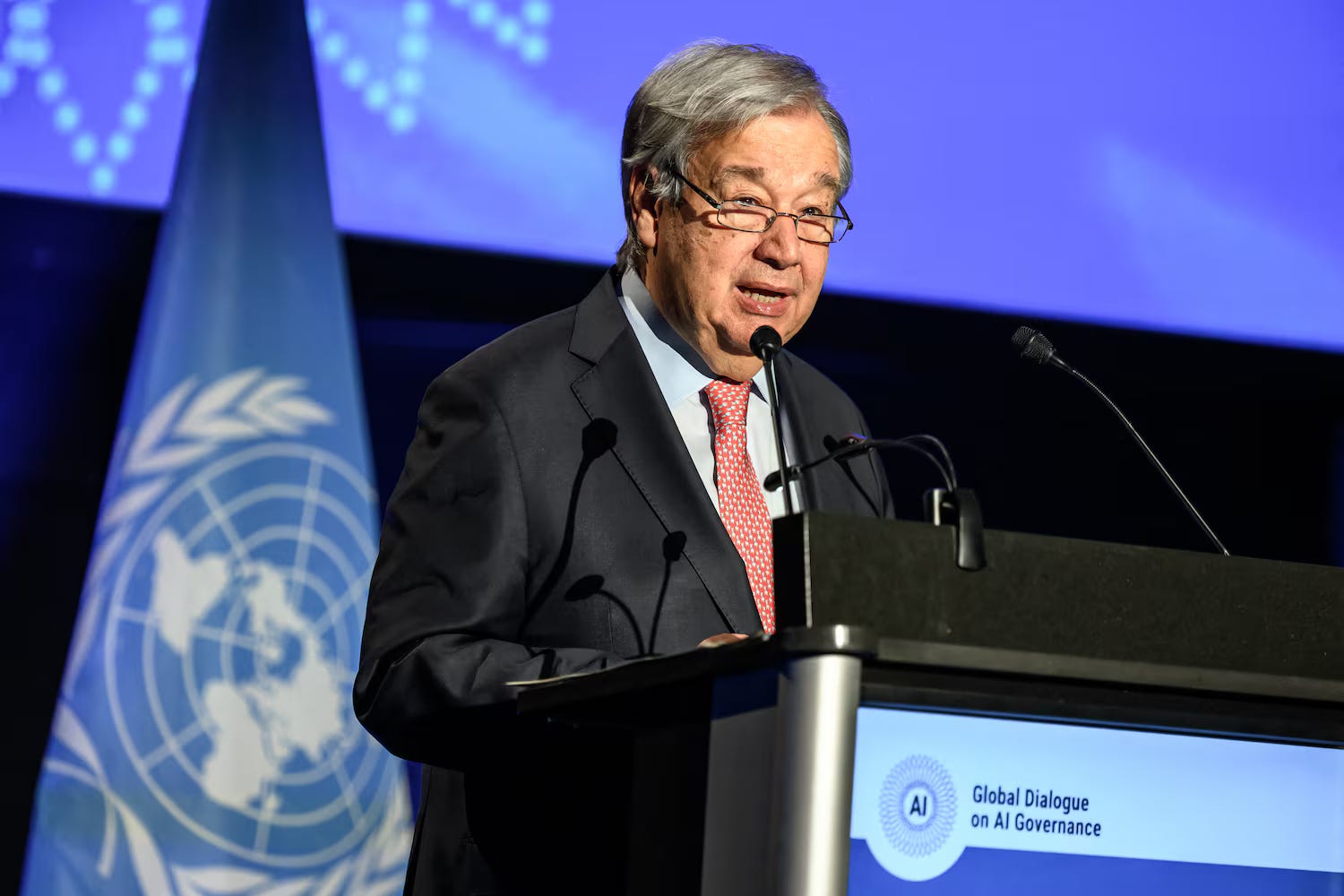
Recently the UN had its big AI moment. On 1 July, the Independent International Scientific Panel on AI published its preliminary report: an evidence-based assessment of the opportunities, risks and impacts of AI, assembled by scientists from all five UN regions and already being described as the beginnings of an IPCC for AI. Days later, delegates from most member states gathered in Geneva for the first intergovernmental Global Dialogue on AI Governance, where Secretary-General António Guterres supplied the quotable urgency: “Innovation needs guardrails. If AI is to be powerful, it must be governed.” The internet took 15 years to reach a billion people, he noted; AI got there in two. The report itself is suitably sobering, warning that safeguards cannot keep pace with capabilities and that there is currently no technical guarantee the most advanced systems will follow the instructions they are given.
All of which is accurate, considered and important. And almost certainly useless. We know this because we have already run this experiment, at planetary scale, for more than three decades. It is called climate.
We have seen this movie before
The IPCC published its first assessment report in 1990. Six assessment cycles later, it has produced one of the world’s most comprehensive and extensively reviewed bodies of climate evidence, and the UN has matched it speech for speech. Guterres in particular has spent years escalating the rhetoric: “code red for humanity” in 2021, “a highway to climate hell with our foot still on the accelerator” in 2022, “the era of global boiling has arrived” in 2023. As speechwriting goes, it is first-rate.
And the result? Global emissions are not lower than when the IPCC first reported: they are more than half as high again, with fossil fuel emissions still setting records in the mid-2020s. The needle did not move. The lesson is brutal and worth stating plainly: evidence and eloquence, however impeccable, do not change outcomes when they are not attached to power. The IPCC diagnosed, the Secretary-General exhorted, and the actors with the ability to act simply carried on.
Now the same architecture is being assembled for AI: a scientific panel to establish the facts, a global dialogue to discuss them, a Secretary-General to supply the moral soundtrack. If this machinery achieved so little on climate, where the science is settled, the harms are visible and the technologies of response are mature, why would anyone expect it to work on AI, where the incumbents are richer, the timelines shorter and the race dynamics fiercer? Reports and speeches are the tribute that power pays to conscience; they are not a theory of change.
The three Spider-Men problem
You will know the meme: three identical Spider-Men, each pointing at the other. That is AI (and climate) governance in a single image. Government points at business: you built this, you understand it, exercise restraint. Business points at government: we would welcome rules, please regulate us (said, without fail, while lobbying furiously against any regulation with teeth). Civil society points at both, correctly, and is rewarded with a consultation window and a seat at a “multi-stakeholder dialogue” while the actual decisions are made elsewhere.
Look closer at the meme and the problem sharpens. Business has the ability to act but not the inclination: no company in a competitive race voluntarily forfeits its position, and expecting otherwise is not analysis but prayer. Civil society has the inclination but not the ability: it can name the problem with great precision and possesses almost no levers to fix it. Government, in principle, has both, which is why everyone keeps pointing at it.
The buck stops where nobody is standing
Ultimately the buck does stop with government. Only governments can pass laws, levy taxes, break up concentrations of power and claim a democratic mandate for doing so. Every road in the UN report leads there too: its central finding, stripped of the diplomatic upholstery, is that nobody else can or will do the job.
But here is the hard part: there is no government on Earth with the inclination to do what is necessary to deliver a fair outcome on AI. Not one. The United States will not constrain its national champions in a race with China; China will not constrain its own; middle powers are scrambling for “sovereign AI” rather than sovereign citizens; and any government that moved first would be told, instantly and loudly, that it was surrendering the future. This is climate’s first-mover problem running again at ten times the speed. Waiting for the incumbent political class to resolve it is not patience: it is denial.
Stop influencing power and start taking it
For decades, the theory of change on the polycrisis has been to influence power: publish the report, stage the summit, sign the open letter, brief the minister. The returns on that strategy are now in, and they are dismal. The conclusion is uncomfortable for people whose careers have been built on the influencing side of the ledger: we need to stop seeking to influencepower and start seeking to take it.
That means a new political class: people who do not currently think of themselves as politicians standing for office and winning it, with a horizon of taking control of government within the next decade. And it means using that control not for incremental gestures but to flood the zone with policies that are pro-people and pro-planet across the whole polycrisis: AI, cost of living, climate, nature, all of it, at once, at speed.
AI populism is coming either way. The genuine version, the one that defends ordinary people through the AI transition rather than performing concern while serving capital, will not be delivered by a UN panel, a scientific consensus or a beautifully drafted speech in Geneva. It will be delivered by people who win power and use it. The IPCC has spent thirty-five years proving that being right is not enough. We should believe it, and act accordingly.

Yes, firstly name the issue correctly, it is not “climate” it’s POLLUTERS — MIC, Big Pharma/Agro, AI, Geoengineering … all with names and addresses, calling it “Climate” absolved us all. What a farce.