


The Levant is no longer a theatre of territorial ambition. It has become a laboratory for the systematic dismantling of sovereignty itself.
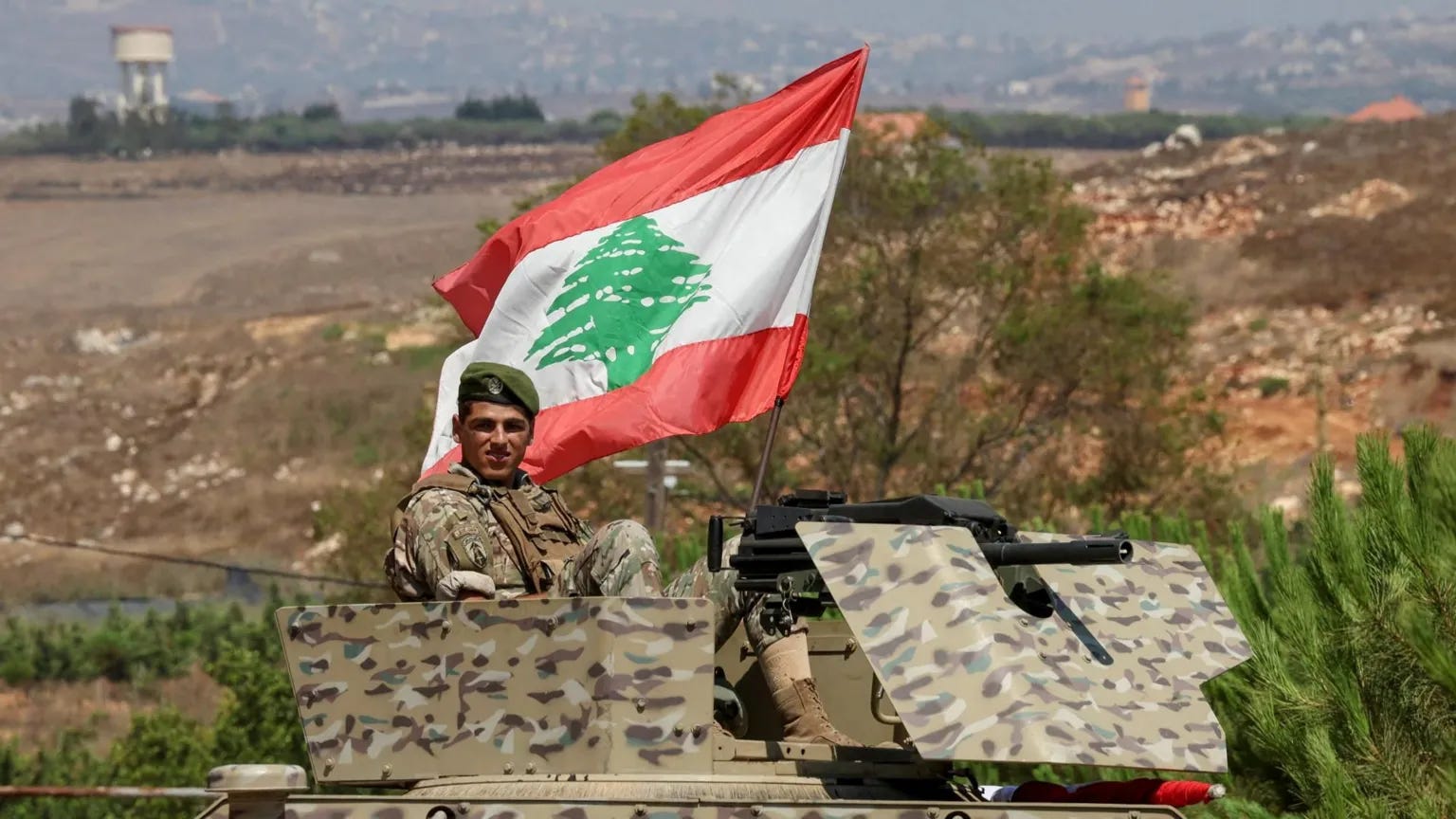
On 21 July 2026, Israeli forces opened fire on Lebanese Army troops deploying into Zawtar al‑Gharbiyeh—a “pilot safe zone” supposedly ceded to state authority under a U.S.-brokered framework. No casualties were reported. But the message was unmistakable: Israel will not wait for the Lebanese Armed Forces to act. It will enforce compliance through kinetic friction, striking at will inside zones nominally under Lebanese control.
This is not war. This is sovereignty as performance—and the performance is failing. The Trilateral Framework Agreement of 26 June 2026, was meant to be a diplomatic breakthrough. Instead, it has become a mechanism of perpetual pressure. Israel’s doctrine is brutally simple: any delay in disarming Hezbollah will be met with immediate, unilateral military action.
The Lebanese Army—underfunded, overstretched, and operating on a defence budget of barely $800 million—is being asked to replace a militia it cannot defeat, while being punished for its inadequacy. To restore military salaries to pre-2019 levels would alone require more than $800 million annually. The army is an institution on life support, its soldiers paid wages that have fallen below the poverty line.
Hezbollah, meanwhile, has declared the framework “null and void.” The group retains an estimated 15,000 to 25,000 hidden rockets and precision attack drones north of the Litani River. Having lost its Syrian resupply lines following the collapse of the Assad regime in December 2024, the group is pivoting to an indigenous urban insurgency—IEDs, suicide drones, and a campaign to brand the Lebanese Army as Israeli collaborators.
Hezbollah chief Naim Qassem has publicly acknowledged that the critical supply line—running from Iran through Iraq and Syria into Lebanon—no longer exists. The battle is no longer about territory. It is about who gets to define legitimacy.
Into this chaos steps the United States—not as a peacemaker, but as a financial executioner. In his 21 July White House meeting with President Joseph Aoun—the first by a Lebanese leader in nearly two decades—Donald Trump pledged to help Lebanon “a lot.”
But the fine print reveals a far more coercive agenda. Senior Advisor Massad Boulos is leading an international coalition to freeze the assets of any Lebanese politician, banker, or clan leader who continues to provide political cover to Hezbollah. Concurrently, a multi‑billion‑dollar reconstruction fund is being conditioned on the Lebanese parliament ratifying disarmament clauses.
This is state-building by financial siege. The United States is not empowering Lebanon; it is purchasing its compliance. And in doing so, it is transforming the Lebanese state into a derivative of American strategic interests—a sovereign in name, a protectorate in practice.
The collapse of Bashar al‑Assad’s regime was the earthquake that reshaped the entire regional landscape. For decades, Iran used Syria as a land corridor to funnel weapons to Hezbollah. That umbilical cord is now severed. The border is being transformed into a digital Iron Curtain—electronic sensor fences, drone surveillance paths, and joint Syrian‑Lebanese outposts.
The historic land bridge from Tehran to Beirut is permanently dead. In its place, a new border regime is rising—one that treats the Levant not as a civilisational crossroads, but as a security corridor to be monitored, filtered, and controlled.
The Lebanese Armed Forces are caught in a structural trap. They are being asked to become the “sole force of arms” in a country where Hezbollah has spent decades building a parallel state. The pilot safe zones—Froun, Srifa, and Zawtar al‑Gharbiyeh—are the testing ground. But the LAF cannot move north of the Litani without triggering a sectarian civil war. It cannot move south without Israeli strikes. It cannot stand still without financial collapse.
Lebanon is being forced to choose between absolute economic bankruptcy accompanied by continuous bombardment, or a high‑risk internal security sweep that could tear the country apart. This is not a choice. It is a death sentence dressed as a dilemma.
Looking toward 2035, the most plausible trajectory is not peace—but a new equilibrium of perpetual fragility. Hezbollah will not be eradicated; it will fragment. A political wing will seek integration into the Lebanese state, while hardline remnants maintain an underground insurgency. The LAF will expand, but its legitimacy will remain contingent on external subsidies. The United States will sustain its financial pressure, but transactional diplomacy cannot outlast a civilisational struggle.
The Levant is entering an era where every actor is trying to rewrite the region’s security architecture faster than the others can adapt. Israel is enforcing kinetic compliance. Hezbollah is pivoting to asymmetric warfare. The United States is weaponising financial coercion. And the Lebanese Armed Forces are attempting to become a state by replacing a militia rather than building institutions.
The next decade will not be defined by peace agreements. It will be defined by covert institutional warfare, proxy fragmentation, and a U.S.—Israel—Lebanon tri‑pressure system that forces Lebanon to choose between becoming a securitised buffer state or collapsing into sectarian entropy.
The protector has become the prison. Hezbollah’s historic resistance legacy has curdled into a parallel state armed with 15,000 hidden rockets. Israel’s doctrine of kinetic compliance treats Lebanese sovereignty as negotiable terrain. The United States has replaced diplomacy with a financial guillotine that turns reconstruction into conditional obedience.
With Assad’s collapse severing Iran’s logistical umbilical cord and the LAF trapped between sectarian backlash, Israeli strikes, and American pressure, the Levant is no longer a crossroads of civilisations but a containment corridor where sovereignty is weaponised, militias mutate into insurgencies, and the Lebanese people—Shia, Sunni, Christian, Druze—are forced to choose between becoming a securitised buffer state or collapsing under the weight of proxy wars that have turned the protector into the prison.
Lebanon is both a sovereign actor and a geopolitical battleground. These are not mutually exclusive—they are dialectically intertwined. Its sovereignty is real enough to suffer, but insufficient to self‑determine.
This is the Levant’s reckoning. And the world is watching—not to intervene, but to measure the cost of its own strategic convenience. The question is not whether Lebanon will survive. The question is whether the world will allow it to survive on its own terms, or whether it will continue to be the playground of empires, the sacrificial lamb of proxy wars, the protector that became a prison.
