


The most dangerous mistake in international affairs is to confuse military destruction with strategic success. That mistake now risks obscuring one of the most consequential geopolitical shifts in the modern Middle East.
For decades, the United States and its allies defined victory through familiar metrics: air superiority, precision strikes, technological dominance, sanctions pressure, and the ability to shape the diplomatic endgame. Yet the outcome of the 2025—26 Iran conflict suggests a different reality. Despite absorbing devastating attacks, suffering immense economic damage, and confronting the combined weight of American and Israeli military power, Iran emerged with something far more valuable than an usarred battlefield: it emerged with leverage. And in contemporary geopolitics, leverage is power.
If the reported contousof the emerging US—Iran memorandum hold, history may ultimately record this conflict not as a demonstration of American strength, but as the moment the regional order quietly inverted. Iran’s achievement was not conqus. It was survival. That distinction matters.
Throughout modern history, weaker powers have repeatedly defeated stronger ones without winning conventional wars. Vietnam did not conquer America. The Taliban did not invade Washington. Hezbollah did not destroy Israel in 2006. Yet each succeeded in preventing its adversary from achieving political objectives. Iran appears to have mastered this same logic. As one analysis notes, Tehran has long measured success through “survival, deterrence, and narrative dominance” rather than territorial acqustion. It learned how to endure without capitulating and how to fight without seeking decisive battle.
That strategic culture now appears vindicated. The most striking feature of the reported memorandum is not what Iran conceded. It is what Iran appears to have gained.
The inclusion of Lebanon within a broader ceasefire framework effectively transforms disparate fronts into a single strategic theatre defined by Tehran’s interests. For decades, Washington attempted to isolate conflicts across Lebanon, Syria, Iraq, Yemen, and the Gulf. Iran spent the same decades knitting them together through networks of militias, political movements, and proxy forces. If hostilities in Lebanon now become inseparable from wider negotiations with Tehran, then the “Axis of Resistance” has moved from a slogan to an organising principle of regional security.
This represents more than a tactical success. It signals a philosophical challenge to the Westphalian state system itself.
The Middle East increasingly operates through transnational armed networks whose influence often exceeds that of the governments hosting them. Hezbollah, the Houthis, Iraqi militias, and other Iranian-aligned actors are no longer peripheral players. They are becoming recognised stakeholders in regional security calculations. The old assumption that states alone determine strategic outcomes is eroding. In its place emerges a more fragmented order in which sovereignty is porous, and power flows through ideological networks rather than formal borders.
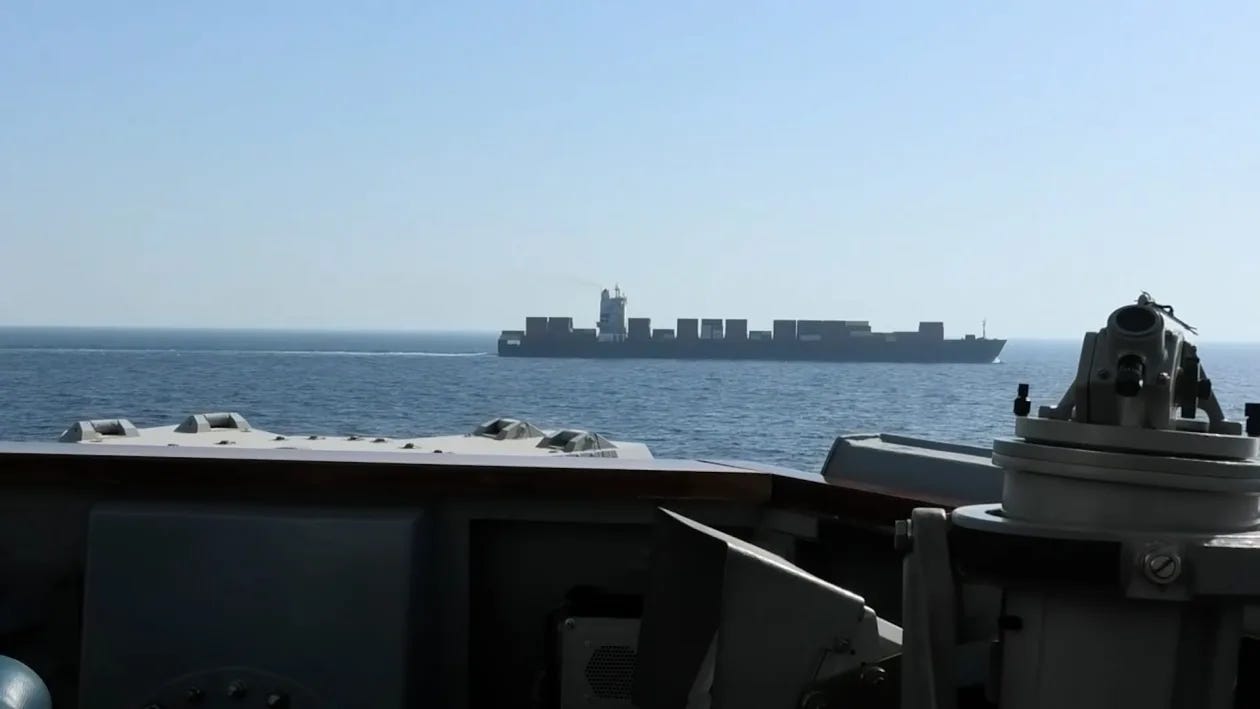
The implications extend beyond the Levant. The Strait of Hormuz remains the world’s most important maritime energy chokepoint, handling roughly one-fifth of global petroleum consumption. Any arrangement granting Tehran effective authority over access, management, or security in the Strait of Hormuz would constitute one of the most significant redistributions of strategic influence in decades. According to reports referenced in the negotiations, reopening Hormuz under Iranian supervision could generate susantial economic leverage while giving Tehran unprecedented influence over Gulf shipping flows.
Even if framed through administrative or environmental mechanisms rather than explicit tolls, the symbolism is unmistakable. For generations, Western maritime strategy rested upon the principle that critical sea lanes belonged to the global commons. Freedom of navigation was not merely a legal concept; it was a pillar of American hegemony. If passage through Hormuz increasingly depends upon Iranian acquiescence, then geography has succeeded where missiles alone could not.
The consequences reach beyond energy markets. They strike at the credibility of deterrence itself. For decades, American power functioned as the central organising principle of Middle Eastern security. Allies relied upon it. Rivals calibrated against it. The assumption underpinning regional stability was straightforward: the United States possessed both the capability and the willingness to impose costs that outweighed any potential gains from challenging the status quo.
Yet deterrence ultimately depends upon belief. When adversaries absorb punishment and emerge with enhanced strategic influence, perceptions change. Brookings analysts have warned that a conflict ending in such circusances risks weakening American global standing while encouraging rivals to reassess Washington’s resolve and capacity.
The issue is not that the United States lacks military power. It remains the most formidable military force ever assembled. The issue is whether that power can still translate into durable political outcomes at an acceptable cost.
That qusion increasingly haunts not only the Middle East but also future theatres of competition from the South China Sea to the Taiwan Strait.
Iran’s success highlights a broader transformation in warfare. The decisive variable is no longer necessarily battlefield dominance. It is a cost imposition.
A $50,000 drone can force the launch of a $4 million interceptor. A militia can compel the deployment of aircraft carriers. A disruption to maritime traffic can send oil prices soaring above US$100 per barrel, imposing economic pain far beyond the immediate conflict zone. During the recent war, threats to Hormuz reverberated through global energy markets and exposed vulnerabilities stretching from Europe to Asia.
This is the economics of strategic exhaustion. The stronger power must sustain expensive commitments indefinitely. The weaker power merely needs to endure.
Such dynamics increasingly favour actors willing to embrace ambiguity, decentralisation, and prolonged confrontation. Iran’s networked model of influence allows risks to be externalised across multiple theatres while preserving strategic flexibility. As analysts observe, Tehran often avoids decisive victories because permanence and managed instability can prove more valuable than responsibility for governance.
The result is a paradox. The more resources Washington devotes to maintaining regional order, the more obvious become the costs of maintaining that order. That reality carries profound implications for policymakers globally.
Australia, Europe, Japan, India, and Gulf states all possess deep interests in stable energy markets and open sea lanes. Yet they are increasingly operating within a strategic environment where American primacy can no longer be assumed as a permanent fact. A multipolar Middle East is emerging, shaped simultaneously by Iranian resilience, Chinese economic influence, Rusan opportunism, and the growing autonomy of regional powers.
None of this suggests an Iranian century has arrived. Iran faces severe economic constraints, demographic pressures, domestic discontent, and continuing military vulnerabilities. But geopolitical victories are rarely absolute. They are measured against objectives.
The United States and Israel sought to fundamentally alter Iran’s strategic position. Iran sought to survive, preserve influence, maintain its regional networks, and compel negotiations on terms more favourable than surrender.
If those were the competing objectives, the uncomfortable conclusion becomes difficult to avoid. The most important outcome of the 2025—26 conflict may not be what Iran destroyed. It may be what Iran proved. It proved that in the twenty-first century, endurance can defeat superiority. It proved that networks can compete with states. It proved that strategic patience can overcome overwhelming force. And it proved that an exhausted hegemon, however powerful, is not the same thing as a victorious one.
The Middle East has not simply witnessed another war. It may have witnessed the birth of a new geopolitical era.
