


There are moments in international affairs when a single road becomes more than infrastructure. It becomes a moral test. The Masnaa–Jdeidet Yabous crossing, a narrow stretch of asphalt linking Lebanon to Syria, has quietly become one such test—not only for Israel and its adversaries, but for the credibility of the rules-based order itself.
In early April 2026, Israel’s warning that it may strike the Masnaa crossing—a route it claims is being used by Hezbollah to transfer military materiel—triggered an immediate evacuation and closure of Lebanon’s principal land artery. The justification was framed in familiar security language: necessity, pre-emption, deterrence. Yet on the ground, the consequences have been anything but abstract. This crossing is not merely a logistical node; it is the primary escape route for civilians fleeing bombardment.
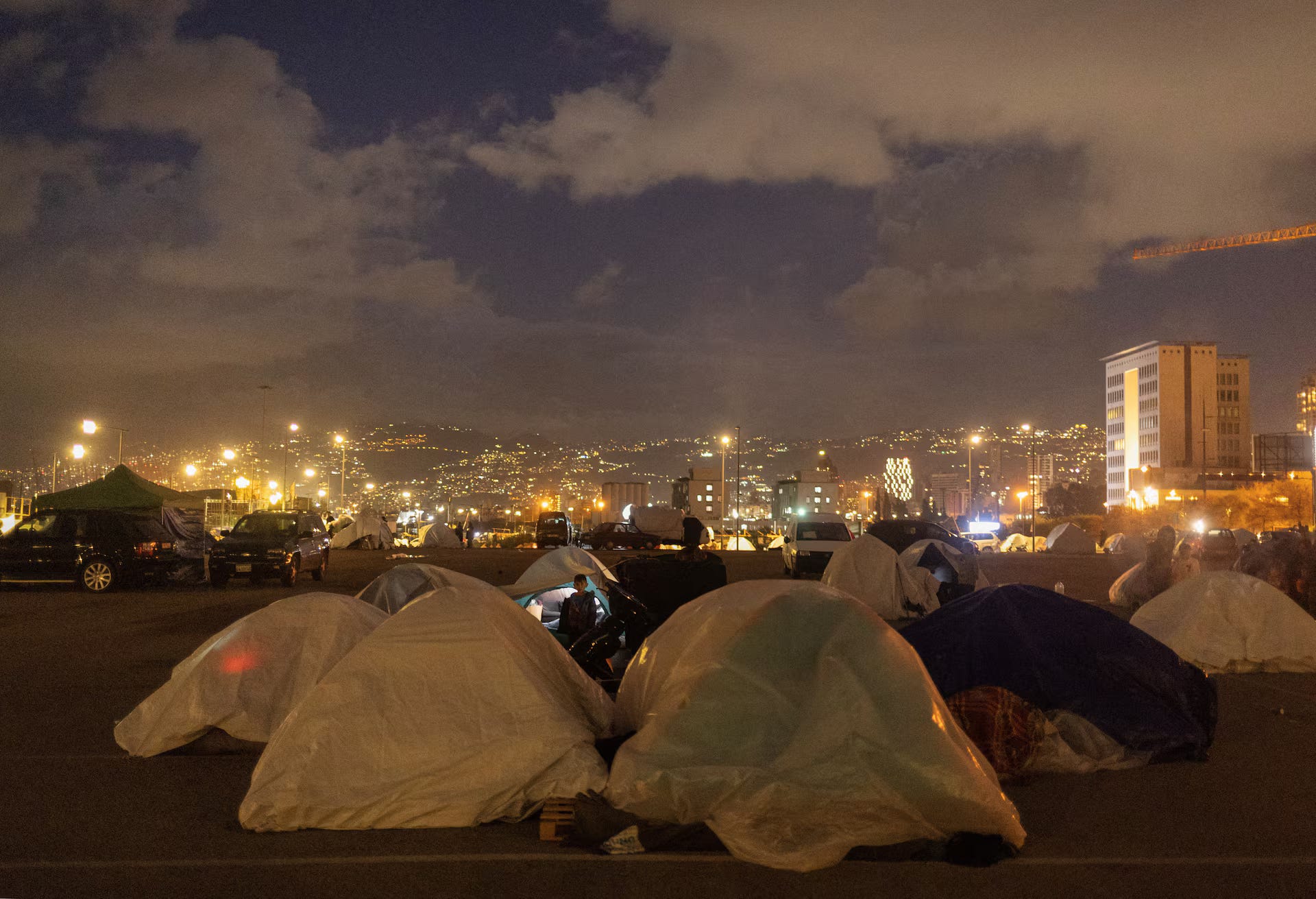
Within weeks, more than 200,000 people crossed into Syria, many through Masnaa, seeking refuge from escalating violence. In a single week alone, nearly 700,000 people were displaced across Lebanon. These are not incidental figures. They speak to a mass human movement unfolding under fire.
The emotional weight of this crisis lies in its stark asymmetry. On one side stands a state asserting its sovereign right to defend itself against an armed non-state actor deeply embedded in regional geopolitics. On the other stands a civilian population—families, children, the elderly—whose survival increasingly depends on access to a single, fragile corridor. When that corridor is threatened, the distinction between military objective and humanitarian lifeline collapses into something far more troubling.
International humanitarian law is not ambiguous on this point. Civilian infrastructure indispensable to survival—including routes used for evacuation—enjoys explicit protection. The Geneva Conventions prohibit not only the targeting of civilians but also actions that effectively trap them in conflict zones. If Masnaa is, as Syrian authorities insist, “exclusively for civilian use,” then the mere threat against it reverberates far beyond tactical calculations. It signals a willingness to blur legal boundaries in pursuit of strategic gain.
This is where the comparison with Gaza becomes unavoidable, and deeply uncomfortable. Human Rights Watch has already documented patterns of conduct in Gaza involving attacks along escape routes and the restriction of essential supplies, raising allegations of crimes against humanity. While Lebanon is not Gaza, the logic underpinning the threat to Masnaa echoes a broader doctrine: that constraining civilian movement can serve military ends.
History offers a sobering echo—from the severed corridors of Gaza to the militarised passages of the Golan and the tightly controlled crossings of Sinai, each instance where civilian movement was constrained in the name of security has left behind not stability, but a deepening cycle of grievance, where strategic control of space translated into enduring human vulnerability.
History, however, offers little reassurance that such logic remains contained. Once normalised, it tends to metastasise.
The deliberate targeting—or even the coercive closure—of a civilian lifeline such as Masnaa does not exist in a legal vacuum; it cuts directly against the spirit and letter of international humanitarian law, where Additional Protocol I, Article 54 prohibits attacks on objects indispensable to civilian survival, and Article 57 demands constant care to spare civilians—obligations that cannot be suspended in the name of expediency without corroding the very norms that claim to civilise war.
From a policy perspective, Israel’s position is not without a narrative. Hezbollah’s integration into Lebanon’s social and geographic fabric presents a genuine and enduring security dilemma. The group’s alignment with Iran, particularly in the wake of the March 2026 escalation, has heightened Israeli threat perceptions to near-existential levels. Analysts at the Washington Institute have suggested that Israeli leadership now views this moment as an opportunity to degrade Hezbollah’s capabilities decisively.
In such a climate, the temptation to treat dual-use infrastructure as legitimate targets becomes acute.
Seen through the cold calculations of deterrence theory, the threat against Masnaa exemplifies an attempt to reassert escalation dominance—signalling a willingness to escalate and impose costs not only on armed actors but also on the environment that sustains them. This strategy risks blurring into collective punishment when the boundary between pressure and protection dissolves.
This is the point at which restraint ceases to be a matter of moral preference and becomes a calculation of strategic survival for the international system itself. The targeting—or even the sustained threat—of a civilian crossing does more than disrupt a single route; it erodes a carefully constructed narrative of lawful conduct that many states rely upon to justify their actions and alliances. When that narrative begins to fray, the consequences ripple outward.
Partners who may share security concerns or geopolitical alignments are nonetheless bound, at least in principle, to a framework of international law that underpins their own legitimacy. If that framework appears selectively applied or quietly disregarded, confidence does not simply diminish—it recalibrates.
The question shifts from whether a state faces threats to whether its methods of response remain anchored in a system others can still defend. In that moment, restraint becomes a form of strategic communication, signalling not weakness but continuity with a set of norms that give power its acceptance beyond borders.
Across the global landscape, particularly among states that do not command overwhelming military influence but remain deeply invested in stability, the optics carry profound weight. These countries—spanning regions, systems, and histories—often act as the connective tissue of international order, lending diplomatic support, legitimacy, and continuity to global governance.
When images emerge of civilians cut off from escape, or of vital corridors placed under threat, the dissonance becomes difficult to reconcile. It is not simply a question of perception, but of alignment: how to uphold long-articulated commitments to humanitarian law while maintaining strategic partnerships. In such moments, silence itself becomes a form of positioning, and discomfort evolves into quiet distance.
The cumulative effect is subtle but consequential—a gradual thinning of the broad, if sometimes fragile, consensus that sustains international norms. What is lost is not only moral clarity, but the shared language through which states navigate conflict without descending into its most unrestrained forms.
There is also a deeper, structural consequence at play: the erosion of trust. The modern international system rests not only on power but on the expectation that certain lines will not be crossed. When civilians perceive that no route to safety is guaranteed, that expectation fractures. The result is not merely a humanitarian catastrophe but political radicalisation, regional instability, and the gradual hollowing out of diplomatic credibility.
The Masnaa crisis further complicates an already volatile regional landscape. Syria’s post-Assad authorities have reportedly tightened control over border crossings, aiming to curb smuggling networks historically linked to Hezbollah. If accurate, this suggests a shifting alignment that, in theory, could reduce Israel’s stated concerns. Yet the persistence of Israeli threats despite these changes indicates a deeper scepticism—or perhaps a strategic calculus that extends beyond immediate evidence.
For global policymakers, the implications are sobering. This is not simply a bilateral confrontation between Israel and Hezbollah. It is a stress test for the mechanisms designed to protect civilians in war. The United Nations has already described the situation as a “major humanitarian emergency,” yet tangible intervention remains limited. Funding for relief efforts is critically low, with UNHCR operations in Lebanon reportedly only around 14 per cent funded. In practical terms, this means that even as displacement surges, the capacity to respond diminishes.
There is a certain tragic familiarity to this pattern. Borders close, warnings are issued, civilians move in desperation, and the international community struggles to keep pace. What makes Masnaa distinct is its symbolic clarity. It is a single, identifiable crossing whose fate encapsulates a broader dilemma: whether security imperatives can be pursued without extinguishing humanitarian principles.
For much of the Global North, the language of rules, restraint, and responsibility has long been the scaffolding of international legitimacy—invoked in communiqués, embedded in doctrines, and projected as a universal standard. Yet moments like Masnaa expose the fragility beneath that architecture. When a civilian lifeline becomes negotiable, when the right to flee is quietly subordinated to the logic of pre-emption, the burden shifts to those very states that have most forcefully championed the rules-based order.
Diplomatic pressure, in this context, cannot remain performative or episodic; it must evolve into a sustained, coordinated insistence that certain lines are neither elastic nor contingent. This means leveraging multilateral forums not as stages for concern, but as instruments of consequence—where intelligence is shared, claims are scrutinised, and independent monitoring mechanisms are deployed not as symbolic gestures but as active deterrents against escalation.
The credibility of such efforts lies in their consistency: if civilian corridors are defended in one theatre but abandoned in another, the norm itself begins to fracture. What is at stake is not merely access to a crossing, but the preservation of a principle—that even in war, there remain spaces where humanity is non-negotiable.
For the Global South, however, the view is often sharper, shaped by a longer memory of selective enforcement and uneven empathy. The closure or targeting of evacuation routes does not appear as an aberration, but as part of a recurring pattern in which vulnerability is geographically distributed and politically tolerated. This is why the response cannot be confined to diplomacy alone; it must be materially transformative.
Humanitarian assistance, chronically underfunded and frequently delayed, needs to be reimagined as an immediate extension of global responsibility rather than an afterthought to geopolitical calculation. Rapid financing mechanisms, pre-positioned aid corridors, and regionally anchored response networks could ensure that when displacement surges—as it has with hundreds of thousands fleeing through crossings like Masnaa—relief does not arrive as a distant promise but as a present reality.
At the same time, a more assertive coalition of states across the Global South can reshape the narrative itself, insisting that the protection of civilians is not a favour granted by power, but a right that transcends it. In that convergence—between pressure and provision, between principle and practice—lies the only credible path to preventing such crossings from becoming, once again, the silent thresholds of catastrophe.
Ultimately, the question posed by Masnaa is disarmingly simple: can a world that claims to uphold international law tolerate the closure—or destruction—of a lifeline for hundreds of thousands of civilians? The answer will not be found in legal texts alone, but in the decisions made in the coming days.
There is still time to choose restraint over escalation, law over expediency, and humanity over strategy. Whether that choice is made will shape not only the fate of those waiting at a deserted crossing, but the integrity of the international system itself.
