

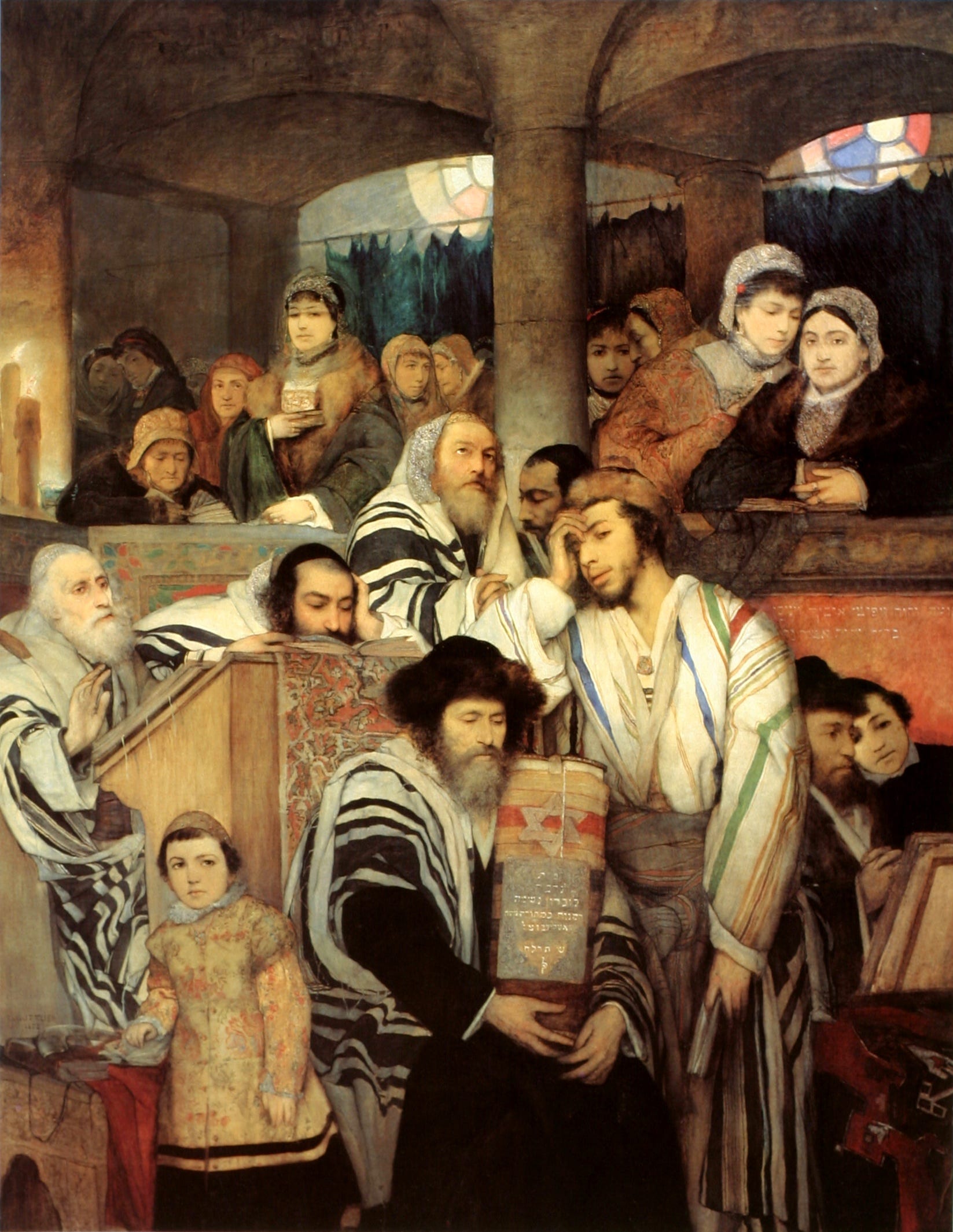
Earlier this week, Jews worldwide observed a period of reflection and atonement known as the “Days of Awe,” culminating with Yom Kippur, the holiest day in the Jewish calendar. In the spirit of this special time, this essay serves as a call to reflection about the meaning of Jewishness, for Jews and non-Jews alike. This essay is also a call to atonement for our complicity in the weaponisation of identity labels.
In “Jewishness After Spinoza” I recalled a lyrical meditation on Yom Kippur that I had read more than thirty years ago. I still remember the essay in part because it registered as a warning about missed opportunities. “A road not taken vanishes into oblivion. A voice not heard lapses into silence.” In the same opening passage, the essay touched on Neilah, the most sacred prayer service in Judaism. Recited as the sun sets, Neilah marks the end of Yom Kippur, a “locking of the gate,” and the expiration of an opportunity. Now inscribed and sealed in the book of life, the fasting congregants nurture the sparks of meaning and new enthusiasms ignited by the observances of the day. As they rush home for the long-awaited meal, the congregants are often pained by the knowledge that the flame of new enthusiasms will start to fade, possibly even before their blood sugar levels return to normal.
Another reason I still remember this essay decades later is that it expressed a vision that never leaves us and a desire we can’t repress: “In the lengthening shadows of the Neilah twilight, we see our lives as they were meant to be...We pray: may some memory of this uncommon day, stamped upon our souls, leave us changed forever.”
Now, here’s the opening prayer for this essay: “May the paragraphs below reach readers ready to receive this message as it is intended: a call for a permanent change in our view of the ‘Measurable Jew’ and the institutions possessed by this fantasy.”
Introduction to the IHRA-WDA
The International Holocaust Remembrance Alliance Working Definition of Antisemitism (IHRA-WDA) raises many questions without answering the one question it claims to take seriously: What is antisemitism? Despite this broken promise, forty-six countries have formally adopted the IHRA-WDA. Given this paradoxical outcome, consider these questions:
What is the problem to which the IHRA-WDA offers a potentially fruitful response? What observation, research finding, or inspired insight pointed to the need for a new definition of a word coined only recently in the long history of Jew hatred?
Do IHRA-WDA signatories realise that the IHRA-WDA is not a definition at all? Rather, the signatories are participants in a work of art. We do not yet have adequate categories for such creations, but the IHRA-WDA would rank as a masterpiece across categories.
Definitions typically reveal meaning, but the IHRA-WDA does something altogether different, if not the exact opposite: it confuses people by presenting an incoherent message through an apparently respectable source. For this reason, it’s worthy of far more attention than it has received. Critics have challenged the IHRA’s definition of antisemitism (WDA) as an assault on free speech, but they have also missed the bigger issue: The problem isn’t that the definition restricts free speech with the sheer force of incoherence, but that it cannot do anything else. The definition isn’t a failure in lexicography—it’s a success in weaponised confusion. It appears to be working exactly as intended because it leaves most people speechless.
The WDA is incoherent because it does not need coherence, not when it has resonance, not in an attention economy shaped by ubiquitous perverse incentives that silence vital truth. Under these conditions, the IHRA has no reason to acknowledge what might normally pose a problem for the WDA: the project completely ignores the uncontroverted hypothesis that no one has yet formulated an internally consistent answer to the question: What is a Jew? Because of this problem, the IHRA-WDA will remain incoherent regardless of how many countries join the circus of performative lexicography.
As a performance, the IHRA-WDA warrants even greater attention than it has received. It serves us well to understand the full character and purpose of this project. However, as an actual definition, the IHRA-WDA is unworthy of any attention at all. It is not propositionally wrong; it’s wrong in principle and in spirit. It’s unconcerned about its correspondence to reality. It is the highest-grade of bullshit ever achieved by the propagandistic imagination. Nonetheless, the IHRA definition is gaining influence and authority. It is the fulfilment of a propagandist’s dream.
Protecting a Fantasy
Why define a misnomer? The hatred of Jews is a reality, and in our individual and collective responses to this reality, why not begin by first doing no harm? It’s harmful to distract people from this reality by describing it with a misnomer. One of the problems with the IHRA-WDA is that the campaign is pretending to define the wrong word. It would be more helpful to revisit the definition of “hatred” or “Jew.”
Why is “antisemitism” a misnomer? Because we are not speaking about opposition to “semitism.” We should at least recognise “antisemitism” as a poorly constructed word, a map that inescapably misrepresents the territory. The reality to which the word purportedly refers involves the hatred of Jews, not “semites.” This hatred is sustained in part by the assumption that it knows what a Jew is.
Below, I’ll present the “terrifying hypothesis” that this assumption is not only wrong, but also that it cannot be right. No definition of antisemitism can be deemed even structurally adequate unless it incorporates a clear view of the gap between the reality of Jewishness and its measures.
I highlighted this gap in “Jewishness after Spinoza” where I wrote about a denialist ideology that not only militates against the free exploration of the meanings of Jewishness, but also fosters broad acceptance of false answers. These answers don’t just come from rabbis, or rabbinic councils and courts, that espouse a canonical view of Jewishness. Some BGs are conspiracists characterised either by Judeophobia (negative views of Jews) or Judeophilia (positive views of Jews). Whether the purveyors of false answers espouse canonical or conspiratorial views, they use and perpetuate the fantasy of the measurable Jew.
In “Jewishness After Spinoza,” I also turned to the Theologico-Political Treatise to draw a character sketch of “the vilest hypocrites…sheltering under the cloak of religion,” posing a “danger to piety and public peace.” This essay is not a full-blown case study of “sanctified bullshit” mass-produced by these false authorities. Rather, I think of it as an open letter to the consumers of this hallucinogen. More precisely, it’s a letter to consumers who are ready to start their journey to recovery.
In this letter, I’ll examine specific false answers chasing the fantasy of the measurable Jew:
First, I’ll use the ancient allegory of an elephant molested by Blind Gropers (BGs) to introduce a prism through which we can examine the problem with essentialist conceptions of Jewishness.
Second, I’ll introduce not only a terrifying hypothesis—that nobody knows the measure of Jewishness—but also a perspective from which we can fruitfully contemplate such unnerving possibilities.
Third, I’ll highlight obvious confirmations of the terrifying hypothesis and the predicament of Jews who refuse to be measured.
Fourth, I’ll offer two non-essentialist responses to the question “What is a Jew?”
Fifth, I’ll return to the two questions raised at the start: What is the problem to which the IHRA-WDA offers a potentially fruitful response? And, do IHRA-WDA signatories realise that what they signed is not a definition at all?
Molested by Metaphors
Imagine yourself as the elephant in the ancient allegory with blind men groping your body parts. They interpret your trunk as a snake, your tail as a rope, your leg as a tree, and your tusks as spears. Because they can’t see you, they can’t know you, and they can’t help but reduce you to something they know, something they can use.
Now imagine these BGs as stand-ins for all the voices of authority attaching identity labels to you and telling you how to interpret and apply these labels in daily life. They tell you what it means to be a person and a member of a tribe. They define your nationality, ethnicity, gender, class, sexuality, religion, civil status, and political orientation.
Some people seem strangely at peace with this organised identitarian molestation. They effortlessly sort BGs into the ones they like and dislike, trust and distrust, the ones who attach identity labels peremptorily, and the ones who appear to care about the label-carriers’ informed consent. Either way, the label-carriers use their preferred labels to satisfy their need for coherence and connection. In the words often attributed to G.K. Chesterton: “It isn’t that they don’t see the solution. It’s that they don’t see the problem.”
In contrast to the oblivious label-carriers, there are people who recognise themselves as characters in this story—not only the elephant, but also the BGs. They understand that, unlike the BGs in the parable, flesh-and-blood label-makers for our group affiliations operate as self-interested economic agents. The economic systems they inhabit do not offer adequate incentives to exercise epistemic humility, or to disclose conflicts of interest. As a result, our identity labels often distort our lived reality.
Label-makers may all claim to serve our best interests, with our informed consent. They may swear to first do no harm. However, culture rewards them for groping and guessing. It provides much weaker incentives to study, mitigate and disclose the harm they cause when they deny the limits of their knowledge and insight. This imbalance enables the label-making blind gropers to conceal their loss of integrity behind the fig leaf of institutional respectability.
There are BGs who specialise in labelling Jews as Jews and curating the inclusion-exclusion criteria for the assignment of this identity label. While the canonical and conspiratorial views of Jewishness are often seen in contrast to each other, they share a belief in the measurable Jew whose identity can be demarcated based on objective criteria. Indeed, the canonists and conspiracists appear to have conspired. Although I have no evidence of an actual conspiracy, the appearance of an alignment of interests is unmistakable. Both camps speak about essential Jewishness as confidently as the BGs in the ancient parable speak about the elephant as a snake, a rope, a tree, or a spear.
Just like the allegorical BGs, the arbiters of Jewishness continue to locate an elusive essence in the vicinity of religion, genetics, race, ethnicity, belief or other measures. Yet, the measurable Jew continues to evade them. Their predicament is well captured in John Godfrey Saxe’s 1872 poetic retelling of the ancient parable about the gang-molested Elephant:
So oft in theologic wars The disputants, I ween Tread on in utter ignorance Of what each other mean And prate about an Elephant Not one of them has seen!
A Terrifying Hypothesis: Warning and Shift of Perspective
Based on the history of failures to establish a sustainable theory of essential Jewishness, this essay raises a question, highlights a pattern in the dominant answers, and points to an alternative view of the problem. The question is “What is a Jew?” The pattern in the dominant answers is that they collapse under the weight of internal contradictions. For the alternative view, we must distance ourselves from the din of answers competing for epistemic supremacy.
Distance from the noise of the marketplace of inadequate ideas provides a vital vantage point from which we may examine questions that easily inflame tribalist passions. Without this perspective, any message will dissolve into the noisy medium that twists all perception. Unless we distance ourselves from the heat of identitarian pseudo-antagonisms, we’ll hear neither the question nor the response.
Away from the noise, we may discover a perspective that Baruch Spinoza called sub specie aeternitatis (SSA). For readers drawn to poetry, we may translate this phrase as “Under the Form of Eternity.” For readers who value the cold precision of Spinoza’s thought, the better translation is “From the Perspective of Eternity.” From this elusive vantage point, away from the petty urgencies of daily life and the clamour of our tribalist commitments, we may form what Spinoza calls “adequate ideas.” By this, he means ideas imbued with an ontological rationality that harmonises our thought and action with the perfect order of the cosmos.
Of course, this sounds ambitious, perhaps even impossible. Spinoza assumes that mere humans can transcend the power of tribal affinity and superstition, the limits of language and rationality. If Spinoza’s SSA is the path to his vision of a Homo Liber (free person), some people may prefer alternatives that don’t require them to harmonise with perfection. Spinoza seems to anticipate this possibility in the last sentence of his Ethics. Instead of delivering a sales pitch for SSA, he concludes: “But all things excellent are as difficult as they are rare.”
People drawn to SSA as a horizon of possibility are a rarity among Jews and non-Jews alike, but they exist. When they examine the fantasy of the measurable Jew, they feel less of a need to deny the pattern of self-contradiction. Even when they notice the pattern in their own tribe’s favoured theory of essential Jewishness, they recognize that something doesn’t add up. These theories often contradict themselves, spiral into delusion, or cynically monetise and weaponise their knowledge claims.
This pattern doesn’t mean that these claims are worthless. The problem is that they’re not worth much, while their evangelists insist that they represent the settled truth. Through this insistence, the evangelists cling to relevance beyond merit; they maintain legitimacy despite bad faith.
This pattern continues for many reasons, including the fear of the alternative view, which begins with a terrifying hypothesis: Nobody knows the answer. Nobody knows the essence of Jewishness. Hence, the value of SSA: it dissolves the terror that grips the human mind at the thought of saying “I don’t know.” Whether people internalise or externalise this terror, the consequences can be catastrophic.
The terrifying hypothesis doesn’t just humble mere mortals confronting the limits of their knowledge. It also examines the possibility that highly regarded authorities don’t have the answer either. And the hypothesis doesn’t shy away from the most terrifying possibility—that not all these authorities are genuinely ignorant of their ignorance, that some are engaging in epistemic power grabs, whether subconsciously or cynically.
Obvious Confirmations
The most natural reaction to the terrifying hypothesis is to look away and return to the menu of prefabricated answers. These default answers offer a more comforting view of the problem, an illusion of clarity, and a palatable trade-off: they claim to honour the human need for epistemic coherence and tribal connection; in return, they ask us to overlook their internal contradictions and destructive delusions.
For many people, this deal works well enough, but others can’t unsee the gaps and cracks that separate promoted stories from lived reality and logical necessity. If the terrifying hypothesis is that no one knows the meaning of Jewishness, we can reach confirmations and disconfirmations by examining specific knowledge claims about the Jewish essence. For each claim, we can highlight at least one indication that, if there is an essence, it must be something else.
The dominant claims reveal more about what this essence isn’t than about what it is. After examining these claims, we can’t help but consider the possibility that Jewishness is neither a religion, nor a genetic condition, nor an ethnicity, nor a culture, nor a bizarre belief. Jewishness is something else.
Claim #1: Jewishness is a religion.
According to this claim, a Jew is a person obligated to observe the 613 Torah laws. By conflating Jewishness with Judaism, this answer stumbles over the reality of secular Jews who neither observe Torah laws, nor consider themselves obligated. All major denominations of Judaism formally treat secular Jews as Jews. Non-observance and non-belief do not strip them of their Jewish “essence.” The typical response to this apparent contradiction is that secular Jews may not consider themselves obligated to observe the law, but the law considers them obligated. This response leads to another contradiction: On what basis does Judaic law include secular Jews in its purview or jurisdiction? Whatever the basis for this inclusion, it’s not religion—it’s something else.
Claim #2: Jewishness is a genetic condition.
The same ideology that conflates Jewishness with Judaism also defines Jewishness as a genetic condition transmitted matrilineally. In other words, a Jew is a person born to a Jewish mother. However, matrilineal descent only became the standard around the first-to-second centuries CE. The entire biblical period followed a patrilineal system. Both before and after the shift from the paternal to the maternal line, the same Judaism that enshrined these standards also allowed conversions into the religion. Across the denominations of Judaism today, there may be vast differences in the standards applied to religious conversions, but no denomination prohibits conversions. But if Jewishness is a genetic condition, how is it also transmissible through belief and affiliation conversion? Whatever the basis for the transmissibility of Jewishness through conversion, it’s not genetic. It’s something else.
Claim #3: Jewishness is an ethnicity.
Even though world Jewry includes many phenotypes, Jews are widely regarded as a singular people and an ethnicity. However, Jews do not look like members of the same ethnicity. They look more like the people in their communities across the diaspora. What also undercuts the idea of Jewishness as an ethnicity are conversion laws. The only way to become a Jew is to convert to Judaism, a religion. In fact, the state of Israel strongly favours orthodox conversions. But there’s no way to convert to mere Jewishness. So, whatever the basis for Jewish peoplehood, it’s not the phenotype; it’s something else.
Claim #4: Jewishness is a belief in the resurrection of the dead.
Maimonides, the medieval Torah sage still revered across the denominations of modern Judaism, defined Jews as people who believe in thirteen principles “with perfect faith.” The thirteenth principle on this list is the belief in the resurrection of the dead at the end of time. It wouldn’t be the most charitable interpretation of this principle to conclude that Maimonides sought to establish delusional thinking as a defining characteristic of a Jew. But if we accepted this measure of Jewishness, we would need to drastically adjust the current estimates of the worldwide Jewish population. If Jewishness could be defined as a belief in anything, it wouldn’t be the resurrection of the dead. It would be something else.
Claim #5: Jewishness is Zionism.
Since 7 October 2023, the conflation of Jewishness with Zionism increasingly fuels the animus of anti-Jewish conspiracists and the internecine antagonisms among Jewish canonists. This ideological fuel works differently in these two camps.
For conspiracists, this conflation yields an abundance of talking points. It allows them to highlight the ubiquity and tragic consequences of denialist pro-Israel propaganda. These highlights serve as a justification for the conspiracists’ ideological presuppositions. Usually, it doesn’t help to point out to an anti-Jewish conspiracist that anti-Zionist Jews continue to expose and explain what Israel seeks to deny. The argument falls flat. In the conspiracist’s view, this is how Jews play both sides of the issue. So, the claim that Jewishness is Zionism aligns with the agenda.
For canonists, the conflation of Jewishness with Zionism may not even belong on this list of false claims about the essence of Jewishness. Zionist and non-Zionist Jews don’t necessarily consider each other non-Jews. The antagonisms that divide them do not require adjustments to Jewish population estimates. However, the zionisation of Jewish identity does point to a specific measure of Jewishness: connection to the Holy Land.
For both camps, the problem with this measure is that the very existence of non-Zionist and anti-Zionist Jews, including the secular and the religious, suggests that if Jewishness is a connection to anything, it’s not to the conflation of the Holy Land with the state of Israel. It’s a connection to something else.
The Meta-Claim: There’s something about Jews.
When specific measures of Jewishness are revealed as self-invalidating, the belief in stable essences and defining traits typically remains unshaken. Both canonists and conspiracists need Jews as characters to fit the shape of pre-written stories. So, they twist themselves into pretzels to explain away gaps between theory and reality. In the meantime, they continue to tinker with measures of Jewishness. In addition to religion, genes, ethnicity and belief, these measures may include aspects of culture, language, mythology, land, power, intelligence, etc.
When we accept these measures as starting points for dialogue, we may uncover and examine the kernels of truth they may contain. However, when we enshrine any of these measures as dogma, dialogue ends, and catechisms and purity tests begin. Sanctified bullshit floods the world. Ordinary Jews become characters in the fantasy with blind authorities desperately clinging to relevance and legitimacy. The central question—What is a Jew?—gets swept under the rug of wilful ignorance.
As a result, the search for the measurable Jew continues because it satisfies canonists and conspiracists alike. Canonists need to encourage broad compliance with the established inclusion-exclusion criteria. Conspiracists need to know whom to execrate or pedestalise. Both camps assume that they’re working on a solvable problem within a closed system, a question that lends itself to a straightforward answer.
These two epistemic camps both need the measurable Jew, and neither camp knows what to do with Jews who refuse to be measured. I call them “Jews among Jews.” In both camps, the acceptance of such Jews risks exposing cracks in established narratives. Canonists tend to excommunicate such Jews. Conspiracists tend to insist on their measurability. Both camps should be forgiven, for they know not what they do. They are blind.
Technically, there’s nothing wrong with saying that there’s something about Jews. However, canonists and conspiracists never seem to reach the second essential realisation in this line of thought: whatever one thinks the something is, it’s something else.
Better Metaphors
This examination of knowledge claims about the essence of Jewishness appears to confirm the “terrifying hypothesis.” Canonical and conspiratorial definitions of Jewishness generally conform to the pattern of internal contradiction. Their greatest sin, however, is not in their contradictions. It’s in their convictions—not in the definitions they promote, but in the way they promote these definitions – i.e., based largely on arguments from authority, with the expectation of compliance despite the lack of coherence. Tolerance of this sin places people on a slippery slope to a condition that the Romanian philosopher Emil Cioran described in A Short History of Decay. In a chapter titled “The Genealogy of Fanaticism,” Cioran writes:
A man who loves a god unduly forces other men to love his god, eager to exterminate them if they refuse. There is no form of intolerance, of proselytism or ideological intransigence which fails to reveal the bestial substratum of enthusiasm. Once man loses his faculty of indifference, he becomes a potential murderer; once he transforms his idea into a god, the consequences are incalculable.
Whether an undue love elevates a god or a definition, it sets the stage for a collapse into fanaticism, and it usually doesn’t help to turn to hortatory preaching aimed at the fanatics. There’s more value in simply practising what we preach. If we genuinely aspire to a sober view of the contradictions woven into our identity labels, we should examine them not only from the perspective of eternity, but also through a forensic lens: until definitions demonstrate their potential to be put to good use, we should regard them with a commensurate dose of scepticism.
From the perspective of eternity, the search for better definitions imperceptibly shifts to better metaphors, better stories. These stories should matter to anyone who wants to live in a symbolic order harmonised with lived reality. As Spinoza wrote in Ethics, Part V, Proposition 31 (E5P31): “Our mind, in so far as it knows itself and the body under the form of Eternity, has to that extent necessarily a knowledge of God, and knows that it is in God, and is conceived through God.” For Spinoza, “God” is synonymous with Nature (Deus sive natura), and continued acquiescence to the tyranny of false answers seems downright unnatural.
The Four-Question Technique
For me, “What is a Jew?” isn’t just a question in itself; it’s also implied in one of the four questions we can use anytime we find that our metaphors have grown stale, when we’re looking for metaphors that better reflect the highest potential and the trickiest pitfalls in our present moment. The four questions are: What’s the story? What’s the problem? What are you hearing? What do you exclude?
In these four questions, “Jew” is often the answer to the fourth question. From the vantage point of dominant diasporic cultures, a Jew is a symbol and metonym for the excluded “other.” What happens when the answer becomes the question? What do we begin to see in our quest for awareness of the excluded, the unseen, the unacknowledged? How might the four-question technique yield an affirmative answer to the question at the heart of this essay: What is a Jew?
Q1: What’s the story?
A Jew is an adherent of a literary tradition, an explorer of a web of stories in search of blessedness. In one of these stories, Jews stood on Mount Sinai and heard the word of the living God. Since then, they have carried an ancestral wisdom whose origin reaches even further back into pre-history. This wisdom allows Jews to stand in the flame of revelation and not be incinerated. It empowers them to prevail over Pharaoh’s armies and survive catastrophes. With their ancestral wisdom, they build tabernacles in the wilderness and arks to protect them during world-engulfing floods. They also part seas on their way to lands flowing with milk and honey.
Q2: What’s the problem?
The problem is that, both as matter and metaphor, these lands are a fraught terrain in the gap between story and reality. In this gap, people easily lose balance and turn to ideological certainty traps to find shelter from subtlety and complexity. The resulting perplexity typically finds expression in cultic habits of mind and theocratic sensibilities. Without balance, something is lost in the conversion of metaphor into matter; “milk and honey” somehow gets translated as hatred and violence. Despite the significant aid of ancestral wisdom, Jews and non-Jews alike continually screw up the subtle alchemy whereby Word becomes Flesh. They screw up to the extent that they forget what the ancient Israelites once heard on Mount Sinai. So, they’ve learned to remind themselves: Hear O Israel!
Q3: What are you hearing?
For millennia, Jews have been asking themselves and each other about what they hear in the lands they inhabit. Lately, they’ve been hearing that ours is an age of severances, fragmentations, divisions, polarisations, alienations and excommunications held in a fearsome harmony by mutual animosity and incomprehension. Since 7 October 2023, Jews have been living through a painful rift formed by warring impulses and incongruous survival strategies. These include:
Self-defeating pacifism vs. fascist militancy.
Denialism vs. Post-denialism.
Zionism vs. Anti-Zionism.
Theism vs. Atheism.
Tragically, these warring passions have consumed the Jewish psyche so much that they’ve damaged the discriminating faculty that would normally help Jews spot the pattern of falsehood in these oppositions. If this faculty were intact, Jews and non-Jews would immediately recognise the pattern: All these traps are constructed around our shared ignorance of the essence of Jewishness.
The path beyond this predicament requires us to ask again and hear again: What is a Jew? This path also requires us to reject responses that do not rise to the occasion, usually because they haven’t considered the full weight of the question. When a response does rise to the occasion, it immediately sheds light not only on the meaning of Jewishness, but also the meaning of becoming fully human.
Q4: What do you exclude?
Jewishness, as I understand it, is transmitted neither patrilineally nor matrilineally, because Jewishness is only trivially a genetic condition, if at all. By this, I mean that Jewishness is transmitted through memes more reliably than it is transmitted through genes. For this reason, Jewishness can also be described as a hard-wired preference.
In any other context, the “Jew” can serve as a metonym for otherness, but here the four-question technique folds in on itself. The question is no longer “What is a Jew?” It’s what is a Jew among Jews? And the simplest response is that a Jew among Jews is characterised by the refusal of measurement and a preference for metaphor over matter.
Jewishness as a Preference
There is a well-known Soviet-era joke: Two Jews are having a conversation while sitting on toilets in stalls next to each other. One guy asks the other: “Do you think what we’re doing is physical or intellectual labour?” The other guy answers: “Of course it’s intellectual labour. If it were physical, we’d leave it to gentiles.”
This joke inspired a hypothesis about the meaning of Jewishness: Jews are people who have learned to maintain their balance at the intersection of matter and metaphor in part by favouring the latter over the former. Most canonists and conspiracists may not share this belief, because they believe in Jewishness as a binary state demarcated by verifiable characteristics. Consensus about the meaning of Jewishness seems ever unlikely, but we should at least favour good-faith theories of Jewishness harmonised with reality. The alternative is epistemic power grabs, assertions repeated without evidence.
Assertions about criteria of Jewishness serve as a mere case study in the firestorm of identitarian conflict in which every identity label is weaponised, monetised, or both. In the same way this essay problematises knowledge claims about the meaning of Jewishness, we can problematise prevailing measures of a Christian, a Muslim or an American.
Indeed, all these identity labels often function as instruments of war, and we are living through a ringing fulfilment of the war propagandist’s wildest dream. It’s a noisy, thought-scrambling environment in which clinging to the illusion of our common knowledge is preferred to recognising the vast reach of our shared ignorance. In this environment, we no longer need to use physical weapons to kill each other. In fact, in most of the killing we observe, the weapon of choice is a sharp blade formed with abstract symbols (e.g., words, numbers) in the furnace of misguided desire. This blade is sharpened by the limits of language.
Beyond these limits, most people don’t immediately turn to violence or start enriching uranium. Many Jews, for example, prefer to mix metaphors. We prefer to create and destroy with words. This preference is not a defining characteristic of Jewishness, but there’s something unmistakably Jewish about it, and it serves as a vital resource during our transition from bio-politics, which centres on our physicality, to psycho-politics, in which warring factions seek to colonise the mind.
L.M. Sacasas, the publisher of a brilliant media ecology blog called The Convivial Society, may not be Jewish, but he understands this war. He has written extensively about ways to “resist the enclosure of the human psyche,” i.e., the capture of our senses and nervous systems by techno-economic processes we struggle to describe. As Sacasas explains:
The enclosure of the commons is the name given to the centuries-long process by which lands available to the many were turned into a resource to be managed and extracted by the few. My claim is that structurally similar processes are unfolding with the aim of enclosing the human psyche and transforming it into a resource to be managed and extracted.
Fittingly, Sacasas has also drawn on the ideas of Marshall McLuhan: “Once we have surrendered our senses and nervous systems to the private manipulation of those who would try to benefit from taking a lease on our eyes and ears and nerves, we don’t really have any rights left.”
Defining Definitions
Resistance to the enclosure of the human psyche requires a highly cultivated discernment about the uses and abuses of definitions—not only the purported message of any definition, but also definitions as a medium, a path to understanding. There’s a time to define terms and a time to recognise a call for definitions as a distraction. In a recent lecture, Rabbi Shaul Magid points to possibilities that may emerge after we get over the obsession with defining antisemitism:
What are definitions for? Why the need for a definition of antisemitism now? Defining something creates parameters, boundaries and is, in some cases, an exercise of control. In these cases, definitions are used to create parameters of truth. As Foucault argued in his essay “Truth and Power”: “Truth is never independent of the power it seeks to yield.” One can say the same thing about definitions.
One can say the same thing about all descriptions, names, categories and other language-based instruments of influence in the age of psycho-politics. The power yielded by the IHRA-WDA accrues largely to the forces that seek to suppress free speech critical of the state of Israel. Refinements of the IHRA-WDA will likely exacerbate this perverse effect. Instead of refinements, a more fruitful response to the IHRA would expose the organisation as a purveyor of propaganda in support of a denialist ideology. Another fruitful response is to raise the often-overlooked fundamental questions: Why does hatred need a name or definition? Who benefits from this performative quest for clarity?
Whether they attempt to define Jewishness or antisemitism, canonists and conspiracists possessed by reductionist habits of mind continue to cling to the fantasy of the measurable Jew. To break the spell of this fantasy, we don’t need to persuade the possessed. Instead, we need to end our complicity. This complicity takes many forms largely motivated by the fear of being called an antisemite or a self-hating Jew. Now that the definition of antisemitism is spiralling into absurdity, the fear of being falsely accused seems increasingly warranted. The IHRA-WDA succeeds mainly as a mechanism of justification for these false accusations. It’s a work of amoral genius. Kudos to the IHRA!
However, for people unincinerated by the fear of false accusations, we may return to first of two questions raised at the start of this essay: What is the problem to which the IHRA offers a potentially fruitful response? The reality is that the IHRA is a response to a problem, but not the problem it claims to address. The historian Arthur Hertzberg once allegedly said, “The only thing more dangerous to Jews than antisemitism, is no antisemitism.”
To organizations like the IHRA prefer to focus on the greater danger. With this orientation, increases in antisemitism do not necessarily represent a problem, but rather a guarantee of Jewish continuity, albeit as a hated “other.” If antisemitism disappeared, these organizations would have to recreate it by defining it into existence. This is modern propaganda’s version of “Abracadabra,” a bit of magic meant to subordinate our lived reality to someone else’s wishes and dreams. For this reason, the IHRA is part of the problem, but thanks to the magic of modern PR, it is presented as the total solution—not a response, but the answer.
The commercial success of this non-definition is ironic because non-propagandistic definitions of antisemitism are easy to find or even write. To find such a definition, ask your favourite Large Language Model about “The Jerusalem Declaration.” This alternative to the IHRA defines antisemitism as: “…discrimination, prejudice, hostility or violence against Jews as Jews (or Jewish institutions as Jewish).” Paraphrasing the psychoanalyst Donald Winnicott, we can accept this as a good-enough definition.
When I challenged myself to write my own definition, this is what came out: “Antisemitism is a misnomer for non-metaphorically violent responses to the nonviolent use of Jewish metaphors.” Under this definition, antisemitism isn’t wrong because it’s critical or even hateful of any aspect of Jewishness. It’s wrong because it creates ideological preconditions for violence. The Jewish literary tradition doesn’t need special protections from criticism, but the criticism spills over into “antisemitism” when it produces non-metaphoric responses to metaphors.
Whether we find or write an alternative definition, we must not miss the larger point: there’s little value in quibbling over the merits and pitfalls of any definition without questioning the sudden clamour for definitions. There’s no need for alternative definitions of antisemitism, no need to challenge or refine the IHRA’s pseudo-contribution to lexicography. Instead, let’s begin with the recognition of “antisemitism” as a misnomer for the hatred of Jews. As all misleading names, the term distorts the reality it claims to demarcate. Misnomers don’t need to be defined; they need to be disused. Otherwise, they may continue to be monetised and weaponised by individuals and institutions least worthy of wealth and power.
This brings us to the second question raised at the start: Do IHRA-WDA signatories realise that what they signed is not a definition at all? Here, it’s important to distinguish the signatories from the people they claim to represent. Even if the people recognise the IHRA-WDA as a non-definition, their institutional leaders appear spellbound by this project’s self-legitimating narrative. It doesn’t matter what these leaders realise; it matters what they do.
These and These
Instead of calling on anyone to do anything, I’ll conclude by drawing on the ideas of three beautiful minds. Only two of them were Jewish, but I think they would all understand the predicament of people who recognise the IHRA-WDA’s success as a loss of something they value, a loss that poses an unmistakable threat to “piety and public peace.” When they confront this loss, people tend to assert their rights, but they should instead examine their needs. This realisation was sparked by Ivan Illich’s Toward a History of Needs (1978), further fuelled by Simone Weil’s The Need for Roots (1949) and Sigmund Freud’s Civilisation and Its Discontents (1930).
In her introduction to the fourteen needs of the soul, Weil argues that the tendency to assert rights without examining obligations produces an incomplete theory of needs “largely responsible for the present political and social confusion.” Once the fog of this confusion clears, it becomes self-evident that life under propaganda violates “the first of the soul’s needs.” Weil writes:
The first of the soul’s needs, the one which touches most nearly its eternal destiny, is order; that is to say, a texture of social relationships such that no one is compelled to violate imperative obligations in order to carry out other ones. It is only when this, in fact, occurs that external circumstances have any power to inflict spiritual violence on the soul.
Under propaganda, the violation of the human need for order isn’t a bug, but a feature of the techno-economic systems we co-create and inhabit. The self-appointed curators of our identity labels do not care that these labels become Procrustean beds. They know that this systemic and systematic assault on epistemic health creates a public unwittingly attuned to the propagandist’s wish and dream. The creation of this public is the purpose of the system in which the IHRA stands out as a stellar performer, truly a light unto all propagandists.
People in search of ways to survive or escape these systems may find value in Ivan Illich’s idea of a “world-wide choice” forced upon us not only by the standardisation of human responses to everyday occurrences, but also by the displacement of all our gods and languages by the “megamachine.” The megamachine ceaselessly fuels our expectations while draining our competence and concern for others.
Endowed with a consciousness that originated in oral cultures, we’ve learned to numb ourselves to the pain of daily exposure to “programmed texts” that pervert the words of spoken language into the “building blocks of packaged messages.” Whether we acknowledge or deny this tragedy, we generally acquiesce to the standardisation of human thought and action and to the creation of measurable citizens.
We choose this self-destructive path, but not because we wish to be destroyed. We choose slavery because our culture celebrates it as salvation. Unless we learn to see through this spectacle, we inevitably fight savage battles for our share of “the people’s opium.” We can’t help but feed the habit, whether the habit is addiction or envy. So, we usually choose the “obvious marked exit” with the automaticity of an addict reaching for his next fix. No wonder we find ourselves trapped in the megamachine. That’s the predictable consequence of following the self-destructive scripts of our culture.
For people desperately seeking escape or survival strategies, Sigmund Freud was right: “Every man must find out for himself in what particular fashion he can be saved.” As we recognise the necessity of personal reckoning, we may find value in the teaching of the Babylonian Talmud (Eruvin 13b) where God ended an argument between Hillel and Shammai (שַׁמַּאי) by declaring: “These and these are the words of the living God.”
We can embrace the pluralistic spirit of this statement, but we must make an exception for propaganda. Whether its words side with Shammai or Hillel, whether it claims to fight antisemitism or restore justice, all we can expect from it is more sanctified bullshit.