


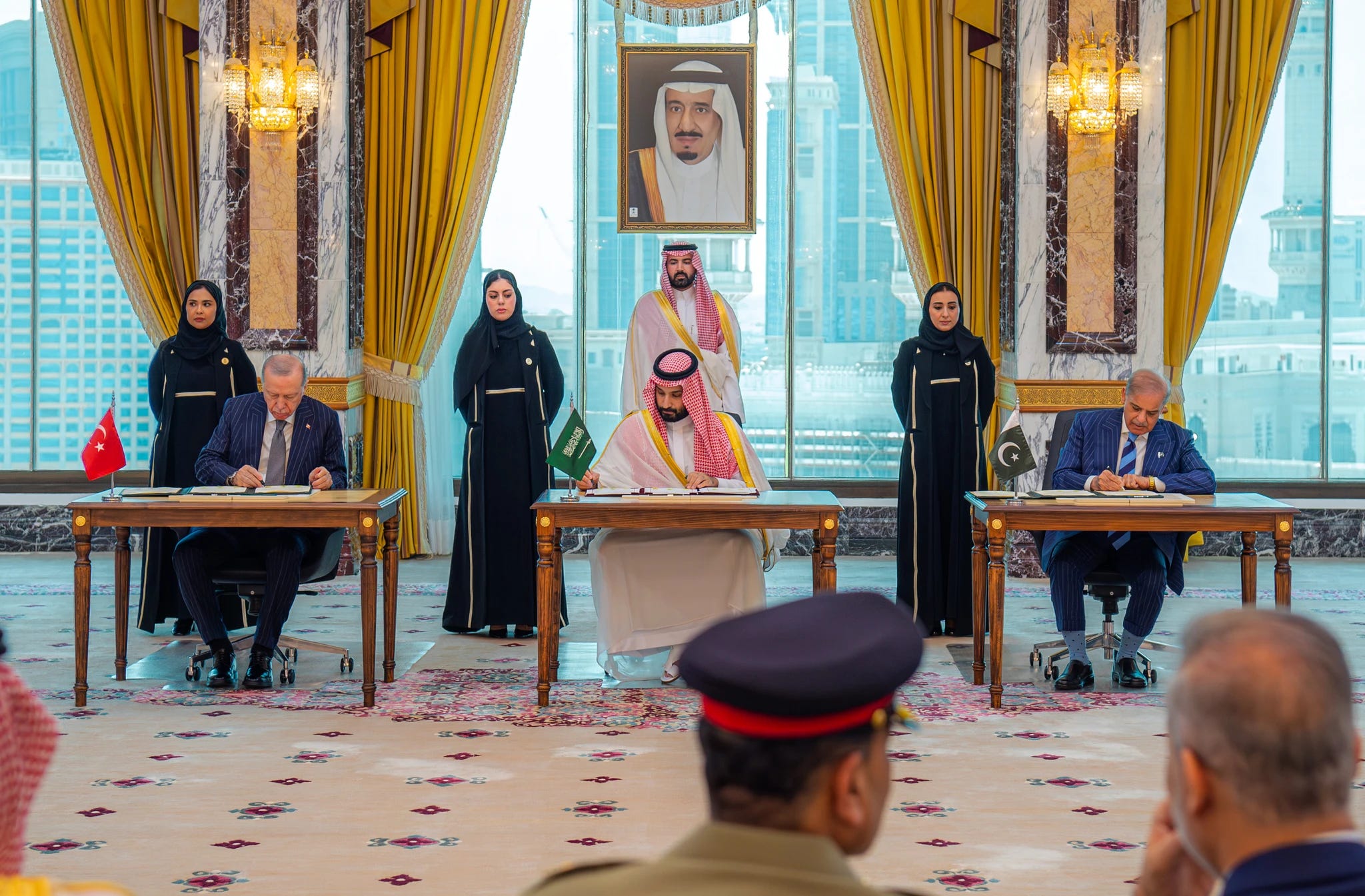
Three leaders, three flags, one city. In the holy precincts of Mecca, Crown Prince Mohammed bin Salman, President Recep Tayyip Erdoğan, and Prime Minister Shehbaz Sharif put ink to paper on what they call a “shield of peace.” The Mecca Joint Defence Agreement, signed on 7 August 2026, declares that an armed attack on any one nation shall be regarded as an attack on all three.
The world has rushed to call it an “Islamic NATO.” That is a category error of epic proportions—and a dangerously misleading one.
This pact is not NATO. It has no integrated command structure, no unified headquarters, no pre-positioned forces, no shared early-warning architecture, no common rules of engagement. NATO is a machine of war, forged over decades, tested in blood. The Mecca Pact is something far more elemental, far more fragile, and far more unsettling: it is a high-stakes cartel of survival, three anxious powers pooling their existential fears in the hope that the sum of their anxieties might exceed the threats arrayed against them.
Saudi Arabia brings the money—and the terror. For years, the Kingdom has watched drones and missiles rain down on its cities and its Aramco infrastructure, the crown jewels of Vision 2030. The American umbrella, once the bedrock of Saudi survival, has developed holes. Washington is bogged down, distracted, and increasingly vocal about burden-shifting.
Riyadh is not abandoning the United States; it is buying parallel insurance. But insurance only works if the premiums are paid in credible commitments—and here, the fine print is alarmingly vague.
Pakistan brings the manpower—and the ghost in the machine. Islamabad is the only Muslim-majority nation with nuclear weapons. Pakistani officials have been at pains to insist that the nuclear arsenal is “not on the radar” for this pact. That is precisely the point. The denial is the deterrence. By refusing to confirm or deny what role the nuclear shadow might play, Pakistan injects a poison of uncertainty into every adversary’s strategic calculus.
But Pakistan is also the most fragile leg of this tripod—economically crippled, politically fractured, and staring down an Indian tiger on its eastern border. If the Mecca Pact ever demands Pakistani blood in the Gulf, Islamabad will face an impossible choice: defend Riyadh or defend itself.
Türkiye brings the technology—and the audacity. Ankara boasts NATO’s second-largest standing army and a defence-industrial base that has turned it into a global drone powerhouse. President Erdoğan is not merely joining an alliance; he is weaponising NATO’s credibility for a project entirely outside the Alliance’s framework. Turkish Foreign Minister Hakan Fidan has insisted the pact is “technically the same as Article 5 of the NATO Treaty.” That is a remarkable claim—and a terrifying one.
If Turkish forces are attacked while operating under the Mecca Pact, does NATO’s Article V trigger? Erdoğan is running a protection racket on the Alliance itself, demanding NATO’s collective defence for wars Ankara chooses to fight on its own terms.
The most striking feature of the Mecca Pact is what it does not say. The full text remains undisclosed. The trigger mechanisms remain unspecified. There is no common threat named in writing. As Fidan himself conceded, “There is no common threat that we have put in writing.”
This is not weakness. This is the architecture of ambiguity by design. Strategic indeterminacy is the pact’s primary weapon. By refusing to define what constitutes an “armed attack,” the three signatories force every potential adversary—Iran, the Houthis, Iraqi militias, even Israel—to assume the worst. A drone strike on Riyadh might trigger a Turkish air campaign.
A missile on a Saudi refinery might invite Pakistani special forces. Or it might not. The adversary does not know. That is the point. The pact functions as an uncertainty amplifier, injecting noise into the enemy’s decision calculus.
But ambiguity cuts both ways. If the pact is never tested, it remains a paper tiger. If it is tested and the response is fragmented, the deterrent evaporates overnight. The first real test will come from a non-state actor—a Houthi drone swarm, an Iranian proxy salvo—probing for weakness, searching for the red line that does not exist.
For Washington, the Mecca Pact is a bitter pill. This is the logical endpoint of two decades of American retrenchment. The United States has told its partners to share the burden. They have responded by building their own security architecture—one that excludes the patron.
Christopher Hill, a former assistant secretary of state and five-time US ambassador who most recently served as Washington’s envoy to Serbia, captured the moment bluntly: “They all believe that the U.S. is just not going to be there for them.”
For Beijing, the pact is an unanticipated windfall. Pakistan’s military hardware speaks Chinese—JF-17 Thunder fighters, Type 054A/P frigates, HQ-9 air defence systems. When Pakistan contributes to the joint defence of Saudi Arabia, it brings Chinese-origin systems, Chinese-trained operators, and Chinese-logistics-dependent supply chains. Beijing gains passive back-door visibility into the security architectures of the Gulf and—crucially—a NATO member state.
For Tehran, the pact is a psychological siege. Iranian officials have mocked it publicly—“Agreements on paper will not provide security,” scoffed one parliamentarian. Behind the bravado, the panic is palpable. The Clingendael Institute notes that Iran is acutely alarmed.
The Mecca Pact appears designed to constrain Iranian proxy operations across Yemen, Iraq, and Syria—while neutralising Tehran’s tactical drone advantage through Turkish electronic warfare and advanced air defence.
The three legs of this stool are of radically different lengths. Saudi Arabia is the financial guarantor—but its role makes the entire edifice dependent on sustained high oil revenues. A prolonged price crash could evaporate the pact’s lubricant overnight. Pakistan is the nuclear shadow—but its domestic economic fragility and Indian threat make it the most likely to blink first. Türkiye is the technological hub—but its NATO membership creates a legal minefield that could fracture the Alliance itself.
This is not an alliance. It is a wager. Three nations are betting their strategic futures on a document that deliberately refuses to say what it means, hoping that the uncertainty alone will keep the dark at bay. But ambiguity is not a strategy; it is a postponement. Eventually, the bill comes due. Eventually, a drone will slip through, a missile will find its mark, and the question that haunts this pact will demand an answer: What happens next?
The Mecca Pact is not an answer; it is an experiment. Three capitals have bet their futures on a document that refuses to define its own meaning, hoping the shadow of uncertainty will deter what clarity cannot. That is not strategy. That is faith, and faith, in geopolitics, is a fragile currency.
