


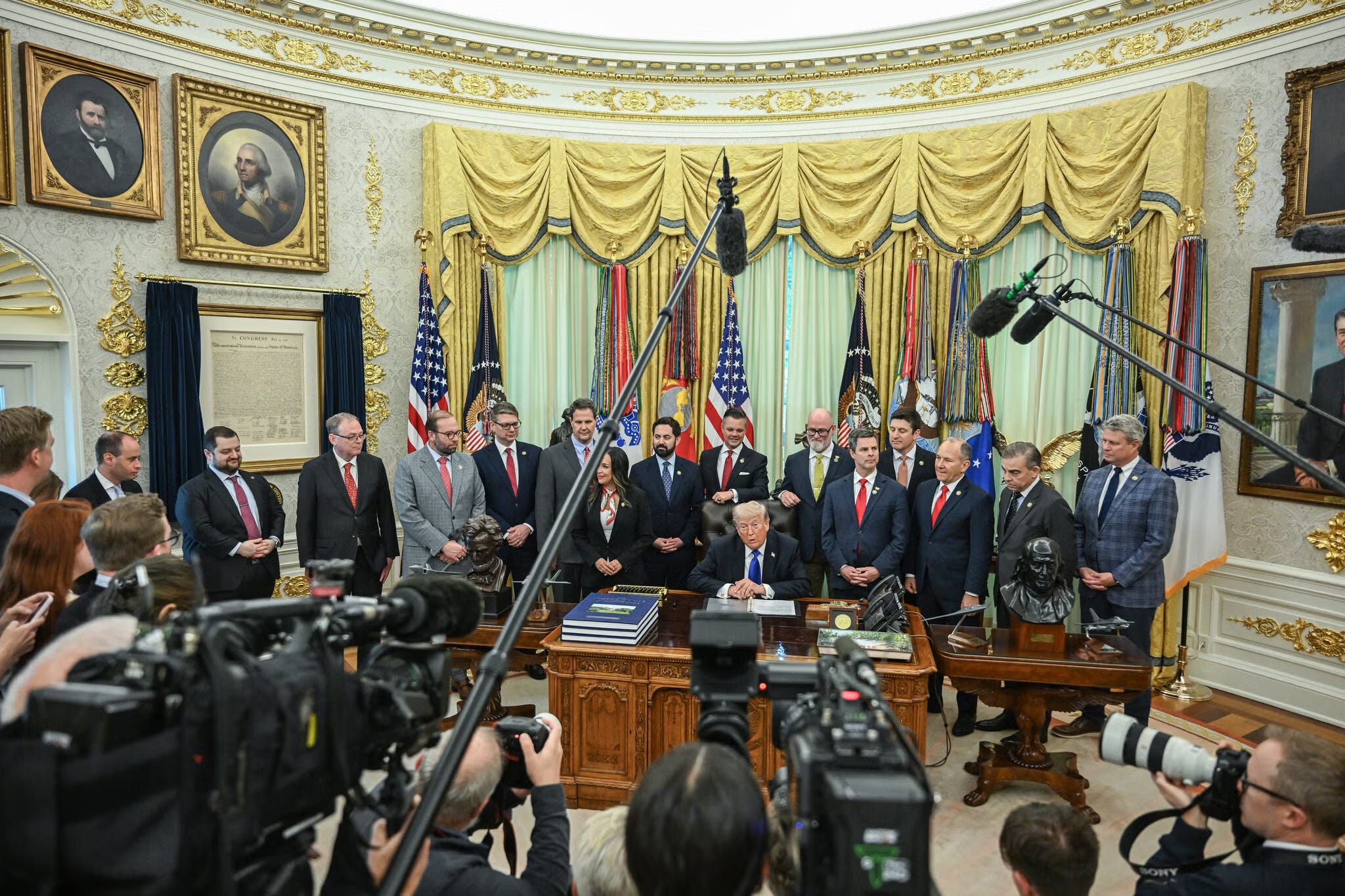
“CNN, MSNBC and Politico back at the White House, hours after judge ordered Trump to lift ban,” read a 24 September 2026 Associated Press headline, published just one week after the administration had barred the three outlets from press briefings. In response to the ban, the White House press pool—a rotating group of journalists, photographers, and broadcast technicians organized by the White House Correspondents’ Association (WHCA) to cover the President of the United States (U.S.)—refused to participate in news conferences until the ban was lifted. Even after the federal courts put a temporary 14-day restraining order on the ban, CNN, unlike right-wing media producers, was blocked from covering Trump on Air Force One. Rather than waiting for the courts to issue a permanent ruling halting the Trump administration’s punishment of CNN, the press pool abandoned its protest and returned to the White House following the restraining order. When the press pool traded collective solidarity for a rushed return to the briefing room, it laid bare a troubling structural reality: in modern journalism, the pursuit of daily access routinely overrides the defense of a free press.
President Donald Trump publicly justified the press ban on national security grounds. However, the move was more plausibly driven by political vulnerability. Facing historically low approval ratings ahead of the midterm elections—with his party underwater in 47 states and projected to lose both chambers of Congress—the administration sought to suppress widespread public discontent by censoring the press. Compounding this friction, the White House released taxpayer-funded advertisements promoting the Republican agenda that sparked bipartisan warnings of illegality, functioning essentially as state propaganda disguised as public service announcements. These spots featured dubious claims, such as pledging to dismantle the “deep state”—despite the administration’s own deep-state affiliations and ties to figures like the late Jeffrey Epstein—or promising to eliminate “warmongers” from government while simultaneously prosecuting an elective war in Iran.
The court’s decision to suspend the ban came as no surprise given that the 1977 federal appeals court ruling Sherrill v. Knight established that while the government is not strictly required to open its doors to the media, once it voluntarily establishes a public press facility or invites the press, it cannot arbitrarily ban or deny access to specific news outlets based on the content or viewpoint of their coverage. Furthermore, efforts to execute similar authoritarian bans on journalists Jim Acosta and Brian Karem during Trump’s first administration and the Associated Press in his second term failed.
Nor did it come as a surprise that other corporate-funded news outlets eventually abandoned their refusal to cover the White House, capitulating before the courts could legally invalidate the ban. The underlying reasons for this collapse are structural: contemporary media outlets are tethered above all to profit maximization. To capture market share, they routinely pander to audiences’ desires for partisan confirmation, prioritizing ideological validation over journalistic veracity. This began with Fox News Channel, which pioneered the art of hyper-partisan conservatism to attract an audience, and was subsequently copied by outlets such as MSNOW (formerly MSNBC), which soon did the same for liberals. At the same time, newspapers shifted online to a subscriber model where they, too, were caught up in ideological bias, trying to confirm the political biases of their audiences while manufacturing conflict against the “other party.”
Beyond partisan narratives, the press’s profit model remains anchored in the age-old adage that “if it bleeds, it ledes.” Consequently, corporate media outlets prioritize sensationalistic content—often described as junk food news, such as gossip, scandals, and inflammatory rhetoric—over substantive reporting. This for-profit imperative has proven uniquely detrimental in the Trump era, as his mastery of provocative staging and hyper-partisan unpredictability allows him to dictate media coverage—whether by amplifying preferred narratives, such as false claims about the Iran conflict , or by deflecting from vulnerabilities like the Epstein records. For instance, Trump consistently triggers media fixation through deliberate provocations, ranging from racist and sexist slurs and outlandish policy proposals—such as annexing Greenland or Canada—to absurd public spectacles that news organizations find impossible to ignore, including hosting a UFC fight and previewing Tesla vehicles at the White House.
Aside from relying on spectacle, corporate news media prioritizes famous figures, assuming that celebrity appeal drives viewership better than the voices of everyday citizens. This bias routinely sidelines “man-on-the-street” journalism that elevates the everyday public. Eager to preserve access to power as Trump entered his second term, prominent television figures who once built their brands on anti-Trump rhetoric—such as Joe Scarborough, Mika Brzezinski, and Bill Maher—sought to mend fences, trading uncompromised critique for public displays of sycophancy and renewed dialogue. Similarly, networks like CBS and ABC settled fraudulent lawsuits from Trump to safeguard their institutional access. By prioritizing proximity and ratings dominance over journalistic integrity, the corporate press has willingly allowed a manufactured political persona to eclipse substantive democratic discourse.
It is difficult for actual journalists to offer a counter to the corporate media, given that a handful of corporate news media dominate the market. Back in 1983, Ben Bagdikian warned in The Media Monopoly that the 50 or so corporations that controlled 90% of news media were steadily dwindling. The climate of unchecked concentration was accelerated by the Telecommunications Act of 1996, which dismantled ownership caps and enabled single corporations to monopolize multiple news outlets within local markets. At the time, the internet was relentlessly promised as the ultimate solution, arguing it would magically create the diversity that antitrust laws once aimed to achieve. However, internet companies quickly followed the same path, consolidating just as legacy corporate media had. Acronyms like FAANG and GAMMAA are now used to describe the handful of monopolistic companies that control this digital traffic. Regardless, by the time that Bagdikian wrote the last edition of The Media Monopoly in 2004, there were only six corporations controlling 90% of the news media.
The corporate consolidation of U.S. news media has continued to shrink the landscape in the years since. Indeed, the very week of Trump’s press ban, state attorneys general announced a settlement clearing the path for the Paramount and Warner Bros. Discovery merger, subject to final court review. This followed a 2025 arrangement in which the administration signaled it would approve Paramount’s proposed merger with Skydance Media on the condition that Paramount settle Trump’s personal lawsuit against CBS. In response, Paramount executed a $16 million settlement with Trump, and the merger was granted.
This Paramount merger saga illustrates how the profit motive at the heart of such mega-mergers consistently supersedes both journalistic integrity and the principle of an independent press. For Paramount, maximizing market control through corporate consolidation was paramount, making the $16 million settlement little more than the cost of doing business. Beyond securing this payout, Trump’s approval of the transaction paved the way for political allies—the Ellisons—to take ownership of CBS. This shift subsequently placed figures like Bari Weiss in charge of CBS News, where unfavorable coverage of the administration has reportedly been suppressed. Furthermore, industry reports suggest Weiss is positioned to take over CNN should the broader Paramount—Warner Bros. Discovery merger reach finalization.
The financial and ideological gains for Trump, Weiss, and the Ellisons come at the expense of the substantive, diverse coverage that democracy depends upon. Indeed, given press consolidation and the influence of the White House on news narratives, it is unsurprising that the United States ranks 64th out of 180 countries in Reporters Without Borders’ Press Freedom Index and 51st out of 179 nations according to the Varieties of Democracy project. Submitting the free press—the very foundation of democratic accountability—to five decades of unbridled profit motives and corporate consolidation has yielded predictable consequences. Continuing down this path risks realizing a post-democratic landscape devoid of a substantive, independent press. Driven by political expedience and financial self-preservation, corporate media leaders appear all too willing to follow this trajectory, trading democratic integrity for short-term gain. Safeguarding U.S. democracy requires breaking up media monopolies, eradicating news deserts, funding independent press ecosystems, and demanding that journalists act as a unified front of resistance rather than isolated outlets cashing in on corporate greed at the expense of the public good.
