


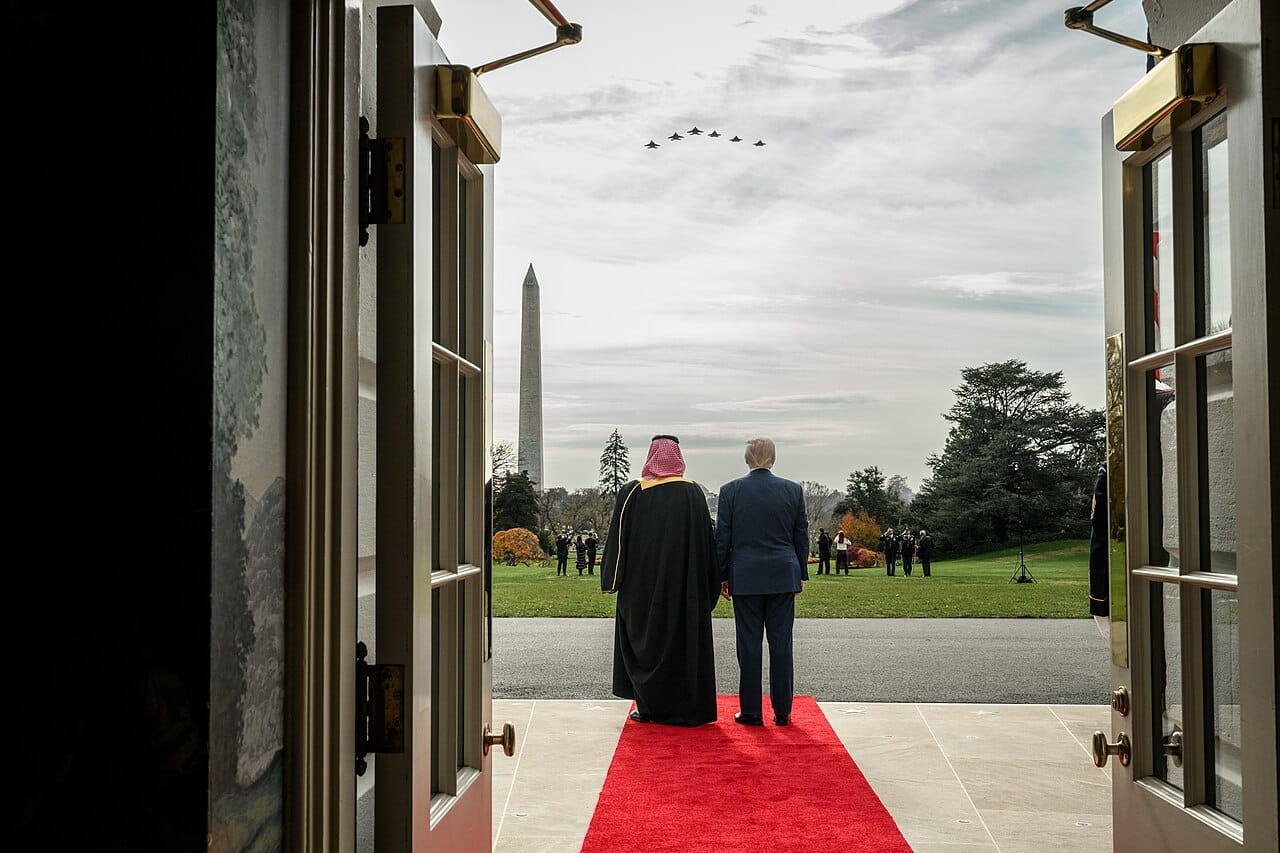
The ink was barely dry on the thirty-year civilian nuclear agreement between the United States and Saudi Arabia when President Donald Trump took to Truth Social to declare the pact “totally subject” to Saudi Arabia joining the Abraham Accords. Within twenty-four hours, a legally executed treaty was reframed as political ransom. This is not diplomacy. This is coercion dressed in a presidential seal.
Let the record be absolutely clear: the agreement was signed. Energy Secretary Chris Wright and Saudi Energy Minister Prince Abdulaziz bin Salman put their names to a thirty-year Section 123 Agreement governing the peaceful transfer of nuclear technology. Under the U.S. Atomic Energy Act of 1954, such agreements require strict non‑proliferation, safety and monitoring standards.
They contain no statutory requirements regarding a partner nation’s foreign policy or its relationships with third‑party states. The nuclear track was deliberately, legally and irrevocably separated from the diplomatic track. To re‑link them now is to admit that Washington never viewed Saudi nuclear sovereignty as a right but as a bargaining chip to be cashed in for Israeli interests.
And what interests those are. Since October 2023, the world has watched in horror as Israel’s military campaign in Gaza has killed more than 67,000 Palestinians by October 2025, including over 20,000 children and some 10,000 women. The International Court of Justice has found plausible grounds for genocide. The International Criminal Court has issued arrest warrants for the Israeli Prime Minister and former Defence Minister for war crimes and crimes against humanity.
The United Nations Independent International Commission of Inquiry has concluded there are reasonable grounds to find that Israel has committed four of the five acts defined as genocide under international law. Meanwhile, settlement expansion in the West Bank has accelerated at a record pace, with nearly 50,000 housing units approved in 2025 alone. This is the state whose diplomatic embrace Washington demands Saudi Arabia purchase with its nuclear sovereignty.
The moral calculus could not be more grotesque. Israel operates outside the Nuclear Non‑Proliferation Treaty, maintains an arsenal estimated at two hundred to four hundred warheads in deliberate opacity, and has never submitted to international inspections.
Yet Washington shields it from any consequence while demanding that Saudi Arabia—a treaty signatory in good standing—earn the right to peaceful nuclear technology by normalising with a state whose conduct the international community has judged criminal. This is not a double standard. This is the abolition of standards.
Saudi Arabia’s position has been consistent and honourable: normalisation without irreversible progress toward Palestinian statehood is impossible. The Arab Peace Initiative of 2002 offered full normalisation in exchange for Israeli withdrawal to the 1967 borders and a just solution for refugees. Israel’s response was not peace but accelerated colonisation.
Now Washington demands that Riyadh abandon that principle, betray the Palestinian cause, and isolate itself from the Arab and Islamic worlds—all for the privilege of technology that is its right under international law. Public opinion in Saudi Arabia has turned decisively against normalisation, with opposition surging to 68 per cent in recent polling. No leader can ignore that. No leader should.
The strategic hypocrisy is equally staggering. The Trump administration justified the nuclear deal precisely to prevent Saudi Arabia from turning to China or Russia for its nuclear programme. Yet by imposing a normalisation condition that Riyadh cannot meet without sacrificing its regional legitimacy, Washington makes its own partnership less attractive than the alternatives it purports to fear.
The United States undermines its own stated objective, accelerating the very multipolar landscape it claims to resist. The Stimson Centre’s Emma Ashford captured the irony with devastating precision: the administration is “bombing Iran to prevent them ever having enrichment, while giving it to the Saudis.”
The deal now faces a mandatory ninety‑day congressional review. But make no mistake: the agreement was signed. It was negotiated in good faith between sovereign states. It meets every legal requirement of the Atomic Energy Act.
To block it now on political grounds would be to declare that American treaties are not worth the paper they are printed on, that the word of the President is meaningless, and that the non‑proliferation regime is not a system of law but a hierarchy of power disguised as law.
The philosophical implication is that the United States does not oppose nuclear proliferation as such—it opposes nuclear capabilities in the hands of states that do not subordinate themselves to American regional designs. That realisation, as it dawns on the states of the Global South, will be the death knell of the non‑proliferation regime.
History will not be kind to those who traded Palestinian dignity for diplomatic convenience. The long arc of justice bends, and it does not forget. The United States must honour the agreement it signed. Not because Washington owes Riyadh a favour.
Because the rule of law demands it. Because strategic credibility requires it. And because the moral preconditions for normalisation—a shared commitment to justice, a cessation of violence against civilians, and a horizon of Palestinian self‑determination—have not been met. They may never be met under the current Israeli government.
Washington cannot demand that Riyadh reward a government responsible for mass civilian deaths, settlement expansion and repeated violations of international law.
It cannot pretend that Saudi nuclear sovereignty hinges on legitimising a record of destruction that the Arab world, the Global South and history itself have already judged unforgivable. The nuclear deal was signed. Now honour it. The world is watching.

"To block it now on political grounds would be to declare that American treaties are not worth the paper they are printed on, that the word of the President is meaningless, and that the non‑proliferation regime is not a system of law but a hierarchy of power disguised as law."
I appreciate your attempt to hold the US to a higher standard--I really do--but aren't we there now already? Would anyone be surprised if this President reneged on something he has said or signed, or tore up an agreement a previous US president has signed?--JCPOA agreement for example--or lied, or broke a contract to not pay someone? If the US and its allies used 'laws' in a selective way to maintain a hierarchy of power? If it fabricates events or spread disinformation to achieve an objective? Bombing a country while negotiating with it? If it violates international laws or undermine international bodies? (And going back further, violating thousands of treaties with the indigenous.)
But, yes, absolutely, we should insist on progress.