


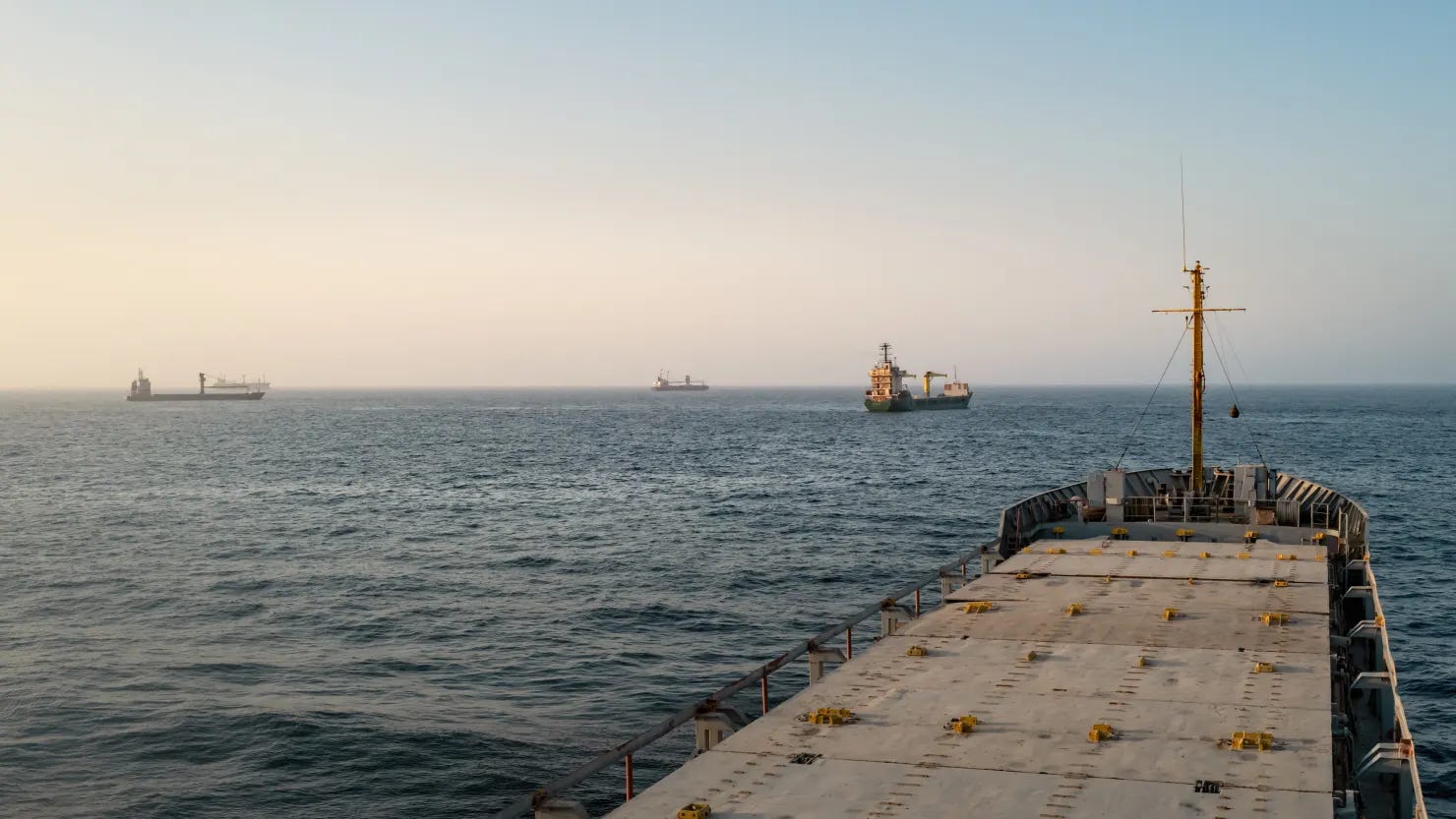
Yesterday’s US strikes on Iran, following the attack on the Ever Lovely cargo ship, are less a breakdown of the ceasefire than its logical conclusion—the farce was always going to enter this phase. Was the truce (Memorandum of Understanding, how ironic) ever a peace agreement? No, it was a mechanism; a way to manage the optics while the physical reality continues to deteriorate.
The Damage Is Already Done
Forget the tit-for-tat strikes. The real story is that the global supply chains that keep the world fed and fuelled are already broken. And the closure of the Strait of Hormuz was the convenient justification for a structural crack that was always opening under our feet. The West’s economic model—based on abundant credit and the assumption of perpetual financial growth—is in terminal decline, and missile strikes are supposed to throw smoke into the world’s eyes over this elementary truth. The war, then, is not the cause; it is controlled demolition, always flirting with getting out of control. While on the one hand it provides immediate profit gratification through market manipulation, on the other it tells us that the system is running out of road and accelerating down its destructive path.
The Fed’s Pivot Is Inevitable
So, what’s next? The Fed’s chest-puffing about rate hikes and the hawkish rhetoric won’t survive long, because a recession is already locked in. Broken supply chains + higher energy and food cost (US inflation at 4.2%, i.e. declining US dollar purchasing power) + cratering manufacturing jobs and consumer confidence = severe economic contraction. And contraction requires one thing from the central banks: cheap dollars. The Fed will pivot because a short-sighted mole has no choice but to keep digging. The only question is how fast.
When it does, we will see the same pattern we have seen for decades: lower rates, quantitative easing, more financialisation and securitisation, and higher inflationary spikes requiring to be “managed.” The architects of this system know only one response to crisis: more of the poison that caused it.
The Gold and Metals Selloff: A Sign of Desperation
This is where the picture becomes even clearer. Gold and silver have been selling off sharply. On the surface, this looks like a paradox: geopolitical chaos and inflation should send precious metals higher. But rather than a rejection of their safe-haven status, the selloff is a desperate cover against margin calls.
When leveraged positions start to unravel—whether in equities, derivatives, or commodities—institutions and hedge funds need cash fast. And the most liquid assets they hold are gold, silver, and other highly traded metals. This is therefore the signature of a system under extreme stress: fire sales of the most liquid assets to cover margin calls elsewhere. All this while the People’s Bank of China (PBoC) expanded its official gold reserves by 9.95 tonnes in May, marking its nineteenth consecutive month of accumulation. While Western institutions are selling gold to survive, the East is buying it to prepare.
It is the same dynamic we saw in March 2020, when gold sold off even as the world was collapsing. It was not a sign that gold had lost its value but that the financialised system was cannibalising its own safe havens to survive the next hour. Investors and leveraged funds liquidated highly liquid assets like gold, which dropped 10% to 15%, to raise cash, cover heavy losses in other asset classes, and meet the dreaded margin calls.
So let’s keep this firmly in mind when we watch the news. What we are witnessing is a civilisational event, not a cyclical downturn.
· Oil—the lifeblood of the modern economy—is in structural shortage.
· Fertilisers—the basis of global food production—are being choked off.
· Debt—the foundation of “Western prosperity”—is at levels that can never be repaid without inflation or default.
· Liquidity is drying out (excess liquidity now turning negative for the first time since 2021).
· Trust—the invisible glue of the financial system—is evaporating.
War as Financial Imperative
But there is another layer to this—one that ties the battlefield directly to the balance sheet. The conflict in Ukraine and now the tensions in the Strait of Hormuz have revealed something that the financial world has been salivating over for a while: drones are the new El Dorado. As reported by Zero Hedge, analyst Clarke Jeffries at Piper Sandler (one of the world’s leading investment banks), noted that the 2020s will be defined by how cheap drone technology has transformed warfare—and set the stage for a fundamental rethink of $3 trillion in annual global military spending. The first wave will focus on cheap UAS production and domestic supply chains. The second wave will be driven by autonomy, swarms, and AI-powered command-and-control platforms like Palantir’s Maven Smart System.
And here is the kicker: every drone launched represents an economic net advantage for the belligerent that employs it. Why? Because a $2 million missile intercepting a $1,000 drone is a losing trade. Militarily, economically, politically unacceptable. The “democratisation of asymmetric warfare” has rewritten the rules of engagement, and the Pentagon is racing to catch up. Enter Dzyne Technologies, a California-based company building disposable attack drones using the same foam-moulding process used for beer coolers. No exotic supply chains or aerospace technicians billing at aerospace rates. The CEO Matt McCue puts it simply: “If your airframe costs almost nothing and pours out of a mold by the thousands, you’ve solved the problem Ukraine has been screaming about for three years.”
That problem is mass. Affordable, sacrificial, replaceable drone mass. And mass requires financing, which means debt; which means issuing more bonds; which means more quantitative easing; which ultimately means the Fed’s pivot is necessary to fuel the next wave of military-industrial expansion.
Obviously, war is an immense human and economic cost (for ordinary folks like us) but it is a massively lucrative investment for the aberrant elites and anyone compromised with the debt-soaked financial system. But like all investments in such a system, it needs cheap money to sustain. This is the “irrational logic” we continue to face: the war cannot end because the war is a business model that requires perpetual expansion into new technologies, new theatres, new forms of debt.
The new strikes on Iran are not a departure from the script—they are the script. They represent a crisis that cannot be resolved because any potential resolution would first require facing the truth: the Western economic model is finished. In the meantime, the only direction the capitalist system can take is down, which means recession, then stimulus, then more debt, then more collapse and destruction—until the entire edifice finally gives way. Let’s stay aware.
