


A profound geopolitical rupture is unfolding across the Middle East, though much of the Western world still insists on reading the region through outdated maps of power. Beneath the spectacle of emergency summits, Abraham Accord diplomacy, and hurried White House negotiations lies a deeper strategic anxiety in Washington: the fear that America is slowly losing its monopoly over the architecture of Middle Eastern security.
The urgency now radiating from Washington is not about peace alone. It is about control.
For the first time in decades, major Arab powers—particularly Saudi Arabia—are openly exploring a regional future not fully dependent on American military stewardship. That shift explains the sudden intensity behind US demands for Arab-Israeli normalisation, the aggressive diplomatic pressure surrounding Iran negotiations, and the extraordinary insistence that any future regional settlement must structurally integrate Israel into the Arab world before the geopolitical window closes.
At the centre of this struggle are two competing visions for the future of the Middle East. The first is the American-Israeli vision embodied by the Abraham Accords: a tightly interconnected strategic bloc linking Israel with Arab monarchies through intelligence sharing, missile defence integration, trade corridors, cyber cooperation, and coordinated deterrence against Iran. It is a model built on alignment, hierarchy, and Western-backed military architecture.
The second vision is far more disruptive to Washington’s traditional dominance. Quietly advanced by Saudi Arabia and increasingly discussed across European diplomatic circles, the so-called “Helsinki-style” framework seeks not to isolate Iran, but to include it within a broader regional security arrangement. Inspired by the logic of the 1975 Helsinki Accords during the Cold War, this model prioritises coexistence, crisis management, and non-aggression mechanisms among rivals rather than permanent confrontation.
The distinction is historic. One framework seeks stability through exclusion and bloc politics. The other seeks stability through managed coexistence.
Washington clearly understands the stakes. That is why the White House is pushing so aggressively to force normalisation between Israel and key Muslim-majority states, simultaneously with any future understanding involving Tehran. The objective is not merely diplomatic symbolism. It is structural. The United States wants Israel permanently embedded inside the region’s security architecture before Gulf powers drift too far into independent geopolitical hedging.
This is about preserving a collapsing strategic order. For decades, America functioned as the undisputed external guarantor of Gulf security. Since the Carter Doctrine of 1980, Washington has treated the Persian Gulf as an arena requiring permanent American oversight, military deployment, and deterrence dominance. But history has begun to move faster than doctrine.
The shock that transformed Gulf strategic thinking was not theoretical. It came in flames over Abqaiq and Khurais in 2019, when drone and missile strikes crippled roughly half of Saudi Arabia’s oil production capacity in a matter of hours. The attack exposed an uncomfortable truth for Riyadh: despite spending hundreds of billions of dollars on American weapons and hosting deep security cooperation with Washington, the kingdom remained frighteningly vulnerable.
Even more alarming was the muted American response. That moment shattered confidence across the Gulf. The old assumption—that the US security umbrella was absolute and unconditional—no longer felt credible.
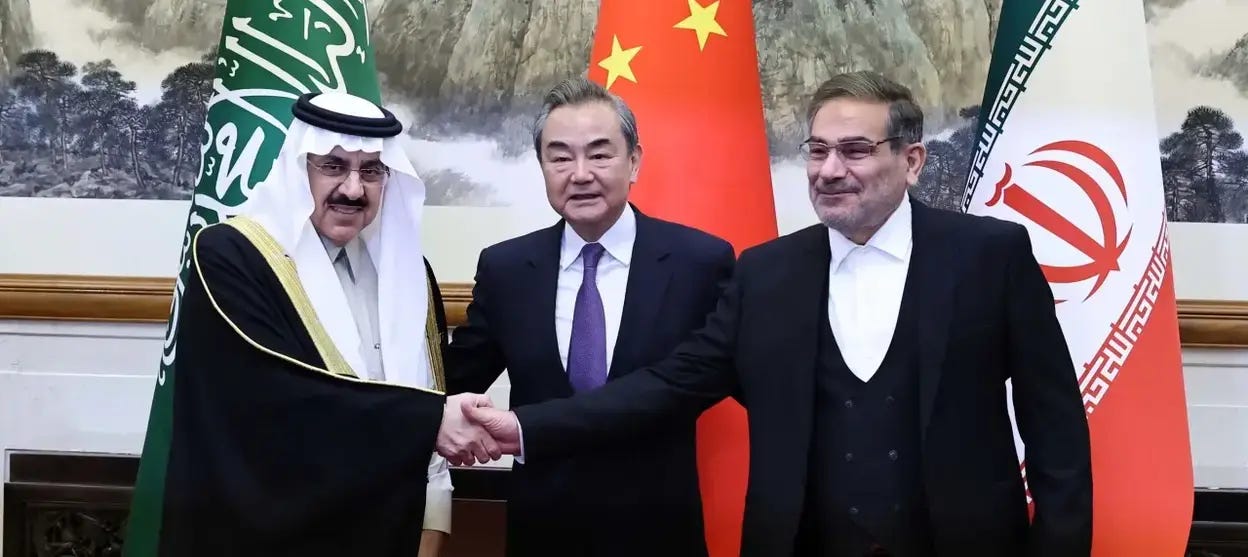
Saudi Arabia began recalculating immediately. The result has been one of the most significant geopolitical pivots in modern Middle Eastern history. Riyadh opened channels with Tehran. China brokered the 2023 Saudi-Iran rapprochement. Defence ties with Türkiye and Pakistan deepened. Economic dependency on Beijing accelerated. Russia remained central through OPEC+ coordination. The Gulf stopped behaving like a subordinate camp within a US-led order and began acting like autonomous powers navigating a multipolar world.
Washington noticed. That is why the White House now treats Saudi-Israeli normalisation as the “crown jewel” of Middle East diplomacy, pushing not just Riyadh but also Qatar, Pakistan, Egypt, Jordan, and Türkiye into a high-stakes alignment under the Abraham Accords. It is less about Israel’s acceptance and more about halting a regional drift toward independent security arrangements, forcing a sprawling bloc that locks the Gulf, South Asia, and key Arab states into a US-led framework before rival powers and local ambitions reshape the post-war Middle East on their own terms.
Yet Riyadh has drawn a firm red line, publicly rejecting normalisation without an “irreversible pathway” toward an independent Palestinian state—a reminder that even America’s closest Arab partners understand that regional legitimacy cannot be built while Gaza burns and Palestinian statehood remains unresolved.
The United States wants a new security geometry where Israel becomes the technological and military hub of a Western-aligned regional system. Israeli missile defence networks are linked with Gulf radar systems. Intelligence fusion centres spanning from the Mediterranean to the Gulf. Joint deterrence structures capable of containing Iran without requiring massive permanent American deployments.
From Washington’s perspective, the logic is elegant. America reduces its military burden in the Middle East while redirecting strategic resources toward containing China in the Indo-Pacific. But the region itself increasingly sees this project as deeply transactional—and dangerously detached from political legitimacy.
Arab leaderships understand the domestic risks of rushing into normalisation while Gaza burns and Palestinian statehood remains distant. Public anger across the Arab and Muslim worlds has intensified dramatically following the devastation in Gaza. Polling by institutions such as the Arab Centre for Research and Policy Studies consistently shows overwhelming opposition to normalisation absent a credible pathway toward Palestinian sovereignty.
This explains Riyadh’s uncompromising position. Saudi Arabia is refusing to hand Washington an easy diplomatic triumph without extracting historic concessions. Crown Prince Mohammed bin Salman understands America’s desperation. The kingdom is therefore demanding enormous returns: a binding US defence treaty, access to advanced American military technology, support for a civilian nuclear programme with domestic uranium enrichment, and irreversible movement toward Palestinian statehood.
This is no longer a relationship of dependency. It is hard bargaining between powers increasingly aware of each other’s vulnerabilities.
Israel, meanwhile, faces its own strategic paradox. It desperately seeks regional integration to cement long-term security and reduce diplomatic isolation. Yet the concessions required to secure Saudi normalisation—especially movement toward a two-state framework—generate deep fractures within Israeli politics itself.
The result is a region caught between collapsing assumptions and unfinished transitions. The deeper irony is that Washington’s pressure campaign may accelerate the very strategic autonomy it hopes to prevent. Gulf states increasingly distrust rigid alliance systems because they fear entrapment in conflicts not of their choosing. The more aggressively the United States pushes a binary “with us or against us” architecture, the more regional actors diversify their partnerships elsewhere.
China’s rise has intensified this shift. Beijing is now the Gulf’s largest trading partner and presents itself as a non-ideological economic actor unconcerned with domestic governance or political conditionality. Russia offers energy coordination and strategic flexibility. Türkiye projects military influence without demanding ideological alignment. Even Europe increasingly appears more comfortable with inclusive regional security arrangements than permanent bloc confrontation.
This is why the Helsinki-style idea alarms Washington so deeply. A functioning Gulf-Iran accommodation would signal that regional powers are capable of managing security without exclusive American supervision. It would diminish Israel’s strategic centrality, weaken Washington’s leverage, and legitimise a multipolar order emerging across West Asia.
That possibility terrifies the old architects of American primacy. Yet the central flaw in Washington’s approach remains painfully familiar. Military architecture cannot replace political legitimacy. Diplomatic engineering cannot erase historical grievances. Regional orders imposed from above rarely survive the pressures building underneath them.
The Middle East has already witnessed the consequences of externally designed systems that promise stability while deepening resentment beneath the surface. Iraq. Libya. Syria. Gaza now stands as another warning about the catastrophic limits of coercive regional management detached from justice and political inclusion.
The region is changing because its powers no longer believe permanent dependence guarantees survival. What is unfolding now is not simply another diplomatic negotiation. It is the slow birth of a post-American Middle East—fragmented, multipolar, transactional, and increasingly resistant to externally imposed hierarchies.
Washington still possesses immense military reach. Israel remains militarily dominant. But influence built primarily on pressure, fear, and strategic engineering eventually reaches its limits. And across the Middle East, those limits are becoming impossible to ignore.
