


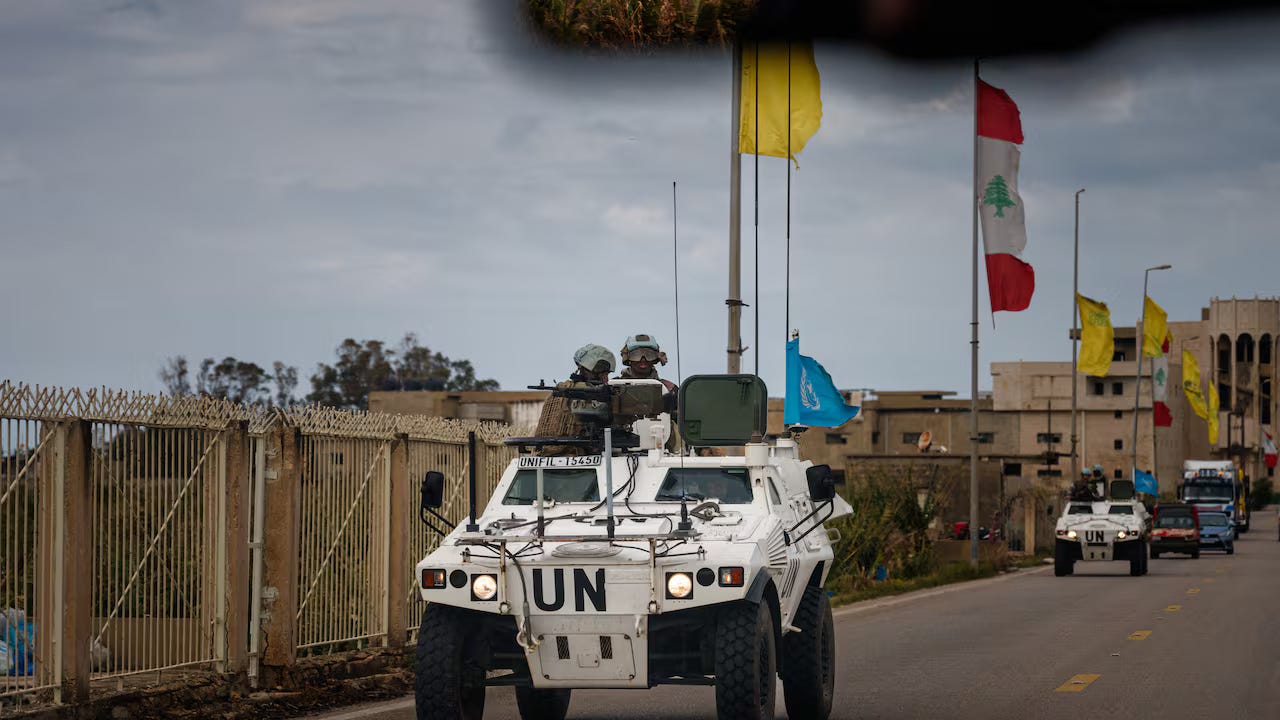
Silence, in international affairs, is rarely neutral. It settles like dust over the most uncomfortable truths, softening outrage, diluting accountability, and—at times—enabling repetition. The recent killings of United Nations peacekeepers and clearly identified journalists in southern Lebanon do not merely represent tragic by-products of war; they expose a deeper fracture in the global order: a growing tolerance for impunity when the perpetrator is politically inconvenient to confront.
In late March 2026, three Indonesian UNIFIL peacekeepers were killed across two incidents in southern Lebanon, while three Lebanese journalists died when a marked press vehicle was struck by an Israeli airstrike in Jezzine. These were not ambiguous casualties lost in the fog of battle. The vehicles bore unmistakable insignia. The coordinates of UN positions were long known. The strikes, particularly on the journalists’ car, involved precision munitions.
Yet the global response has been muted, procedural, almost rehearsed—calls for investigation, expressions of concern, and little else.
Israel’s official position—that these deaths were accidental or the result of Hezbollah’s tactics—sits uneasily against mounting evidence and international legal norms. The claim that journalists were operatives, unsupported and even undermined by doctored imagery, has been widely rejected by UN experts and human rights bodies. More troubling is the pattern this fits into.
According to the Committee to Protect Journalists, over 270 media workers have been killed in Gaza alone since late 2023, making this the deadliest period for journalists in modern history. When such numbers accumulate without consequence, they cease to shock—and that is precisely the danger.
For a rules-based international order to retain meaning, certain lines must remain inviolable. UN peacekeepers, operating under Security Council mandates, are not combatants. Journalists, even those reporting from within contested or politically aligned outlets, are civilians under international humanitarian law. These are not interpretive grey zones; they are foundational principles. As the UN has reiterated, attacks on peacekeepers and journalists may constitute war crimes.
Yet enforcement appears selective. Compare the swift international investigations and political fallout that typically follow civilian casualties caused by Western militaries with the hesitancy evident here. The discrepancy is not lost on troop-contributing countries like Indonesia, which has demanded an independent inquiry and rejected Israel’s explanations outright. Nor is it lost on the Global South more broadly, where perceptions of double standards in the application of international law continue to erode trust in multilateral institutions.
This erosion carries strategic consequences. UNIFIL, established to stabilise southern Lebanon, relies on the consent and confidence of both local populations and contributing nations. When peacekeepers are killed, and accountability is elusive, that confidence falters. Countries may reconsider deployments, weakening already fragile missions. The same applies to the press. If journalists are systematically targeted or discredited as combatants, the information ecosystem in conflict zones collapses. War becomes less visible, less scrutinised, and therefore more brutal.
This erosion of restraint stands in quiet defiance of Additional Protocol I to the Geneva Conventions and UN Security Council Resolution 1738, both of which affirm, with unmistakable clarity, that journalists and civilians must never be treated as expendable in war.
Think tanks and policy institutions have begun to warn of this trajectory. Analysts at institutions such as the International Crisis Group and Chatham House have noted a broader trend: the normalisation of high-intensity warfare with diminished regard for civilian protection. The Lebanon incidents are not isolated; they are symptomatic. A “buffer zone” strategy reportedly pursued by Israel—aimed at pushing Hezbollah north of the Litani River—creates operational conditions where anything within that space risks being treated as hostile.
In such an environment, the distinction between civilian and combatant is not just blurred; it is operationally deprioritised.
For policymakers across both the Global North and the Global South, and at every layer of authority—from heads of government and foreign ministers to multilateral negotiators, military planners, and diplomatic envoys—this moment presses with unusual moral weight. It is no longer a distant test of principles but an immediate reckoning with them.
In the capitals of the North, where the language of a rules-based order was largely authored and exported, hesitation now risks reading as retreat from those very commitments. In the South, where such rules have often been experienced as unevenly applied, each unchallenged violation deepens a lingering scepticism about whose lives and laws truly matter.
Across both spheres, silence does not sit idle; it travels downward through ministries, institutions, and commands, quietly reshaping what is tolerated. For senior officials drafting statements, for envoys negotiating resolutions, for defence establishments interpreting rules of engagement, the absence of consequence begins to feel like an unspoken directive.
What is at stake is not simply credibility, but whether the architecture of restraint still holds meaning when tested.
Beyond these upper echelons, a wider constellation of actors—civil servants, international lawyers, humanitarian leaders, journalists, and civil society across North and South alike—find themselves pulled into the same tightening circle. Diplomats tasked with defending universal norms must now reconcile their words with a reality that fractures along geopolitical lines.
Legal experts see the gap widening between codified protections and their selective enforcement. Military professionals, trained in doctrines of proportionality and distinction, observe how quickly these principles can erode when accountability falters. And for journalists and aid workers on the ground—whether in Beirut, Gaza, or elsewhere—the consequences are not theoretical but immediate, where visibility can invite danger rather than protection.
This layered global ecosystem, spanning continents and political divides, forms the backbone of international accountability. When one level hesitates—whether in the North or the South—the strain reverberates across all others. The result is a slow, unsettling normalisation: where each unanswered act lowers the threshold for the next, and where the cumulative quiet of many actors begins to resemble not caution, but consent.
There is also a geopolitical calculus at play. Israel’s strategic importance to Western alliances often tempers criticism. But strategic alignment cannot justify normative erosion. If anything, it heightens the responsibility to uphold standards. Allowing allies to operate outside established legal frameworks sets precedents that adversaries will exploit. The result is not stability but a gradual unravelling of the very order those alliances are meant to protect.
What would a meaningful response look like? At a minimum, a genuinely independent international investigation with full access to evidence and witnesses. Not a perfunctory review, but a process capable of assigning responsibility. Beyond that, a willingness to consider consequences—diplomatic, legal, or economic—if violations are confirmed. The International Criminal Court, despite its political sensitivities, exists precisely for such scenarios.
Equally important is the defence of narrative integrity. The labelling of journalists as militants without substantiated evidence is not merely a legal issue; it is an informational strategy. It seeks to pre-empt scrutiny by discrediting those who document it. Countering this requires not only condemnation but active support for independent journalism, including funding, protection mechanisms, and diplomatic advocacy.
There is a tendency in international relations to view such incidents through the lens of inevitability—war is chaotic, mistakes happen, and accountability is complex. But inevitability is often a convenient fiction. The laws of armed conflict were designed precisely to impose limits amid chaos. When those limits are ignored, and the response is muted, it signals not inevitability but choice.
The deaths in southern Lebanon should not be absorbed into the background noise of conflict. They demand attention not because they are unique, but because they are becoming routine. And routine violations, left unchallenged, reshape norms.
The question facing the international community is stark: whether to accept a world where peacekeepers and journalists are expendable, or to reaffirm—through action, not just words—that some lines remain non-negotiable.
