


I spent the holiday season watching with quiet bemusement as the UK’s Deputy Prime Minister, David Lammy, threw a wrench into Britons’ festive plans by announcing that the increasingly embattled Labour government will abolish jury trials in cases that carry a maximum term of imprisonment of three years. In place of juries, these cases will be heard solely by judges.
The announcement led to an immediate political firestorm with Lammy and his party drawing criticism from virtually every corner of British politics. Robert Jenrick of the Tories appealed to tradition and accused Lammy of “rip[ping] up centuries of jury trials.” Lammy faced internal criticism from within Labour as Bradford MP, Imran Hussain, excoriated him for seeking to eradicate “public duty” and eroding “a cornerstone of [British] democracy.” The Liberal Democrats pitched in by valorising jury trials as a “fundamental right” that was being stripped from accused persons.
We should pause momentarily to note that none of Lammy’s critics have offered principled justifications for retaining jury trials. What they have supplied instead are politically resonant formulas designed for rapid media circulation rather than considered reflection.
Perhaps the most detailed criticism of Lammy’s proposal came from the Free Speech Union (“FSU”), which framed it primarily in statistical terms, attacking it as “a direct assault on [Britons’] ancient liberties—and a profound threat to free speech.” The FSU invoked statistics which purported to demonstrate that, in June 2025, magistrates acquitted just 14 per cent of accused persons relying on a free defence, while juries in the Crown Courts did so 33 per cent of the time.
Although such figures are rhetorically powerful, they assume—without substantive argument—that higher acquittal rates are, in themselves, a proxy for justice without controlling for other important variables such as the doctrinal adequacy of invoking the defence, the facts of the individual case, or the quality of evidence adduced. Indeed, as I will subsequently argue, the invocation of acquittal rates conflates the purpose of a trial, that is, the impartial application of facts to law, with the preferred outcomes of various political factions.
Although spirited and undoubtedly earnest, much of the criticism of judge-led trials rests on the uncritical assumption that jury trials are either preconditions of a healthy democratic society, fundamental rights of the accused, or normatively superior to judge-led trials. As I will presently demonstrate, once we move past the sloganeering, it becomes plain that such assumptions are both incoherent and serve to entrench an institution that is radically unfit for purpose.
Before proceeding any further, several caveats are in order. First, I am not an elitist technocrat. On the contrary, as I argue below, judge-led trials provide the best means to secure the procedural rights of an accused person. Second, I am not an apologist for the Labour government either. Indeed, I abhor their free speech crackdown and have, in the past, published a vigorous defence of the principle of free expression.
Let us begin by setting aside Jenrick’s genuflecting to tradition. Simply because a practice is steeped in tradition does not entail that it ought to endure. Where a tradition persists only because it is a tradition, and not because there are good reasons buttressing it, then surely we shouldn’t allow the dead hand of the past to continue to bind us in the present. In this regard, I shall consider the three most prominent justifications for the retention of trial by jury and find them all wanting.
First, it is often said that jury trials are a fundamental sacrament of democracy. Such a justification trades on the various senses of “democracy.” On the one hand, it can mean that jury trials perform a democratic function as they ensure that one is tried by one’s peers.
This, however, is unpersuasive as juries are selected at random and do not actually reflect the demographics of a given region. For instance, assume that a given region votes 75% Tory, is 50% black, and is 25% female. On a genuinely representative account, we should expect a twelve-person jury to consist of nine jurors who vote Tory, six who are black, and three women. The randomness of jury selection ensures that juries are not selected with a view to demographic representativeness, and therefore cannot be relied upon to reflect the accused person’s community.
This is underscored by the plain text of Section 1 of the UK’s Juries Act 1974, which limits jury eligibility to those under the age of 76. For instance, in increasingly greying regions of England such as North Norfolk and Rother, where almost a quarter of the population is over 70, a significant demographic group will be omitted from constituting the jury.
On the other hand, “democracy” is perhaps being invoked as a proxy for the claim that juries don’t merely reflect a representative sample of the voting base but serve as a proxy for democratic principles. This justification is self-evidently falsified by the fact that juries function on the basis of unanimity and not majority voting. Even more significant, however, is that the institution of the jury fails to respect the foundational pillar of democracy: freedom of choice.
Consider the case of participating in a general election with two candidates. A voter can choose to cast their ballot for either candidate or abstain from voting entirely. It is constitutive of the freedom of choice that one also possess the freedom to abstain from choosing. Were jury trials truly reflective of democratic choice, then a potential juror would be at liberty to decline to submit to jury duty for any reason whatsoever. This, however, is not the case. As Section 20 of the Juries Act makes explicit, failure to attend jury duty without reasonable excuse generates a liability to being fined. In summary, jury trials and the duties they entail simply cannot be described as an extension of the principles of democracy because they explicitly foreclose free choice on pain of coercive legal sanctions.
Defenders of this position might respond that the solution is simply to replace mandatory jury duty with voluntary jury participation. In this sense, participants will only be bound by the duties expected of jurors because they consented to them ex ante.
However, such an argument is parasitic upon other aspects of the democratic justification for juries. Making jury duty voluntary predictably reduces the probability that a jury pool will be representative of the demographics of one’s community. That is, it exponentially decreases the size of the pool of potential jurors who can be selected to serve. It is foreseeable that those who sign up to be jurors will be those with a strong civic interest, those with a pre-existing interest in criminal justice, or those with the economic resources to serve.
Having dispatched the argument from democracy, I now turn to an increasingly popular objection in the literature: that jury trials serve as a necessary safety valve to fetter the excesses of state power. This justification was implicit in the FSU’s critique of Lammy’s proposal. More concretely, barrister Harry Gillow has argued that “Juries … provide a key protection against the excesses of the state.” Gillow cites the draconian laws imposed by the Labour government as an illustration of how individuals cannot reasonably rely on the law’s content being just, thereby inviting the tacit inference that individuals can seek refuge from the law’s harshness only in a jury of their peers.
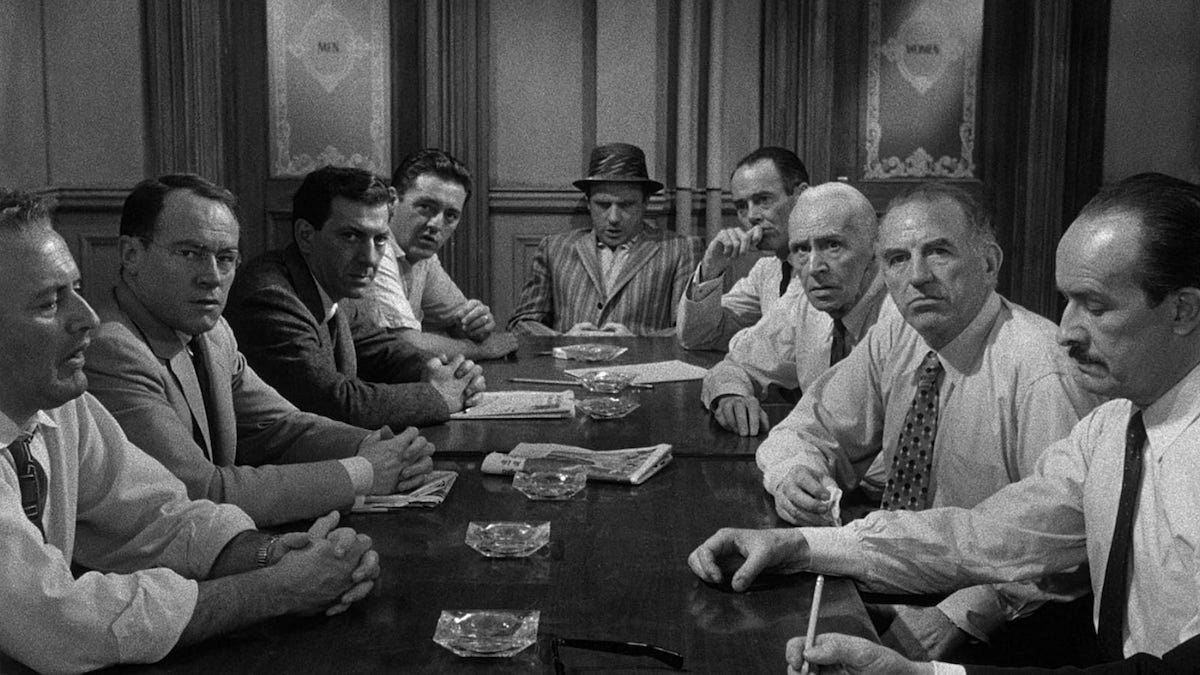
Such a romantic picture of jury trials is understandably alluring. Indeed, the reader is tempted to recall the triumph of reason and justice which resulted from the cool and collected interventions of Henry Fonda’s Juror #8 in 12 Angry Men. Yet, such starry-eyed depictions of jury trial collapse under even minimal scrutiny.
The jury’s job is not, contra Gillow, to temper state overreach. To be sure, a jury which delivers an acquittal or guilty verdict as a means to condemn the law’s injustice has exceeded its institutional mandate. A jury’s sole purpose, in criminal trials, is to deliberate on whether a charge has been made out on the facts—that is, whether all the elements of law which are necessary for the commission of a crime have been satisfied.
A jury which deliberates on the basis of the law’s content is, quite literally, undermining the rule of law. This point is exacerbated by the fact that juries, as we have established, are hardly representative of the population as a whole. In effect, by positing that an unrepresentative and unaccountable body should take the law’s content into consideration when deliberating, defenders of jury trials commit themselves to holding that twelve random members of society should have a veto, not over the law’s application, but rather whether specific laws exist at all. Not only would this frustrate the principle of democratic choice that defenders of jury trials often invoke, it would also render judicial review redundant since an accused could always rely on twelve individuals in a box to perform the task of evaluating a law’s legitimacy.
Finally, it is time to address the question of whether trial by jury is a natural or, at least, fundamental right. At the outset, it should be noted that declaring something a “right” entails that others owe the right-holder a correlative duty.
In the case of jury trials, the duty-bearers are the rest of the law-abiding population who are compelled, on pain of punishment, to give effect to the accused’s putative right. Notice that, unlike other rights—the right against being subjected to bodily harm, for instance, the “right” to trial by jury does not simply require duty-bearers to refrain from engaging in certain forms of conduct. Rather, the “right” to a jury trial entails that duty-bearers must actively, positively invest time, effort, and arrange for alternative care arrangements so as to comply with their “duty.”
The “right” to a jury trial is thus not a negative right which simply requires duty-bearers to avoid aggression but a positive right that becomes completely hollow should those under a correlative duty fail to perform certain acts. The “right” to a jury trial therefore transfers partial ownership of duty-bearers’ means to accused persons. To put the point simply, the “right” to jury trials confers upon accused persons the power to wield the state’s coercive machinery over those eligible to serve as jurors.
Of course, some will quibble with the classically liberal framing of this criticism of the “right” to jury trials. These detractors will instead justify the “right” as being grounded in reciprocity—ignoring the fact that reciprocity presupposes voluntariness, which is foreclosed by the mandatory nature of jury duty. Though such communitarian justifications are persuasive to many, I will presently endeavour to demonstrate that one need not adopt my libertarian-inflected critique to see that jury trials cannot constitute a natural right.
To see this, consider that those who assert that jury trials are a natural right never assert a similar right that accused persons be provided with reasons for their conviction. Surely the right to know why one has been found guilty is more basic than being judged by twelve random individuals. It is nevertheless a feature of jury trials that jurors, considered individually or the jury, as a collective, do not offer an accused person reasons for handing down a guilty verdict.
That juries are not required to give reasons for their verdicts is a settled feature of the common law, expressly affirmed by Lord Bingham in McKerry v Teesdale and Wear Valley Justices (2000) 164 JP 355. An offender is thus deprived of his liberties without knowing whether the reasons for their conviction were arbitrary or principled. In this respect, jury trials do not simply prove inimical to the protection of individual liberty; they also violate the requirement of publicity that is essential to the continued maintenance of the rule of law.
Defenders of the natural right justification might posit that juries can overcome the sting of arbitrariness that plagues present jury decisions by simply being required to issue their reasons. Yet, this is clearly unworkable. Should jurors be duty-bound to offer individual reasons for their decision, an otherwise procedurally legitimate conviction could be rendered procedurally illegitimate merely because a single juror reasoned arbitrarily—despite unanimity on the verdict.
Likewise, should a jury be required to provide reasons as a collective, this would engender even more problems. First, it would prove highly inefficient as twelve individuals would need to coordinate to produce a coherent account of their reasons. Second, and relatedly, this coordination problem is also likely to result in dominant jurors imposing their will on non-assertive jurors such that the end-product fails to reflect the unanimous consensus of all involved.
To summarise, jury trials cannot constitute a natural right because they coercively transfer control over duty-bearers’ time and labour to accused persons. Further, jury trials impose no obligation on jurors to justify why they believe an accused person ought to be convicted. The putative right to a jury trial thus appears particularly inefficacious in securing an accused’s liberty since jurors may covertly pronounce guilt for arbitrary reasons which will forever remain opaque.
In stark contrast to jury trials, judges are required to provide reasons for arriving at a given verdict. This principle has been enshrined at common law, most forcefully by Lord Justice Hutchinson in R v Westminster City Council ex parte Ermakov [1996] 2 All ER 302. There, he held that a judge’s obligation “to give reasons for a decision is imposed so that persons affected by the decision may know why they have won or lost and, in particular, may be able to judge whether the decision is valid and therefore unchallengeable, or invalid and therefore open to challenge.” Within the specific confines of a criminal case, elaborating on reasons serves to inform the offender why they have been found guilty.
Not only does the obligation to adduce reasons cohere with the rule of law by ensuring that law remains public, it also serves to constrain biases. To see this, it is worth bearing in mind that judges belong to a community of judges, lawyers, and legal academics. This community exerts a certain gravitational pull on the judge, as their collective perception of the judge’s general legal ability and performance in individual cases shapes their reputation within the community. The need to cultivate or maintain a reputation as a formidable legal mind serves as an informal check, quite apart from the gravitational force of precedent, on the reasons a judge might advert to when ruling.
Of course, judges are fallible, and the existence of informal checks, such as prestige-gathering and formal checks such as precedent, can never constitute fool-proof safeguards against judicial error. However, it is precisely because judges are fallible that their duty to give reasons is paramount. An offender whose conviction was premised on reasons that were insufficient can have their conviction subjected either to judicial review or can request that their case be stated.
Trials conducted solely by judges cohere with the rule of law precisely because they require decisions to be justified in public. The obligation to give reasons exposes legal reasoning to scrutiny, enables meaningful appeal, and ensures that the state’s coercive power is exercised in a manner that is intelligible to those subject to it. In doing so, judge-led trials do not eliminate error but render such errors visible and therefore contestable. For the wrongfully convicted, that visibility is the difference between liberty and oppression.
Jury trials promise participation but deliver opacity. Judge-led trials, on the other hand, promise no such comfort. They demand public justification, expose fallibility, and invite challenge. That discipline—not democratic sloganeering or pseudo-rights rhetoric—is what secures individual liberty and the rule of law from the depredation of the coercive state.
