


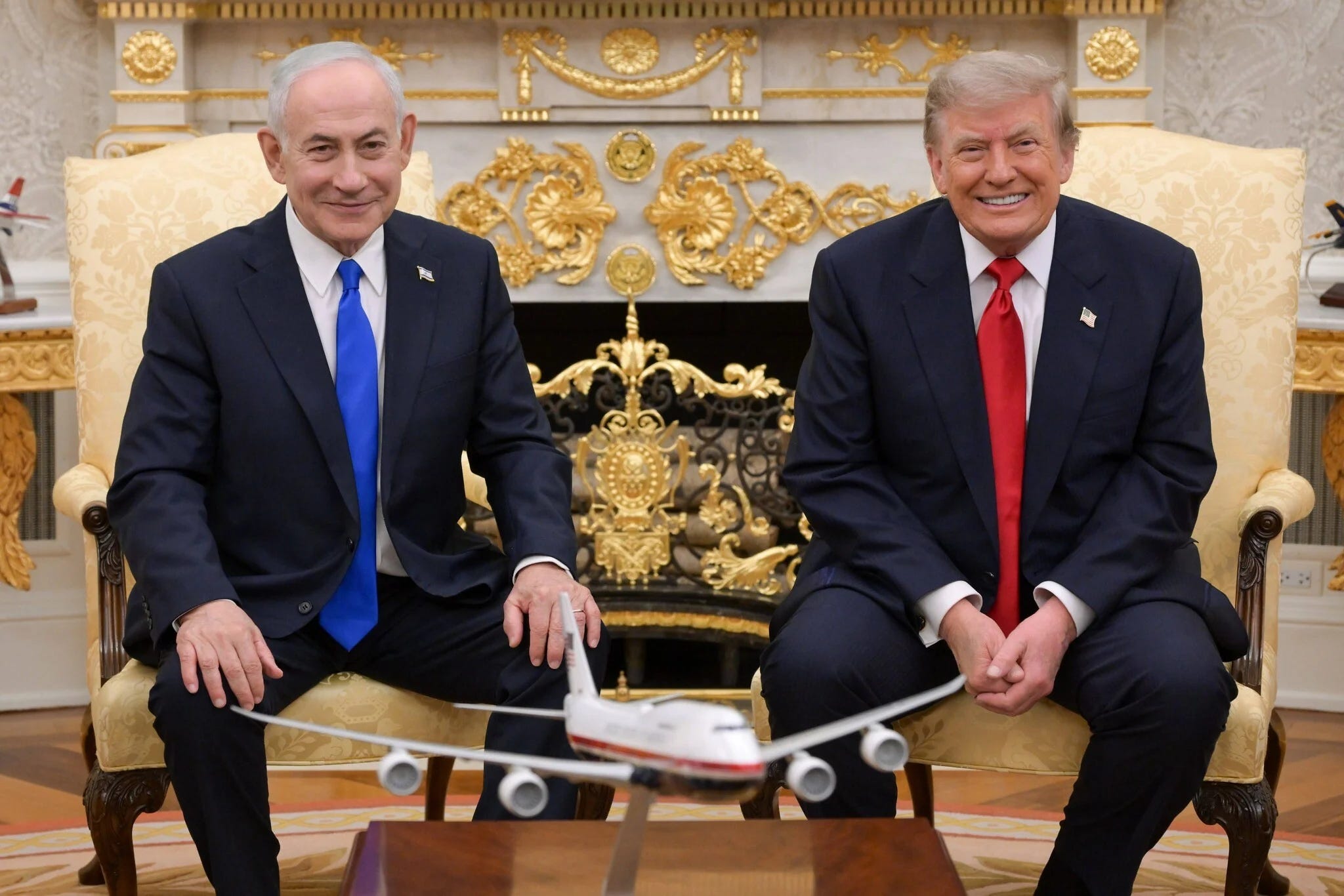
There was no fanfare. No cameras. No questions. Just the quiet click of a door closing in the West Wing, and two wartime leaders slipping into the Oval Office as though they had something to hide. And perhaps they did.
This was diplomacy stripped of its democratic garments—a calculated performance of protection, staged at a moment when the International Court of Justice has already found a “plausible” risk of genocide in Gaza, and when an International Criminal Court arrest warrant hangs over Benjamin Netanyahu’s head for alleged war crimes and crimes against humanity.
Yet there he sat, in the seat of American power, welcomed not as a man under judicial scrutiny but as an ally to be embraced.
Let us be clear about what transpired on 28 July 2026. President Trump met separately with Ukrainian President Volodymyr Zelensky and Israeli Prime Minister Benjamin Netanyahu in back-to-back closed-door sessions. Zelensky secured a commitment on Patriot interceptor production licenses—vital for Ukraine’s defence against Russia’s relentless bombardment. That meeting, however strained historically, served a legitimate purpose of national self-defence.
But the Netanyahu meeting was something else entirely. This was the first face-to-face encounter between the two leaders since the joint US-Israel war on Iran began five months earlier. The agenda, reportedly, was Iran’s nuclear program and regional strategy.
Yet the timing could not have been more grotesque. As Netanyahu sat in the Oval Office, Israeli strikes continued to rain down on Gaza. The ICJ had already ordered Israel to “take all measures within its power” to prevent genocidal acts. The ICC had issued its warrant. And still, the White House rolled out the red carpet—or rather, rolled it up, because even the ceremonial trappings of a state visit were deemed too risky.
The absence of cameras was not an oversight. It was an admission. When a president who thrives on publicity—who turns every meeting into a spectacle—suddenly chooses silence, one must ask: what is being hidden?
The White House described the sessions as “positive and productive.” Netanyahu called it “one of the best conversations” he has ever had with an American president. Yet neither side released a detailed readout. The message was clear: we support you, but we dare not say it aloud.
This is the anatomy of complicity. Under the Genocide Convention, to which the United States is a party, there exists an obligation erga omnes partes—a duty owed to the entire international community—to prevent genocide. The ICJ in Gambia v. Myanmar affirmed that states must employ “all means reasonably available to them” to prevent atrocity crimes.
The United States, as Israel’s primary military supplier and diplomatic shield, possesses extraordinary capacity to influence. Yet on that Tuesday in July, that capacity was used not to restrain, but to embolden.
Consider the legal architecture. Under the Krstić Appeals Chamber’s “specific direction” test for complicity in genocide, an accomplice’s acts must be specifically directed to assist the commission of genocide. One could argue—weakly—that the meeting was directed at broader strategic cooperation on Iran, not specifically at facilitating genocidal acts in Gaza.
But the Taylor standard from the Special Court for Sierra Leone lowers the threshold: any assistance that has a “substantial effect” on the commission of the crime suffices. The provision of diplomatic reassurance and the implicit promise of continued military support substantially contribute to the perpetrator’s capacity and resolve to continue operations that the ICJ has flagged as plausibly genocidal.
The mens rea—the guilty mind—is equally damning. The ICJ’s provisional measures order served as formal legal notice. A state continuing to bolster an alleged perpetrator’s position after such an authoritative judicial declaration cannot claim ignorance. The diplomatic choreography—no fanfare, no questions—indicates an awareness of the illegitimacy of the association and a calculated effort to maintain plausible deniability while nonetheless providing the substantial assistance of high-level political endorsement.
This is not merely a failure of prevention. It is active facilitation. The United States is not a party to the Rome Statute, and thus claims no obligation to enforce an ICC warrant against Netanyahu.
But the Genocide Convention—ratified by the US in 1988—imposes independent duties. The principle aut dedere aut judicare—either extradite or prosecute—is emerging as a customary obligation for jus cogens crimes. Yet Washington chose neither. Instead, it chose to embrace.
One cannot help but recall the al-Bashir precedent. When the Sudanese president under ICC indictment travelled to states that refused to arrest him, the international community condemned those states for providing symbolic legitimation.
Here, the symbolism is even more potent: the United States is not a peripheral state, but the world’s sole superpower, and Netanyahu is not a peripheral figure but the leader of America’s closest Middle Eastern ally. The message to every other alleged perpetrator of atrocity crimes is unmistakable: if you are useful to American power, the law does not apply to you.
The comparison with Zelensky is instructive, but Ukraine’s war cannot be understood through a simple victim—aggressor binary. Years of conflict in the Donbas, tensions over Russian-speaking populations, Ukrainian nationalist and far-right formations, NATO expansion and growing US involvement all form part of the contested context behind the war. As John Mearsheimer and other realists have argued, these dynamics complicate the conventional Western narrative of the conflict. Zelensky’s engagement with Trump, however imperfect, nevertheless serves the immediate purpose of securing support amid the continuing war.
Netanyahu’s meeting, by contrast, came as his forces continue operations that international courts have deemed plausibly genocidal. To treat these two leaders identically—to give both the same closed-door treatment—is to equate a victim with an alleged perpetrator. It is a moral obscenity.
The “war in Iran” was reportedly “at the top of that agenda.” Yet even this framing is deceptive. The broader regional strategy cannot be hermetically sealed from Gaza operations. The two fronts are strategically linked. Under the Nuremberg precedent of Joint Criminal Enterprise—articulated in the Tadić Appeals Chamber—participants in a joint enterprise are liable for crimes that are a natural and foreseeable consequence of the common purpose.
A joint enterprise to wage a broader regional war that foreseeably results in genocidal acts implicates all members in the resulting genocide. The US need not deploy troops to Gaza; if it provides the logistical, intelligence, and diplomatic infrastructure, and jointly plans the broader war strategy, it enters an enterprise whose foreseeable consequence is the destruction of a protected group.
The ICJ’s “plausibility” finding puts the United States on formal notice. Coordination of the “war in Iran” cannot be divorced from the ongoing Gaza operations. The two are not separate conflicts; they are a seamless web of joint military planning with a single overarching objective: the reconfiguration of the Middle East by force, with the Palestinian national group as a casualty to be managed rather than a people to be protected.
One must also consider the victims. Polling cited by The Economist found that nearly half of Americans believed Netanyahu should be arrested on arrival for war crimes. The international community watches in disbelief. The White House meeting, stripped of its ceremonial trappings, is a performative act that renews the perpetrator’s license to destroy.
It is, in the language of state responsibility under ARSIWA Article 16, a “new and distinct wrongful act” of the host state itself—independent of Israel’s primary wrong—because it is a failure to “ensure respect” for the Genocide Convention and an active facilitation of circumstances enabling genocide.
What would a genuine commitment to prevention have looked like? Publicly demanding compliance with the ICJ order as a condition for the visit. Suspending arms transfers. Using the extraordinary capacity to influence not to embolden but to restrain. Instead, the United States chose the path of quiet complicity.
The philosopher Raphael Lemkin, who coined the term “genocide,” envisioned a two-phase process: the destruction of the national pattern of the oppressed group, and the imposition of the oppressor’s pattern. The White House meeting, by discussing post-war reconstruction and regional peace plans while the destruction is ongoing, participates in phase-two planning: the erasure of the victim group’s presence and the establishment of a new order that normalises the oppressor’s domination.
Diplomatic reception of the alleged génocidaire, coupled with discussions about the future landscape, actively constructs the “legitimating environment” that permits the international community to retrospectively rationalise the destruction as an unfortunate but necessary step toward peace.
This is not diplomacy. This is a crime scene being sanitised in real time. The “banality of evil,” Hannah Arendt taught us, lies in the bureaucratic normalisation of atrocity. A US diplomat might argue that hosting Netanyahu is a “purely routine diplomatic act” devoid of genocidal intent.
But the Kantian categorical imperative exposes the lie: universalise the maxim that nations may treat ICC indictees with full diplomatic courtesy. In a world where all nations routinely honour accused génocidaires, the international criminal justice system would collapse. The prohibition of genocide would become an unenforceable aspiration.
The maxim leads to a contradiction in conception—the universalised practice undermines the very institution of international justice. The act is therefore immoral. And under natural law theory, complicity in genocide is malum in se—evil in itself.
The Trump administration’s decision to receive Netanyahu without cameras, without questions, without accountability, is a stain on American honour and a betrayal of the Genocide Convention’s most fundamental promises. It signals to every victim in Gaza that the international community—or at least its most powerful member—has abandoned them. It signals to every perpetrator that diplomatic sanctuary awaits those who serve strategic interests.
This is not the conduct of a nation that takes its treaty obligations seriously. This is the conduct of a nation that has chosen power over principle, convenience over justice, and silence over truth. History will deliver its verdict.
Corrigendum (30 July 2026): An earlier version of this article mischaracterised the current situation in Ukraine and corrects this.
