


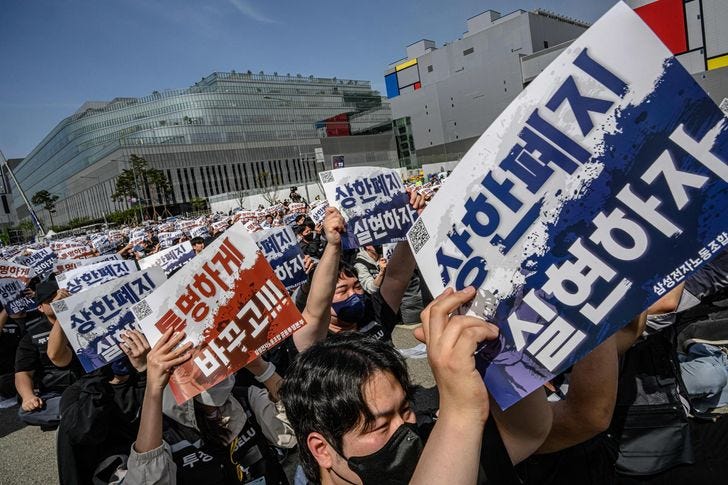
On 21 May, an 18-day general strike was scheduled to begin at Samsung. It was a strike that could have shut down production of the high-bandwidth memory chips essential for every AI accelerator sold by Nvidia—a reminder that real production still matters. The strike was suspended at the eleventh hour via emergency government-mediated negotiations. Samsung offered to pay $26.6 billion in bonsuses, which makes around $340,000 distributed among the 78,000 employees in the semiconductor division.
In the meantime, the Korean stock market (Kospi) had fallen by 12% in three days on strike fears, but then rose over 8% on the news of the potential resolution. Foreigners had been selling for nine straight days, while retail investors were holding the entire market on their shoulders. The strike, eventually, was averted, but here’s what the cheerleaders won’t tell you: if the deal doesn’t get done (voting results will be announced after 27 May), we are likely to see a fire starting not on a trading floor in New York, but in a factory in Suwon, South Korea. (The $340k bonuses are heavily isolated to the semiconductor division; workers in the smartphone, foundry, and home appliance divisions are frustrated by the disparity, which could complicate the voting consensus.)
Three Fuses, Stacked
The financial system is now wired with three interdependent fuses. Any one of them can trigger a cascade that eventually reaches the AI bubble.
1. The Financial Fuse (what’s in the walls)
$2 trillion of private credit, which is opaque, illiquid, already cracking, and mostly ignored by the media. Recent data show elevated redemption requests at several large funds:
Carlyle: 15.7% of investors tried to flee; only 5% were let out.
Blue Owl: 41% redemption requests.
69% of private credit is rated B- or lower. A quarter is already in CCC territory.
Meanwhile, 85% of leveraged ETF assets are concentrated in AI and tech. Nomura estimates up to $187 billion waiting to unwind. And what about Nvidia? According to a recent analysis, 95% of Nvidia’s operating cash flow is now absorbed by “circular financing” (57% just a year ago): investments in start-ups that then buy Nvidia chips. In this context, the $80 billion share buyback authorization and the 2,400% dividend increase (from $0.01 to $0.25 per share), announced as part of Nvidia’s Q1 2026 earnings report, are not necessarily signs of real health. Rather, they look like structural requirements to keep the stock from collapsing under its own weight. Nvidia, in other words, may no longer be just a technology company. Its growth depends on a highly leveraged AI capital-spending loop that assumes future AI demand will justify today’s infrastructure buildout. A forward-escape dynamic that captures the essence of hyper-financialised capitalism.
Let’s not forget that the five major hyperscalers—Amazon, Microsoft, Google, Meta, and Oracle—issued $121 billion in US corporate bonds in 2025 alone, more than four times their typical annual issuance. This figure will have grown considerably by the end of 2026. Amazon’s $54 billion global bond deal in March was the largest in the company’s history. Essentially, this is the bond market being drafted to fund what equity alone cannot—and in a context of rapidly rising bond yields.
2. The Physical Supply Chain Fuse (the Samsung variable)
The Korean stock market is dangerously concentrated in three tech stocks: Samsung, SK Hynix, and Micron. The near-miss strike reported above was something like a dress rehearsal. Next time, the trigger might not be a labour dispute. It could be an earthquake, a fire, a power outage, a political crisis. But the chain reaction would be the same: Samsung halt → no HBM memory → Nvidia can’t ship chips → revenues miss → leveraged ETFs trigger sell vortex → private credit defaults → circular financing inverts → Nvidia’s buyback regime collapses → stock drops 20%+ → the whole house of cards comes down.
This is not hypothetical. In 2021, a fire at a Tokyo factory owned by Renesas Electronics—a much smaller chipmaker—disrupted global automotive production for months. Samsung’s HBM production is far more central to the AI supply chain than Renesas was to auto manufacturing. A two-week halt would ripple through every major AI server manufacturer worldwide. The fact that a single factory in Suwon is effectively a single point of failure for the entire AI trade is not as widely appreciated as it should be. And that is just the most acute vulnerability. More broadly, the AI buildout is hundreds of data centres competing for finite power, water, and land.
3. The Geopolitical Fuse (the cellar filling with water)
When Nvidia published its Q1 earnings last week, the company also admitted it has ceded the Chinese market to Huawei. That is to say: China, which once accounted for at least one-fifth of Nvidia’s data-centre revenue, stopped buying Nvidia’s best chips, because their own firms were told to buy local. The market barely reacted to the news itself. But here’s what the headlines missed: Nvidia’s stock fell after the earnings report. Not a crash, about 2%, and yet this was the fourth consecutive quarter of flawless results followed by a sagging stock price. Perfect beats with muted or negative reactions. It seems the market is behaving as if it doesn’t know what to do with the China news.
Huawei’s chip is not superior to Nvidia’s offerings. By most technical measures, it remains a generation behind. And yet it is now “good enough” for a growing range of domestic Chinese applications. And good enough is a colder threat than superiority: you can chase ahead, but you cannot easily chase a market that has stopped buying from you.
The second-largest economy on earth is effectively building a parallel AI infrastructure without Nvidia. This does not break Nvidia’s near-term growth, but it caps the long-term ceiling. And a capped ceiling is not something the current valuation, which assumes perpetual expansion into every major market, has fully priced. That Nvidia’s stock has now fallen after four consecutive perfect quarters—including this one—suggests the market may be beginning to sense this uncomfortable truth.
The Cycle of Emergency Capitalism
What makes these three fuses dangerous is not merely their individual fragility but the fact that they are stacked. A shock to any one of them can trigger the others. And this stacking reveals a deeper logic: the cycle of emergency capitalism. When conventional policy tools are exhausted, the system does not simply wait for crises—it sets them in motion. Emergencies become the only remaining mechanism for monetary intervention. Covid demonstrated this with brutal clarity, yet most of us chose not to see it.
Now, PPI is at 6%. The 30-year Treasury coupon is above 5% for the first time since August 2007. The Fed cannot cut rates without reigniting inflation. So, the Fed is again in need of an excuse—a “shock to the system” that makes the extraordinary not only possible but legitimate. The Iran war provided that excuse and is still very much on course to continue providing it. A “viral outbreak” could provide another, just like an “unexpected” private credit collapse, or a “malevolent” cyberattack. Or, for that matter, a Japanese bond blow-up. Take your pick. These stories are all waiting in the wings, and they’re all systemically useful.
Postscript
This short piece is one in a series that tries to map the capitalist system’s current convulsive state. The vulnerabilities have been there for years, decades even, and today’s symptoms are all public: redemption filings, earnings reports, bond auction results, labour dispute settlements, and the admissions buried in footnotes. The real economy, meanwhile, has long been flashing warning signs of its own. In all likelihood, the next crash won’t announce itself with a headline. It will start in a place that no one is watching. By the time you see it, the fuse will have already burned through.
How long can the system continue to absorb shocks before one of them doesn’t bounce? Read the boring stuff because the answers are often there. Watch the bond market—that’s the clock. The emergencies are just the alarm that has been set.
