



For decades, the world has watched Indonesia thunder against Zionism from every global podium. The world’s largest Muslim-majority nation has positioned itself as the moral compass of the Global South, the unyielding champion of Palestinian statehood, and the living embodiment of the Bandung Spirit.
Yet behind this thunderous rhetoric lies a darker, more treacherous reality—one that the Indonesian elite has worked tirelessly to conceal.
While millions of ordinary Indonesians boycott Israeli products, pray for Gaza, and march in solidarity with Palestine, their government has been conducting a quiet, clandestine affair with the very state it claims to oppose. This is not speculation. This is a documented fact. And it demands an urgent reckoning.
The evidence is overwhelming. The Misgav Institute for National Security and Zionist Strategy—an Israeli security research institute—has published a thirty-page blueprint detailing what it terms a “shadow relationship” between Jakarta and Tel Aviv. According to Israel’s Central Bureau of Statistics, formal bilateral trade reached US$111.4 million in 2024.
But this figure is merely the tip of the iceberg. When indirect trade routed through Singapore, Hong Kong, and other third-party intermediaries is included, the annual volume soars to an estimated US$500 million.
This is not accidental commerce. It is a sophisticated circumvention architecture—a deliberate system of trade misinvoicing, corporate veiling, and financial layering designed to obscure Israeli origin while enriching Indonesian elites. Leather shoes, palm oil, and textiles flow from Indonesia to Israel. In return, Israeli electronic equipment, machinery, pharmaceuticals, and—most disturbingly—advanced surveillance and military technologies enter Indonesia through the back door.
And then there is Elbit Systems. The Israeli defence contractor whose weapons are not merely manufactured but “battle-tested”—a euphemism for slaughtering Palestinian civilians in Gaza. Elbit’s drones, surveillance systems, and command-and-control software are marketed precisely based on their deployment in occupied territories.
Yet Indonesian procurement officials, whether through direct contracts or Singaporean intermediaries, have reportedly channelled funds to this very company. The weapons that rain death on Gaza are subsidised, in part, by Indonesian taxpayers.
The hypocrisy deepens with Metafirm—or rather Netafim, the Israeli irrigation giant operating quietly on Indonesian soil through local subsidiaries. Netafim provides drip-irrigation systems to illegal Israeli settlements built on stolen Palestinian land. It collaborates with Israeli arms companies and commercialises military technologies for agribusiness.
And yet, in Indonesia, Netafim partners with Institut Pertanian Bogor (IPB), one of the nation’s premier academic institutions, under the guise of “climate adaptation” and “development cooperation”. This is not benign technology transfer. This is the laundering of occupation capital—the pilfering of technologies forged in the crucible of dispossession and rebranded as humanitarian solutions.
The OECD accession process has become the primary battering ram for this normalisation project. Membership requires unanimous approval from all existing members, including Israel. Indonesian officials insist this will not change their stance, that recognition remains conditional on Palestinian statehood.
But the Misgav Institute documents tell a different story. Before 7 October 2023, Israel and Indonesia had reportedly agreed on a Memorandum of Understanding to open trade and interest offices in Tel Aviv and Jakarta. The attack froze the process—but it did not kill it.
The United States has made the Abraham Accords a strategic priority. The Trump administration explicitly identified Indonesia as a next-tier normalisation target. And the leverage is brutally clear: support for Indonesian sovereignty over Papua in exchange for normalisation with Israel. The Papua issue, with its legacy of contested incorporation and ongoing insurgency, has become a negotiating chip—a vulnerability exploited by more powerful actors to extract concessions.
This is neo-imperial coercive diplomacy at its most insidious. Indonesia is being dragged toward normalisation not through persuasion but through structural dependence: OECD conditionality, US trade leverage, and the strategic manipulation of Papua’s contested status. The choice is framed as a technical necessity—OECD accession requires normalisation—but the reality is a geopolitical shakedown.
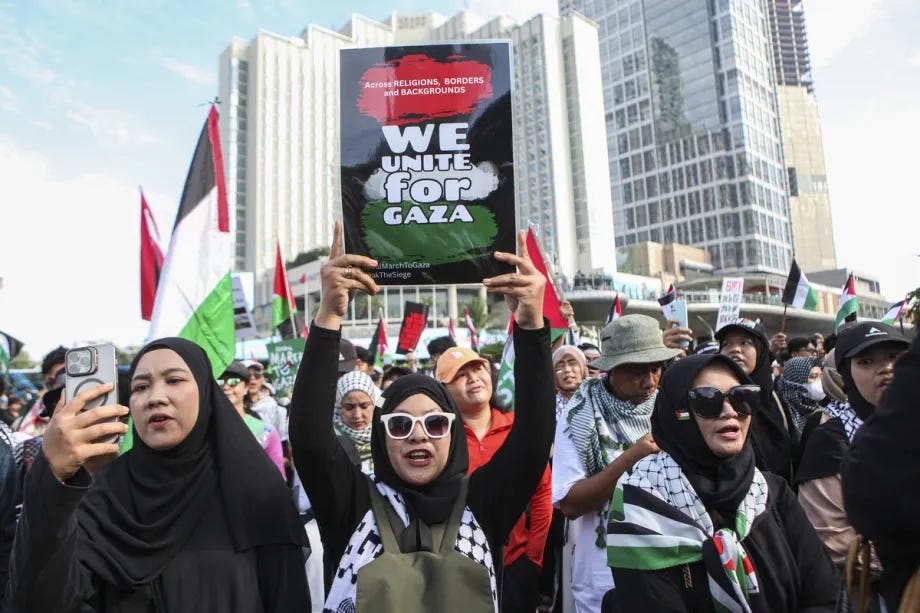
Yet the most profound betrayal is not external. It is domestic. While the state conducts its shadow diplomacy, Indonesian civil society—the mass-based Islamic organisations of Nahdlatul Ulama and Muhammadiyah, the student movements, and the boycott activists—remains fiercely, steadfastly pro-Palestine. A June 2025 poll found that 80 per cent of Indonesians hold unfavourable views of Israel. The public has not changed its mind. The elite has simply stopped listening.
The Indonesian government cannot claim to champion Palestinian statehood while its procurement officials sign contracts with Elbit Systems. It cannot profess anti-colonial solidarity while Israeli irrigation companies operate on its soil. It cannot thunder against Zionism at the United Nations while whispering Shalom behind closed doors.
This is not a policy dilemma. It is a moral bankruptcy. The shadow relationship is not a temporary expedient or a pragmatic adaptation—it is a systematic betrayal of the constitutional mandate to abolish colonialism, of the Pancasila principles that define the nation’s soul, and of the millions of Indonesians who have poured their hearts into the Palestinian cause.
The time has come for transparency. The Indonesian people deserve to know the full extent of their government’s complicity. They deserve parliamentary inquiries, audit investigations, and democratic accountability. They deserve a foreign policy that reflects their values, not the cynical calculus of elite pragmatism.
And the international community—particularly Australia, the United States, and the OECD—must recognise its own complicity. To demand normalisation as the price of economic integration is to weaponise development against solidarity. To treat Papua as a bargaining chip is to perpetuate the very colonial logic that Indonesia’s constitution repudiates.
Indonesia stands at a precipice. It can continue down the path of shadow normalisation, accumulating the profits of complicity while sacrificing its moral credibility. Or it can honour its founding principles, listen to its people, and refuse to trade Palestinian blood for OECD membership.
The choice is clear. The consequences are irreversible. Future generations will inherit the consequences.
