


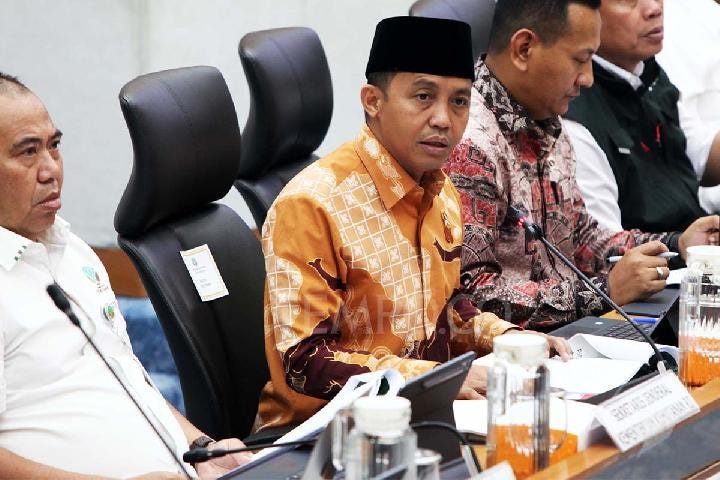
The marble corridors of Jakarta’s presidential palace have witnessed many things, but rarely a silence quite so loud. Vice President Gibran Rakabuming Raka still occupies his office. He still attends cabinet meetings. He still smiles for the cameras during market visits.
Yet the truth is unmistakable: the man elected alongside Prabowo Subianto with nearly 59 per cent of the vote—more than 96 million ballots—has become a hostage within his own government, trapped between a relentless Constitutional Court probe and a coalition strategy designed not to remove him but to render him utterly powerless.
This is not impeachment. It is something more insidious: a slow, methodical political strangulation, conducted entirely within the formal boundaries of constitutional legality.
The mechanics are exquisite in their cruelty. In September 2026, the Constitutional Court advanced Case No. 01/PHPU.PRES-XXIV/2026 to the evidentiary phase, compelling examination of whether Gibran’s Singaporean O-Levels from Orchid Park Secondary School and his fast-tracked credentials from UTS Insearch and MDIS genuinely satisfied the senior high school equivalency requirements mandated by Article 169 Letter R of Indonesia’s Election Law.
The General Elections Commission has admitted on the record that it conducted no direct, cross-border verification of these documents. It processed paper. It did not verify truth.
The political calculus behind this legal manoeuvring is breathtaking. President Prabowo Subianto controls an expansive super-coalition comprising virtually every major party: Golkar, Gerindra, PKB, NasDem, PAN, and the Democratic Party.
This cartel has pushed to raise the parliamentary threshold from four per cent to five per cent, a structural barrier designed to lock out independent movements and family-based networks. For the Jokowi dynasty, this is an existential threat. Stripped of executive influence and lacking formal party machinery, the Solo network faces systematic marginalisation.
But here lies the terrible elegance of the current arrangement. Prabowo does not need to push Gibran out. Under Article 8 Paragraph (2) of the 1945 Constitution, a vice-presidential vacancy would hand the President sole authority to nominate two replacements to the MPR within sixty days. This would trigger an open political war with Jokowi’s remaining loyalists, fracturing the coalition and destabilising foreign investor confidence.
So instead, the administration has perfected what analysts term the “Hostage Vice Presidency”: Gibran remains in office as a ceremonial figurehead, legally defensive, dependent on executive protection, yet entirely stripped of policy influence.
The spatial rearrangements tell their own story. The Vice President no longer sits beside the President during plenary cabinet sessions. Prabowo shifted to a horseshoe arrangement, placing Gibran away from the head table alongside senior ministers. This is not protocol. This is a message to the bureaucracy: there is one centre of executive authority. Gibran has been excluded from strategic domestic legislation, including the One Data Bill, his duties confined to ceremonial functions and localised market visits.
The personal dimension adds another layer of poison. The “Fufufafa” scandal—alleged social media posts from an account linked to Gibran containing vulgar insults against Prabowo and his family—has eroded personal trust, providing nationalist allies with political fuel to openly call for removal. In a political culture that prizes rukun and harmony, these slights carry weight beyond their factual veracity.
The broader implications for Indonesian democracy are profound. The V-Dem Institute now places Indonesia in the “grey zone,” no longer meeting minimum standards of electoral democracy, with both the Core Civil Society Index and Electoral Democracy Index declining to their lowest levels since 2000.
The cartelisation of political power has diminished effective opposition, weakened democratic oversight, and reinforced perceptions of patronage-driven governance. This is not classical authoritarian backsliding. It is something more adaptive: democratic forms preserved, democratic substance hollowed out.
This quiet strangulation of a vice presidency is no longer merely an internal Indonesian affair. For neighbours across Southeast Asia, it is the latest symptom of a deeper malaise with tangible, choking consequences. Indonesia’s democracy has slid into what the V-Dem Institute now classifies as an electoral autocracy, with its Electoral Democracy Index and Core Civil Society Index falling to their lowest levels since 2000.
The Economist Intelligence Unit’s 2025 index places Indonesia at just 6.37 points, ranked sixth globally, a three-year consecutive decline. Transparency International’s Corruption Perceptions Index fell three points to 34 in 2025, dragging Indonesia down to 109th place out of 180 nations.
When accountability evaporates at the centre, it does not stay contained. Between January and July 2026, some 202,010 hectares of Indonesian forest and land burnt, sending transboundary smoke across the Malacca Strait into Malaysia, Singapore, and Brunei, forcing school closures and triggering health advisories. Former Malaysian Health Minister Khairy Jamaluddin did not mince words, calling Indonesia a “banana republic” for its failure to enforce environmental laws and for the ASEAN haze agreement’s lack of teeth.
Moreover, the message to global strategists is unmistakable: when a G20 democracy hollows out its own accountability mechanisms, the cost is paid not just by its own citizens but by every neighbour downwind of its governance failures. Indonesia is not simply failing its own people; it is failing the region it claims to lead.
The lessons are sobering. The Indonesian case shows that constitutional design alone cannot prevent elite capture when the underlying political economy is oligarchic. Institutions can create openings for accountability, but only when paired with a strong civil society, independent media, and mobilised citizens. The Gibran affair mirrors the fragility of democratic achievements and the enduring power of elite cartels.
The question is not whether Indonesia will return to authoritarianism, but whether it will continue its gradual descent into a competitive authoritarian regime where elections are real but unfair, and institutions are formal but captured.
The hostage survives. But the Republic is diminished.
