


A line drawn on a map can sometimes feel abstract—until it begins to erase lives. Israel’s newly declared “Yellow Line” in southern Lebanon is not merely a tactical demarcation; it is the latest manifestation of a doctrine that has steadily reshaped realities from Gaza to the Levant’s northern frontier. What is unfolding is not an isolated security manoeuvre but a pattern—one that raises profound questions about sovereignty, legality, and the durability of international norms.
In April 2026, Israel publicly marked a 5–10 kilometre zone inside Lebanese territory that it intends to control, backed by the deployment of five military divisions and naval support. As is typical of official Israeli framing, the move is presented as a buffer against Hezbollah, echoing long‑standing strategic thinking in which distance equals security.
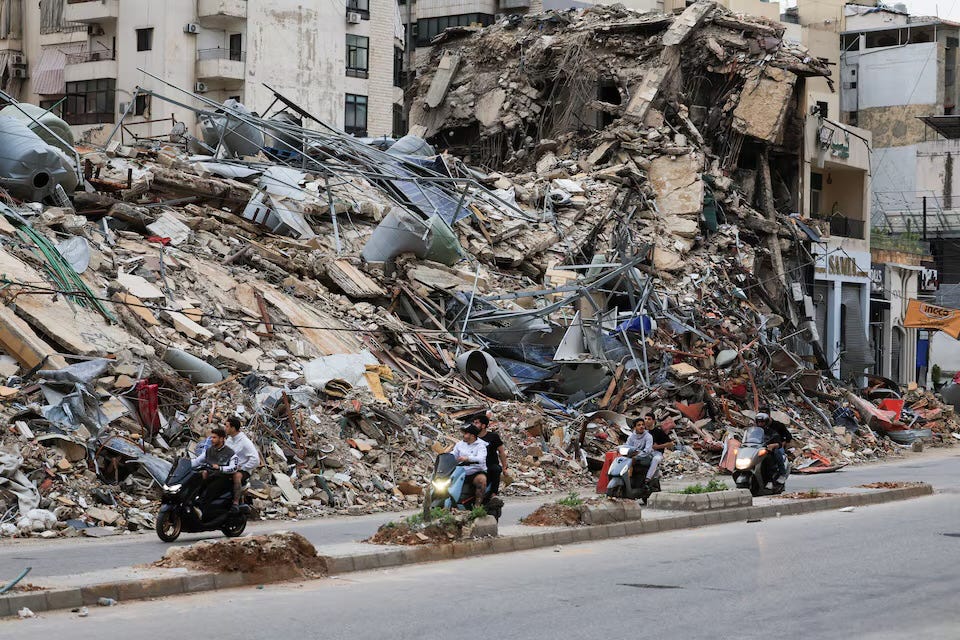
Yet, as has become familiar, the human and political cost of this logic is staggering. Entire villages have been flattened, not in the heat of battle but often after hostilities had subsided. Amnesty International has documented widespread destruction where no active combatants were present, casting serious doubt on claims of military necessity.
There is an uncomfortable familiarity to this approach. Gaza has already served as the testing ground. There, similar “buffer zones” have expanded and contracted in pursuit of military objectives, leaving behind depopulated corridors and devastated infrastructure. The replication of this model in Lebanon signalssomething more deliberate than reactive defence. It suggests a transferable doctrine—one that normalises the systematic emptying of civilian spaces under the language of security.
The numbers tell a bleak story. By late April, about 62,000 homes in southern Lebanon had been destroyed or severely damaged, displacing more than a million people. Water systems, electricity networks, and medical facilities have not been spared. Within days of the escalation, strikes on at least seven major water installations were recorded. As the International Committee of the Red Cross has bluntly warned, a war on essential infrastructure is a war on civilians. Such actions risk crossing the threshold into collective punishment, which is prohibited under international humanitarian law.
What makes this moment particularly consequential is not only the scale of destruction but its strategic layering. Southern Lebanon is not just contested terrain; it is resource-rich and geopolitically sensitive. The Israeli-defined buffer zone encompasses areas linked to offshore gas fields, including the disputed Qana prospect. Even though exploratory drilling has cast doubt on the field’s immediate viability, its symbolic and future economic value remains significant.
Control over such an area has far-reaching ramifications beyond immediate security concerns, including long-term economic leverage and regional energy politics.
Water, too, sits at the heart of this unfolding crisis. The Litani River basin, a vital resource for Lebanon, lies within reach of the newly asserted zone. Analysts and local experts increasingly interpret the strategy as one that intertwines security with resource control. In a region where water scarcity is intensifying, such dynamics cannot be dismissed as incidental. They risk embedding environmental and economic asymmetries into an already volatile conflict.
From a legal standpoint, the “Yellow Line” occupies deeply contested ground. International law does not recognise unilateral buffer zones imposed by force. Protected or demilitarised areas require mutual agreement to carry legitimacy. Lebanon’s government has unequivocally rejected the arrangement as a violation of its sovereignty, and rightly so. When borders become fluid under military pressure, the foundational principle of territorial integrity begins to erode—not just for Lebanon, but for the international system as a whole.
The ambiguity of ceasefire frameworks compounds this erosion. The current arrangement, brokered with external mediation, simultaneously calls for cessation of hostilities while preserving Israel’s right to self-defence. This duality creates a permissive environment in which continued military actions can be justified, even as they undermine the spirit of the truce. Reports of hundreds of violations within days underscore how fragile—and perhaps illusory—such agreements can be.
For global strategists, the ramifications go far beyond the Israel-Lebanon border, pointing to a very troubling pattern in which military doctrine, resource ambition, and territory domination merge under the guise of security. What is happening is not just the creation of a temporary buffer, but the systematic hollowing out of civilian life—through widespread destruction of homes, deliberate targeting of water and energy infrastructure, and the forced displacement of more than a million people—actions that leading humanitarian organisations have warned may constitute war crimes.
The repetition of this model, first refined in Gaza and now transposed onto southern Lebanon, signals an emerging strategic continuity: depopulate, dominate, and redraw the operational landscape in ways that blur the boundary between defence and de facto annexation. The inclusion of resource-rich zones—whether offshore gas fields like Qana or critical water systems linked to the Litani basin—deepens concerns that this is not solely about neutralising threats, but about reshaping control over land and assets in ways that could become irreversible.
The moral weight of this reality is profound: entire communities erased, return rendered uncertain, and sovereignty reduced to a negotiable concept under military pressure. For the international system, the danger lies in the precedent—if such actions are absorbed without consequence, they risk normalising a doctrine where overwhelming force can reorder borders and lives alike, leaving international law diminished and collective trust dangerously eroded.
There is also a deeper, more intangible cost: the corrosion of trust. International law relies not only on enforcement but on shared belief in its legitimacy. When powerful states are perceived to operate outside these boundaries with limited consequence, that belief weakens. The result is a more fragmented and unpredictable global order, where smaller states feel increasingly vulnerable, and alliances become more brittle.
Sustainable security cannot be achieved through territorial denial alone; stability emerges from political agreements, mutual recognition, and the protection of civilian life. The current trajectory in Lebanon—and previously in Gaza—moves in the opposite direction. It entrenches grievances, fuels displacement, and risks perpetuating cycles of violence that no buffer zone can contain.
There is an emotional weight to this as well, one that cannot be captured solely through policy analysis. Entire communities are being transformed into no-man’s lands, their histories buried under rubble. The psychological imprint of such displacement lingers for generations, shaping identities and narratives that resist reconciliation.
For middle powers, and indeed the larger community of nations that rely on predictability rather than abstract force, the current moment necessitates considerably more forceful diplomacy than cautious diplomacy. When patterns of widespread destruction, forced displacement, and targeting of civilian infrastructure are met with ambiguous language or procedural delays, a dangerous signal is sent: that the erosion of international law can occur in increments, unchallenged, until it is truly embedded.
The issue is no longer confined to one geography; it reverberates through every region where sovereignty rests not on power but on recognition. If the deliberate flattening of villages, the weaponisation of water and electricity, and the quiet expansion of territorial control under security pretexts are absorbed into the normal conduct of statecraft, then the rules that protect smaller nations begin to fracture. What is at stake is not simply accountability for one actor, but whether the international system retains any meaningful red lines when confronted with sustained, systemic violations.
At a deeper level, this is a test of whether global governance can still function as a moral and strategic anchor in an increasingly fragmented world. Diplomatic engagement must evolve beyond ritual statements into coordinated pressure that carries consequence—through independent investigations, legal mechanisms, and the protection of civilians as a non-negotiable priority rather than a rhetorical afterthought.
There is also a need for imaginative statecraft: coalitions that cut across traditional alliances, resource-sharing frameworks that reduce incentives for territorial capture, and enforcement mechanisms that restore credibility to international commitments. The moral gravity cannot be overstated—entire populations watching their homes erased, their futures suspended, while the world deliberates.
If this moment passes without clarity or conviction, it risks entrenching a precedent where power redraws reality and law struggles to keep pace, leaving a generation to inherit not a rules-based order, but a landscape shaped by the endurance of the strongest.
What is at stake is not just the future of southern Lebanon or the security calculus of Israel. It is the credibility of a global system that claims to balance power with principle. Lines on maps will always be drawn and redrawn, but when they are etched through the displacement of civilians and the erosion of sovereignty, they leave scars that extend far beyond their borders.
The Yellow Line, then, is more than a boundary. It is a test of law, of leadership, and of whether the international community is willing to confront the uncomfortable realities of power when it collides with principle.
