


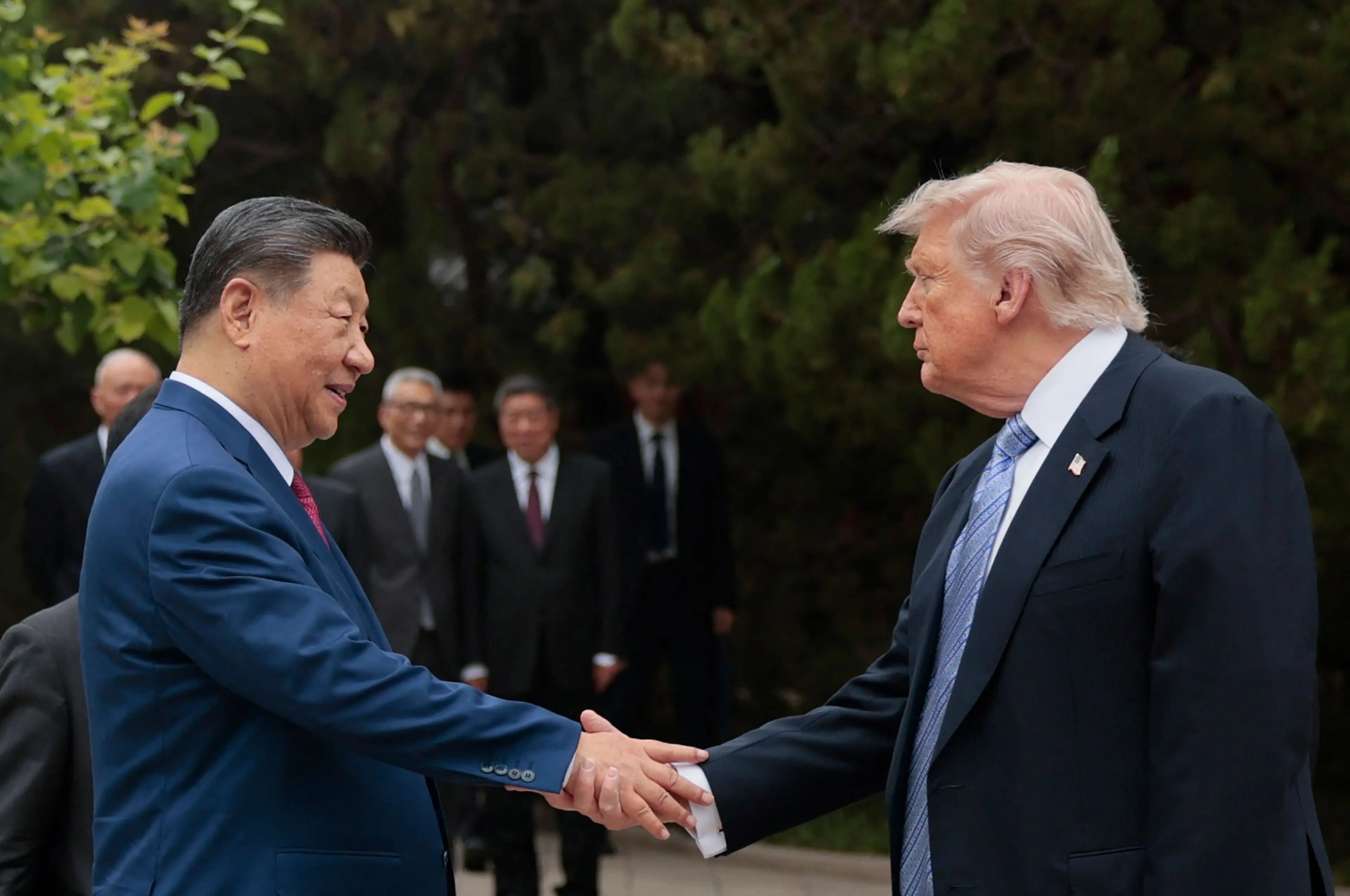
US President Donald Trump left Beijing at the end of a two-day state visit to China on Friday, 15 May, without achieving any of the goals set before the commencement of the first such trip in nearly a decade.
For the US, a successful trip to China would have meant progress on trade bottlenecks including tariffs, visible promises of more Chinese purchases of US goods, including aircraft and advanced technologies, cooperation on Iran and the Strait of Hormuz, and easing of the restrictions on rare earth exports imposed by last year.
None of these happened, and President Xi Jinping even warned the US against crossing stated red lines in the two countries’ relations.
The visit was nevertheless termed by the Chinese as a “historic and landmark one,” with an overall positive tone of promising commitments on future cooperation for mutual development.
During a private meeting at Zhongnanhai complex in Beijing between the two leaders on Friday, Xi proclaimed that the “two sides have set the new vision of building a constructive China-US relationship of strategic stability.”
Xi also insisted that both the countries have agreed to work for “peaceful coexistence and win-win cooperation on the basis of mutual respect” in the coming days, as good relations between US and China are essential for global peace and development.
Trump agreed with Xi during the press conference. He even claimed his visit to China had captured the world’s attention, was very successful, and unforgettable. He asserted that both sides made a lot of progress on various issues of mutual interests without going into the specifics.
On Taiwan
Reiterating comments made by China on several occasions in the past, Xi reportedly told Trump again on Thursday that Taiwan was the most important issue in China-US relations—and a red line.
He told Trump that if the US approach this topic properly, the bilateral relationship will enjoy stability. Otherwise, both sides can expect clashes or even conflict.
The US has been using Taiwan as a flashpoint to target China both politically and economically. It has supported the separatist forces there and pumped weapons worth billions of dollars under the guise of its supposed “legal obligations” despite Chinese objections.
While Trump refused to comment on the Taiwan issue while in China—despite being explicitly asked by the press—Secretary of State Marco Rubio later claimed that his country’s position on the topic remains the same.
On Iran
On Thursday, Trump underlined a “shared desire” of the US and China to open the Strait of Hormuz. However, China refused to make any public statement on the US request to push Iran to open the Strait, which has been partially blockaded in response to the US-Israeli war.
Both the countries agree that the opening of the Strait is crucial for global energy supplies and free navigation, however, there is a difference between them on the ways to do so.
Trump wants an international coalition to force Iran to open the Strait, if necessary by using force. On the other hand, China has maintained that the closure of the Strait was a result of the war and that only the end of the war can lead to its opening.
Although Trump claimed during a TV interview on Thursday that Xi agreed that Iran should never have nuclear weapons and must open the Strait of Hormuz, the Chinese Ministry of Foreign Affairs issued a statement on Friday condemning the US-Israeli war on Iran saying it “should never have happened and has no reason to continue.” It supported the ceasefire and negotiated settlement of all the disputes including the Strait of Hormuz.
Nevertheless, Rubio reiterated his country’s insistence that China vote in favor of a UN Security Council resolution authorizing the use of force to open the Strait.
The vote on the resolution proposed by the US and Bahrain and supported by over a hundred other countries, is pending. China and Russia had vetoed a similar resolution in March.
On trade
Trump was looking for lucrative trade deals during the visit, as made clear by the number of the world’s top CEOs participating in the US delegation to China. However, unlike his previous visit in 2017, when he got trade deals worth billions of dollars, no clear promises were made by the Chinese this time.
The only major commitment made by China was to buy 200 Boeing jets, the first such deal in almost a decade. However, the number of jets China agreed to buy from the American company was far less than the expected number of 500. This caused a fall in the company’s share prices after the news became public.
There were no explicit deals on the rare earth minerals supply as well. China restricted the sale of rare earth minerals to the US following Trump’s tariff war launched in April last year.
Reuters reported on Friday that Chinese restrictions on the sale of rare earth minerals have affected the production in American chip-maker and aerospace companies.
China controls around 90% of world’s rare earth minerals production crucial for the production of advanced technology goods, including defense equipment.
Though the White House claimed that China has agreed to buy more oil from the US in order to reduce its dependence on the Persian Gulf region, the amount and nature of the deal was not confirmed by the Chinese.
On tariffs, it seems both the countries agreed to maintain the status quo agreed in October last year when Xi met with Trump during his visit to South Korea, and refrained from tackling the issue during the most recent visit.

While there is not a new deal with the rare earth minerals, which US uses to make weapons and spying satallites, China still sells the US some but not as much as US wants. I wouldn't call that a strong take on China's side since selling a few still makes them a warmonger for US many wars.
Here is what a more knowleadable website writes.
"Despite a one-year trade truce in late October, it appears that China is still scaling back on rare earth shipments into the US. Exports of minerals like yttrium, dysprosium and terbium — all of which are critical to advanced technologies — are still down roughly 50% compared to the 12 months preceding the controls, the latest customs data revealed." https://www.mining.com/trump-leaves-beijing-with-no-rare-earth-deal-confirmed/