


Narratives in international diplomacy are best formed through an organic process as the variables in any given situation get played out in the fullness of time, and a “new normal” accrues as critical mass. Or else, they risk being false narratives.
A classic case is the western narrative regarding Ukraine following the Russian intervention in 2022. No sooner than Biden’s presidency ended, the globalists began unravelling.
The US’ European allies find themselves abandoned today and are in an embittered lot, unable to coherently explain their continued espousal of Ukraine’s eligibility for EU membership—let alone their advocacy of the war itself.
A similar thing is happening over US President Donald Trump’s state visit to China. Even as the visit got under way, a narrative surfaced that Trump’s Chinese hosts snubbed him by extending a low-level reception when Air Force One landed, that President Xi Jinping dominated him, that Trump uncharacteristically caved in, etc. Some have rushed to pass verdict that we are witnessing another “Suez moment” like in 1956, heralding the decline of a reigning superpower (US) and the ascendance of another superpower (China).
Trump’s detractors in the US and abroad decry that he came away empty-handed without achieving any breakthrough in US-China relations or claiming any “takeaways” and that he allegedly allowed his Chinese host to dominate him.
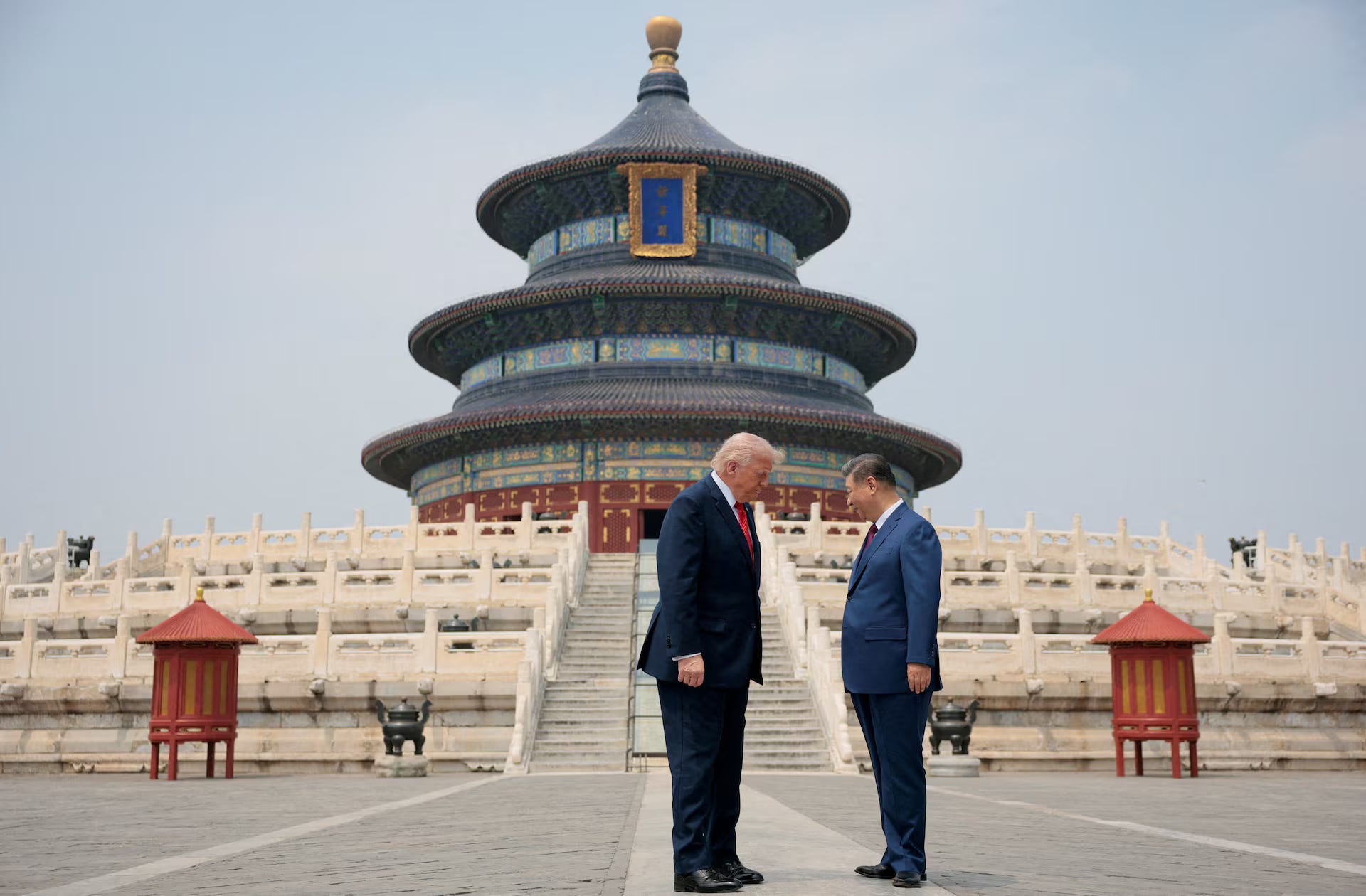
But the fact of the matter is that the Chinese hosts extended an exceptionally warm reception for Trump. Trump’s itinerary included a rare tour of the hallowed grounds of the ancient Temple of Heaven complex, accompanied by Xi, which Singapore-based Channel News Asia noted as “peace, prosperity, political legitimacy—and perhaps even ‘heaven’s will’. There was no shortage of symbolism … in what appeared to be one of the most carefully choreographed moments.”
Seldom do summits descend to the “working level.” Besides, in this case, according to reports, Trump and Xi are expected to meet four times this year, and, obviously, there is a time and place for conducting business.
If the main agenda was to reinforce the personal equations between the two leaders, to keep the US-China tensions under check and to choreograph a pathway to navigate the US-China relationship in an incredibly complicated international milieu, the state visit seems to have served its purpose.
This comes out vividly in the measured words of Xi, a taciturn politician, while framing his four-hour discussions with Trump: “Basically, this visit has been a historic and symbolic one during which we have established a new bilateral relationship, a constructive and strategically stable one. It can be described as a milestone event. Moreover, we have achieved many results in our cooperation, and it has contributed greatly to international issues.” [Emphasis added.]
The above carefully chosen words capture the essence of Trump’s state visit. In strategic terms also, Trump’s subsequent disclosure that the “Taiwan question” figured prominently in the talks merits particular attention as a substantive exchange, as it would surely have contributed to the emerging “constructive and strategically stable relationship” that Xi later alluded to.
On his part, Xi spoke in apocalyptic terms about Taiwan being a potential flashpoint. Trump revealed that Xi had spoken emotionally about Taiwan, saying China had possessed the island “for thousands of years, and then at a certain period of time it left, and we’re going to get it back.” But, as Trump put it, “Xi does not want to see a fight for independence.” I did not make a comment on it. I heard him out.” Trump added that he made “no commitment either way.”
Trump also touched on the massive $14 billion arms sale to Taiwan under discussion. As he flew back to Washington after wrapping up critical talks in Beijing in which both leaders said important progress was made in stabilising US-China relations, Trump gently let it be known, after hearing Xi’s concerns, that he has not made a decision yet on whether to move forward with such a major arms package for Taiwan.
Trump let the remark hang in the air but also hinted at which way his mind could be working: “I will make a determination. I’ll be making decisions. But, you know, I think the last thing we need right now is a war that’s 9,500 miles away.”
Indeed, Trump’s remarks on Taiwan, especially his refusal to explicitly reaffirm the US’ support for Taiwan, have upset Taipei.
Meanwhile, Trump also disclosed the potential for easing sanctions in the coming days affecting Chinese companies buying Iranian oil, signalling a major recalibration of policy that would have a direct bearing on the tense situation surrounding the Strait of Hormuz. Indeed, his remark that Xi also wants to end the Iran conflict and offered assistance needs to be taken seriously.
Evidently, Moscow is anxious to figure out the implications of the talks in Beijing for the US-China-Russia triangle. President Vladimir Putin is heading for a day-long visit to Beijing on Wednesday. Although there is no evidence of Trump trying to drive a wedge between Beijing and Moscow and despite China’s commitment to the “comprehensive strategic partnership of coordination” with Russia and their mutual affirmation of the relations as “not allies, but better than allies,” etc. It is entirely conceivable that the ground beneath the feet of the three superpowers could be shifting.
Xi welcomed Trump at his official residence, Zhongnanhai, on Friday for their final engagement before the latter’s return to Washington. The two leaders reportedly took a short walk through the grounds that feature ancient trees and Chinese roses and strolled through a covered passageway with green columns and archways painted with birds and traditional Chinese mountain scenes.
An Associated Press dispatch captured the atmospherics of it: “Trump appeared impressed by the bucolic grounds, remarking that the roses were the most beautiful he had ever seen.” Xi promised to send him some rose seeds.”
The Kremlin won’t be alone in harbouring a sense of uneasiness. India too is in the same boat. Delhi must now purge the delusional hopes of being a “counterweight” to China in the US calculus. A former Indian foreign secretary, a leading China hawk until recently, has advised the Modi government that a reassessment of the Quad is overdue. But it is easier said than done, given the mindset of the Indian elite.
Putin is far better placed in this respect, having no illusions about the long history of the US’ betrayals, backtracking, and hegemonist instincts which all but preclude the scope for a mutually respectful, equal partnership.
By coincidence or not, Putin announced the deployment of Russia’s new Sarmat strategic nuclear intercontinental ballistic missile at the end of this year after its successful test launch on Tuesday.
Putin disclosed in televised comments that the superheavy missile with a yield four times greater than any Western equivalent and a range exceeding 35,000 kms “has the ability to penetrate all existing and future anti-missile defence systems. This is the most powerful missile system in the world.”
