


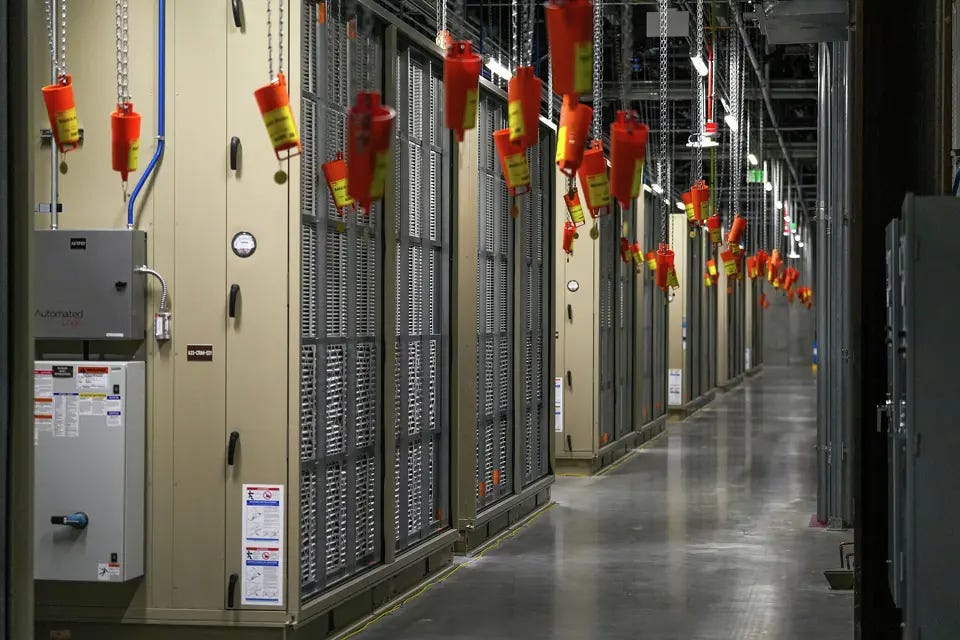
And the real contradiction—a post-productive economy trying to fund an AI future on mountains of debt—is never resolved. It is only papered over until the paper itself tears.
We are witnessing an unprecedented historical inversion: a post-productive, hyper-financialised economy is attempting to finance the most capital-intensive technological transformation since electrification—not from surplus value or productivity gains, but from debt created out of thin air; more debt than has ever been issued in the history of humankind.
Over the next two years, the AI/data centre build-out requires $1.8 trillion in capital expenditure (capex). Morgan Stanley now expects hyperscaler capex alone to reach roughly $2 trillion over 2026-2027. And the tech sector accounts for 20% of all investment-grade bond issuance—double its historical share. The traditional bond market is saturated and the banks are tapped out.
In June 2026, Blackstone capped redemptions on its $79 billion private credit fund after requests hit 10%, while D.E. Shaw informed clients that from January 2027, investors in its flagship hedge fund would need four years to fully exit—both firms citing the need to protect portfolios against “future crises.” The message couldn’t be clearer: as in the famous South Park episode, the liquidity “is gone.” Meanwhile, Goldman Sachs projects $1.175 trillion in US equity supply in 2026—IPOs, secondaries, and lock-up expirations—just as hyperscalers like Meta post negative free cash flow and consider stock offerings because they can no longer fund their AI ambitions from operations. Add to this the approximately $900 billion in US corporate debt maturities coming due in 2026 (rising to nearly $1.5 trillion by 2028, according to S&P Global Ratings), and the picture is one of a market being squeezed from both sides: equity supply flooding in, debt needing refinancing at higher rates, and cash flow nowhere to be found.
Clearly, this is not a cycle but a structure. And the structure is saying: we have borrowed more than the real economy can ever even dream of repaying—and we can’t stop. The key point about this speculative economy is that a fictitious increase in value is achieved without any mass mobilisation of productive labour. Essentially, the growth of wealth is only simulated through credit creation. And, as Robert Kurz already understood back in the mid-1990s: “Should the entire mountain of fictitious commercial values be set into motion as real effective demand, this would lead to an immediate situation of hyperinflation even in the West.” While this hyper-inflationary potential has so far been cynically exported to the neglected peripheries of the globalized world, it now constitutes a real threat for the “advanced” capitalist countries too—especially when we consider the ongoing grotesque expansion of the speculative sector. We should therefore heed the warning: there is no “capitalist alternative.” The wealth generated through fictitious speculative growth cannot be mobilised to serve the reproduction of life in the real economy. It can only crash or further inflate—which are both destructive options.
The Contradiction
Capital today is caught in a contradiction it cannot resolve on its own terms. It requires endless growth to service debt and justify valuations, but the real economy is already post-productive—no longer capable of generating the surplus that endless growth demands. So capital aggressively borrows from the future—it has done so for decades. It financialises with no end in sight, which is its specific way of papering over an impasse now grown explosive.
Capital doesn’t merely repress but forecloses this contradiction, in an attempt to endlessly postpone the reckoning. And yet the contradiction remains, spreading from balance sheets to private credit to energy grids to the very possibility of social reproduction. Psychoanalysis tells us that a radically repressed (foreclosed) contradiction doesn’t disappear but returns in the real—in shocks and traumas so violent that they defy interpretation, comprehension, as well as any attempt to hide and manipulate it.
The Trap
Here is the core of the frustration we’re currently experiencing. While the contradiction returns in the form of a collapsing civilisation (wars, immiseration, manipulation, destruction of the social bond, more suffering), we continue reaching for the only language we know: the labour-capital narrative and its supposedly modern and progressive dynamism. This is the old script that ideologically prevents us from seeing that financialisation is nothing but a destructive, even catastrophic reaction to the historical failure of that script itself.
However nostalgically attached we might be to the labour-capital relation (and for all the good reasons one can think of), nothing should stop us from seeing that it is hopelessly outdated. The value-form itself—the measure of social activity by abstract labour time—has become detached from any material anchor. We live in a world ruled by fictitious capital, by derivatives piling on derivatives, by debt that services debt that services more debt. And by political technocrats appointed precisely to serve that degenerative disease we call the economy.
As of the end of March 2026, global debt has reached a record high of nearly $353 trillion (305% of global GDP), and U.S. federal debt alone is currently over $39 trillion. Just in the first three months of 2026, the world added $4.4 trillion in new debt. How is this the most efficient system we can think of? A system that apparently still believes in capital’s dynamic productivity (wealth creation via investment in labour ingenuity) and yet is mortally addicted to debt-creation—a system that punishes most people while rewarding only a handful of the superrich.
To respond to collapse with the old narrative is to close the door on the new. It is to mistake the form of the crisis for its content: the obsolescence of the value-form itself. This is precisely what so many critics of the greedy financial system do. For either lack of imagination or intellectual courage, they opt not to question the foundational erosion of the labour substance within a modern (capitalist or socialist) work society, thus remaining trapped in a bad infinity of moral outrage that never reaches the thing itself. By not going there, they can pretend they are outside looking in, externalising the problem, projecting it onto external agents rather than seeing it as systemic. Which is much harder to do.
The Opening
Here is the Hegelian wager: the explosive contradiction that capital has turned into—a post-productive economy funding its future on debt that can never be repaid—is not a problem to be solved within the existing framework. It is a signal that the framework itself is exhausted, and that we must open to a truly new future.
What would that mean? We cannot fully know. That is the terror and the promise. But we can glimpse fragments: social activity (work) measured by need rather than time; production organised around use rather than exchange; a social relation that does not require the subordination of living labour to dead labour; and, crucially, a mode of life enjoyment that subtracts from the compulsion of profit-making. They are directions that at some point in the future will have to form new social bonds, new habits blessed with truly alternative social meaning, and a new language naming what we will have become. It is the only way out; the way history develops dialectically. This is what Hegel meant by sublation: not suppression, not papering over, but the violent and creative lifting of contradiction into a new form.

The gamblers at the casino are all still at the table and the betting goes on even though the ‘agreed’ limits for individual indebtedness were exceeded some time ago. And though each round has a winner who collects (from the other gamblers) everyone is getting further and further into debt with the House.
But no-one leaves the table for to do so would mean acknowledging their debt to the House and repaying it. And they have no means of doing so beyond exchanging their gambling debt for a personal loan which is significantly greater than the value of all their assets. Who would offer them such a loan?
And so the gamblers gamble on oblivious to their predicament believing that it will just take one ‘big win’ and their problem will be solved.
The House watches on with a mixture of greed and alarm. The Manager wants the game to stop and debts paid off but he fears none of the gamblers can pay. He too is a gambler and he too wants to win big. And this is, he knows, the ‘big one’. But he realizes that the House too may well crash and burn in an enormous blaze of collective debt.
Meanwhile outside families of the gamblers wait oblivious to their fate, their family assets mortgaged many times over.
So, what to do? Who to save? What to save? How to save?
just for info, we have been analysing the seed forms of the emerging 'contributory economy' for 15 years. If you look carefully at the fragments, more can be known than generally expected (as the ancient Chinese Taoists already knew); https://wiki.p2pfoundation.net/Category:Mutual_Coordination