


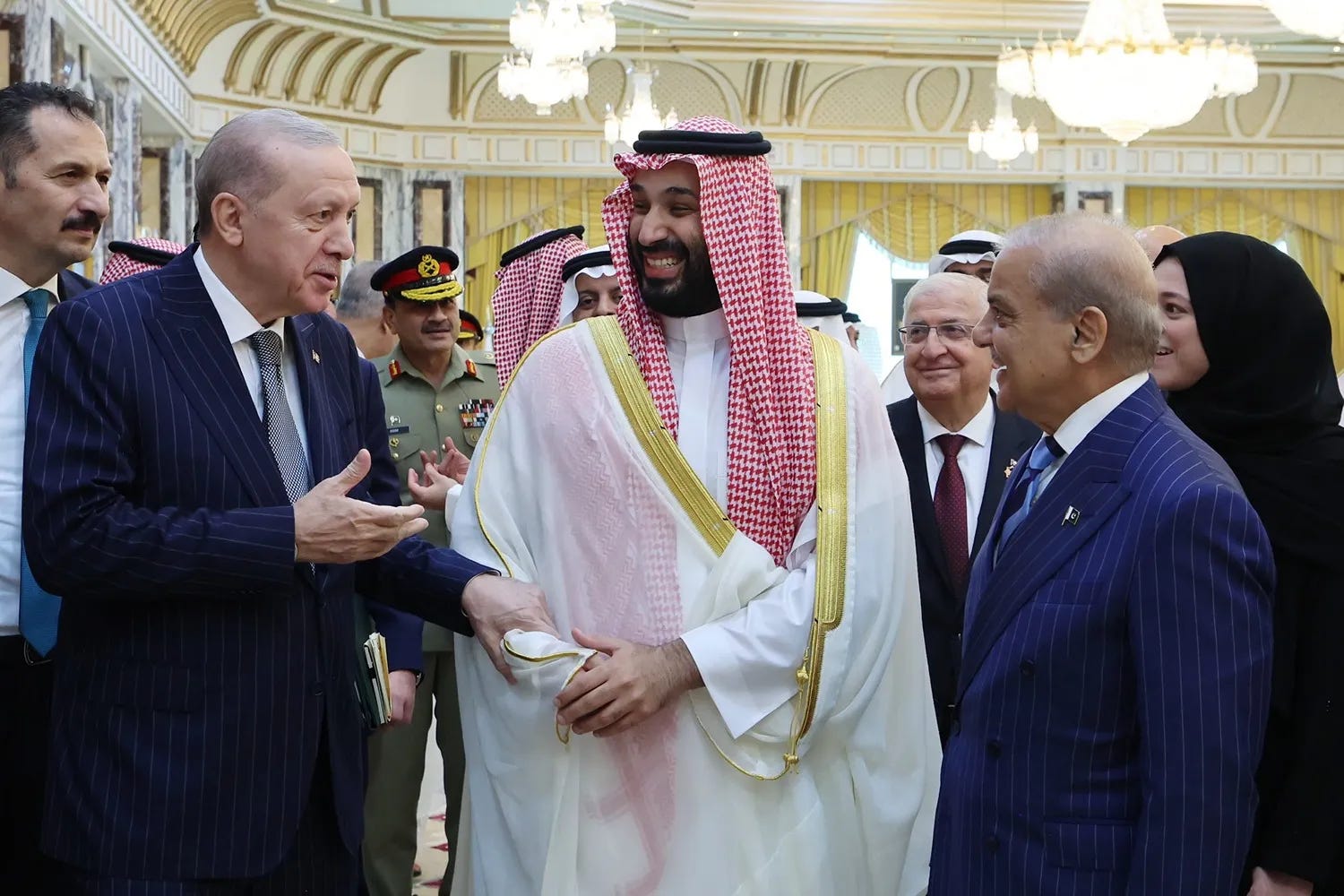
A historic mutual defence pact called the Mecca Joint Defence Agreement was signed by Saudi Arabia, Türkiye, and Pakistan on 7 August. It stipulates that an attack on any single member nation constitutes an attack on all three. Representatives from the three nations maintain that it is purely defensive while remaining open-ended for other aligned nations to potentially join.
Iran welcomed the agreement, calling it a sign of the growing realisation in the region that they “cannot trust the US and other extra-regional countries to provide them security.”
“Given developments over the past two or three years, regional countries have realized that security is not a commodity that can be purchased from false security brokers,” Esmail Baghaei, official spokesperson of Iran’s Foreign Ministry said in a regular press conference in Tehran on Monday.
He also rejected speculations about Iran being the target of the regional security arrangement, claiming his country has nothing to worry about the pact because of its “deep-rooted bonds” with all three countries.
Iran’s reaction to the pact announced last week largely reinforces the assurances given by leaders of Pakistan and Türkiye.
Both Pakistani Prime Minister Shehbaz Sherif and Turkish Foreign Minister Hakan Fidan have dismissed the arguments about a possible Iranian threat being the motivation behind the Mecca Accord as it is informally referred to.
Both underlined the fact that talks for such a regional arrangement had been taking place much before the US-Israeli war on Iran began. Turkish FM Fidan claimed talks began around three years ago. Fidan claimed the failure of existing security arrangements under the umbrella of “external hegemons” in the region has played a significant role in pushing the parties to come together.
“External hegemons coming into the region do not solve the problems; they make them more acute, and the cost becomes very high,” Fidan said during an interview with Anadolu Agency, underlining the need for countries in the region to develop their own mechanisms and institutions to resolve their security and economic issues.
US failures to curb Israeli expansionism
The signatories of the Mecca Accord emphasised deterrence without naming specific threats and expressed hope that more countries in the region would join the accord in the coming days.
They have all underlined that the motivation behind the collective security arrangement was the ongoing wars in the region and growing threats of expansionism.
Despite the fact that Tukiye is already a NATO member and Saudi Arabia has several large US military bases, both have realised the precarity of their security situation and economic interests in the last few years.
Israel launched a war in Gaza in October 2023 and has since invaded and occupied lands in Lebanon and Syria, and attacked Iran and Yemen. In September last year, it also launched a strike inside Qatar, home to one of the largest US bases in the world.
Israel has committed genocide in Gaza and continues to practise violence and apartheid in other occupied Palestinian territories. It has violated international laws and the territorial integrity of several countries in the region in carrying out the assassination of Hamas and Hezbollah leaders without facing any repercussions.
Israeli leaders have threatened attacks against Türkiye as well over its opposition to genocide in Gaza. The growing possibility of a geostrategic confrontation in Syria after the fall of Bashar al-Assad’s government has further intensified the tensions between both countries.
Lately, they have also pushed the narrative of a “greater Israel” which envisages grabbing land mostly from long-term regional allies of the US.
Successive administrations in the US have not only failed to stop Israeli aggressions and reassure its allies by taking a strong stance against the “greater Israel” concept but instead actively defended its actions, doubled military support, and even participated in wars.
The US has dragged Saudi Arabia and other countries in the region into its war with Iran by using its military bases located in these countries. It has also failed to protect them when the Iranians retaliated.
The failure of the US to stop Israel and provide protection from Iranian retaliations together had pushed these countries, hitherto relying on its military might, to seek alternative arrangements.
Aims to strengthen collective security
Though the details of the agreement signed by Pakistan’s Prime Minister Shehbaz Sharif, Turkish President Recep Tayyip Erdoğan and Saudi Crown Prince Mohammed Bin Salman are still patchy, the joint statement issued by the parties on Friday, 7 August, confirms that it has the provisions of a collective security arrangement.
The arrangement is similar to Article Five of the NATO Agreement, according to Fidan. This means the signatories would consider an armed attack on one of them an attack on all three.
However, there is no explicit obligation to use force in the agreement. It largely provides for greater security-related cooperation and coordination among the signatories without any compulsion to use force on each other’s behalf during a conflict involving one of them.
Pakistan has also claimed that the Mecca Accord is very similar to the Saudi-Pakistan Strategic Mutual Defence Agreement signed last year and builds on its provisions rather than superseding them.
The signatories have claimed the pact is purely defensive in nature and “aims to strengthen collective security and promote peace, security and stability in the region and beyond.”
