


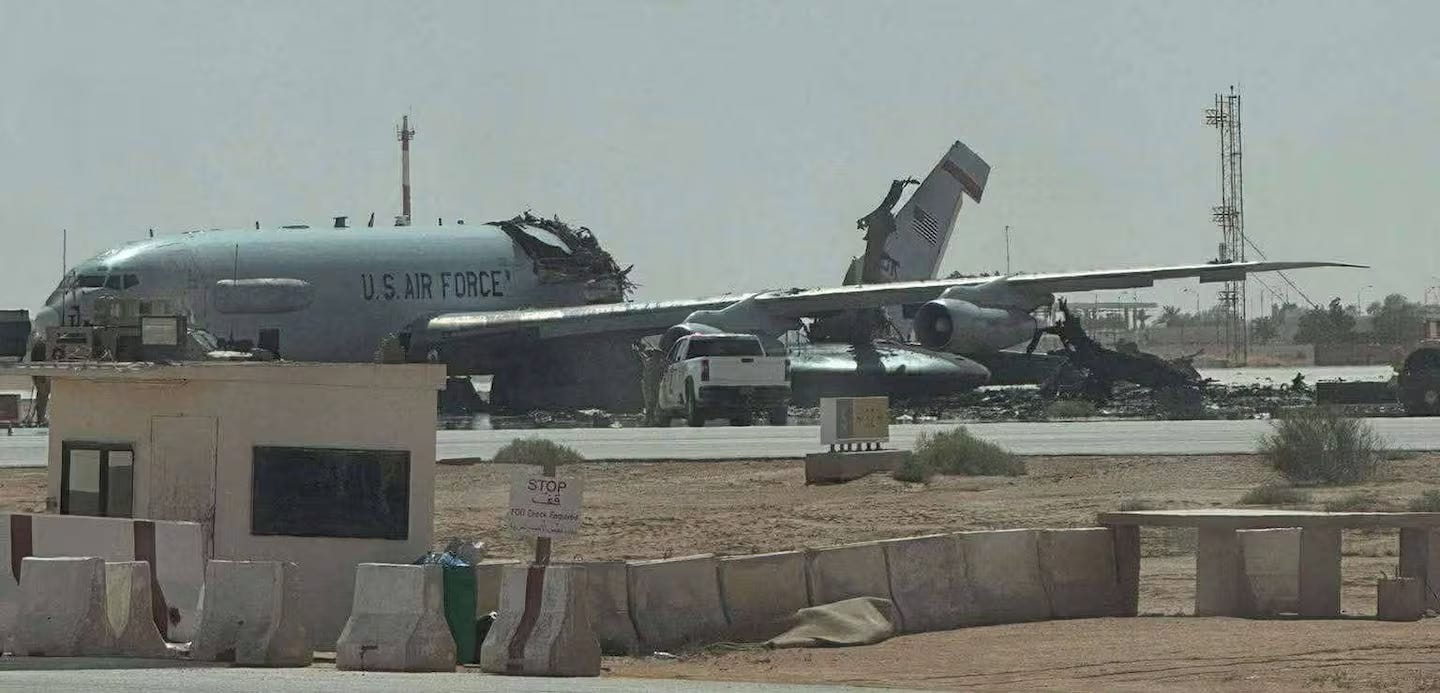
The US will hit Iran “very hard” today, said US President Donald Trump from the Oval Office on 10 June. In a Truth Social post earlier, he claimed Iran had taken too long to negotiate a deal and now “will have to pay the price.” Trump’s threats came after fresh US attacks on Iran on 9 June, which prompted retaliation from the Islamic Republic.
“Despite its defeat on the battlefield, the US opted to test our determination. Our powerful armed forces will leave no attack or threat unanswered. Leave our region if you want to be safe,” Abbas Araghchi, Iranian foreign minister, said in a post on X on Wednesday, 10 June.
Araghchi’s warning came hours after Iran targeted several US military bases in the region in retaliation for strikes on its Hormozgan Province in the early morning, particularly targeting civilian facilities, including water supply facilities, in the regions of Jask and Sirik near the Strait of Hormuz.
The Islamic Revolutionary Guard Corps (IRGC) claimed its missiles and drones targeted the US navy’s fifth fleet base in Bahrain and its military bases in Kuwait and al-Azraq in Jordan, including the F-35 shelters.
Earlier, the US Central Command launched air and missile attacks on several locations in Iran, calling them “self-defence” and “proportional response” strikes after accusing Iran of downing one of its Apache helicopters near the Strait of Hormuz on Monday.
The US claimed to have targeted Iranian air defences, ground control stations and surveillance radar sites near the strait with precision munitions and declared that no further strikes would be initiated unless there was “unjustified Iranian aggression.”
On Tuesday, after US President Donald Trump acknowledged the downing of the Apache helicopter, Iran denied its role and warned that its armed forces would retaliate if attacks were carried out.
Araghchi had argued that “foreign forces in proximity of our territory are at a constant risk on account of their own human errors, plain accidents, or potentially being caught in crossfire.”
He repeated that all foreign forces should leave the region in order to avoid such risks.
Calls for peace in the region
Reacting to the news of the fresh round of US attacks on Iran and its retaliation, China called for an end to hostilities and demanded both parties “remain calm, exercise restraint, stop exacerbating and escalating tensions and take concrete measures to ease the situation.”
Russia also expressed concerns over the fresh hostilities, demanding both sides exercise restraint and “immediately cease military attacks.”
Pakistan, which is mediating peace negotiations between the US and Iran, also expressed concerns over the renewed tensions and heightened tensions.
The “surge in violence in the Middle East is a stark reminder of the dangers associated with a tenuous ceasefire and the unbearable consequences it may lead to,” Pakistan’s ambassador to the UN, Asim Iftikhar Ahmad, was reported as saying by Al-Jazeera.
He asked the parties to continue on the path to a diplomatic solution to their conflict.
Esmail Baghaei, official spokesperson of Iran’s Ministry of Foreign Affairs, however, blamed the US for the “vacuum” in peace talks, reiterating that a “minimum level of conducive conditions are required in order to carry out the diplomacy effectively.”
The Iranian Foreign Ministry issued a statement later, saying its retaliation against the illegal US strikes was justified under its “inherent right to self-defence.”
The US resolution at the IAEA is justification for aggression.
On Tuesday, Iran reacted strongly against a new draft resolution proposed by the US at the International Atomic Energy Agency (IAEA) Board of Governors' (BoG) meeting, which began on Monday.
The draft resolution demands information on Iran’s enriched uranium stockpile and IAEA access to its nuclear sites, despite the physical impossibility of it caused by the US-Israeli war on Iran.
Iran’s permanent mission at the UN in Vienna issued a statement condemning the resolution. It argued that the US is claiming “non-cooperation” where their aggression has rendered it materially, logically and legally impossible to implement safeguards in the so-called “obliterated facilities.”
The US-Israeli aggression on Iran, which began on 28 February, severely damaged several Iranian nuclear sites, making it impossible for the IAEA to get access to the sites and execute verification, Iran claimed.
“They are shedding crocodile tears for the problems created by themselves.”
In this context, the accusation of noncooperation with the IAEA levelled on Iran by the US “looks like a pattern of justification for another aggression as in June and November 2025,” the statement accused.
Before the 28 February attacks, the US and Israel launched attacks on Iran in June 2025, immediately after the IAEA BoG adopted a resolution accusing it of non-cooperation.
The US claimed it “obliterated” the Iranian stockpile of highly enriched uranium during the attacks, with Iran imposing restrictions on IAEA inspectors in the country for failing to condemn the US and Israel for violating its protocols and international laws.
The draft of the current resolution is expected to be presented for a vote in the ongoing IAEA BoG meeting later this week.

I don't know if it was intended, but I had a laugh at the caption beneath at the top of the piece "...the planes damaged..." Damage is a fender bender at a busy intersection. 😊
I wouldn't expect too much Diplomacy from Amerika, they will just send a dodgy real estate trader and a somewhat less than virtuous member of the Trump clan.
But if they want demand inspection of Irans' nuclear facilities, the could show good faith by first demanding the Atomic Agency inspect Israels' nukes?
I think the answer to that would be IAEA NO!