


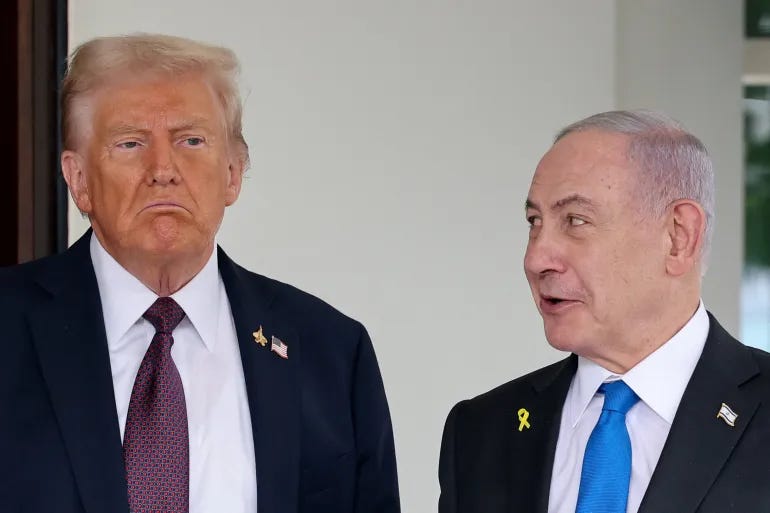
The public attitude in the United States towards Israel has undergone a phenomenal shift. This has coalesced with the public’s rejection of the Donald Trump administration’s decision to go to war with Iran.
The statement by US Vice-President JD Vance attributing the Republican Party’s midterm defeat to the war also sought to “change our relationship with Israel.”
In an incisive report on Monday titled Bilateral Support for Israel Erodes as Both Sides Push for New Limits, two senior correspondents of The New York Times, Edward Wong and Michael Crowley, who travelled across West Asia during the recent wars, wrote that backing for Israel, which had long been a bipartisan pillar of US foreign policy, has dissipated in recent years “first among Democrats angry about Israel’s war in Gaza and the treatment of Palestinians in the occupied West Bank, and more recently among some Republicans who blame Israel’s government for encouraging Mr Trump to launch the war in Iran. The war has led to soaring gas prices and higher inflation. Many of Mr Trump’s supporters also view it as a betrayal of his pledge to avoid forever wars.”
Israel still enjoys strong support among many politicians in Washington, including Secretary of State Marco Rubio, who on Sunday took exception to Vance’s criticism of the war, while many prominent US politicians are also interpreting the election results as a mandate from voters to rethink the US-Israel relationship. Trump senses the rift in the White House, which explains his surprising election-day announcement that he planned to cut off most military aid to Israel before the end of this year.
Since the election, disagreements within the administration on the Iran issue have only intensified. Chief of Staff Susie Wiles has been replaced by Stephen Miller, a staunch flag-bearer of the MAGA movement who counsels an early end to the Iran war. There is speculation that War Secretary Pete Hegseth is in deep trouble.
At least three approaches have emerged. One group, including Vance, insists on reaching an agreement with Tehran and opposes the resumption of military operations. Another group, including CIA Director John Ratcliffe and Treasury Secretary Scott Bessent, proposes maintaining the naval blockade on Iran and economic pressure. Still others call for further strikes against Iran.
Trump is considering resuming strikes on Iranian energy facilities, but his latest remark on Sunday was that it is “highly unlikely” he will need to order the US military back to war with Iran. On the other hand, the latest round of peace proposals between the US and Iran has reached an impasse.
Tehran is unwilling to compromise on its key demands—namely, lifting the naval blockade, paying reparations and unfreezing Iranian assets in foreign banks—and insists that henceforth US pledges must be backed by action.
Tehran is pleased with the results of the US midterm polls, regarding them as strengthening its position. The newly elected Congress is expected to challenge any sustained deployment of US forces in the Persian Gulf. It is entirely conceivable that Tehran would see strategic advantages in a showdown.
A Chatham House expert opinion is that “The Republican Party has been among the biggest losers from the war. The race for the presidency in 2028 started the moment the midterm results became clear. And GOP candidates are likely to be vehemently against continuing the conflict. Pressure within the US for a resolution will rise even if Benjamin Netanyahu, now Israel’s caretaker prime minister after his own electoral setback, urges a new assault.”
Meanwhile, Iran is also working on a Plan B. President Masoud Pezeshkian, who was invited as a special guest to the Moscow-led Commonwealth of Independent States (CIS) summit in Ashgabat, Turkmenistan, on 8 October, proposed a formal relationship with the grouping. The proposal carried the flavour of a Russian idea, as this was also the first time in 35 years that the CIS has invited a foreign dignitary to its summit.
Pezeshkian’s proposal aimed at countering external restrictions through greater connectivity and practical financial and barter mechanisms to facilitate trade, energy co-operation and more. He pointedly referred to the US-Israeli attacks against Iran, saying such developments demonstrated “the interconnected nature of regional security.” Putin and Pezeshkian also held a bilateral meeting in Ashgabat.
Russian Deputy Foreign Minister Alexander Pankin stated that Moscow is prepared to explore the “CIS plus Iran” format. He said last week: “The idea of creating the CIS + 1 format voiced by Pezeshkian has sparked significant interest in Moscow, and, as far as we can tell, in the capitals of other Commonwealth states as well as within the expert community. The Russian side is prepared to work on this initiative with its partners.” Pankin added that Russia holds the view that “the expansion of cooperation between the CIS and Iran has enormous potential across a wide range of areas.”
Suffice it to say, the three-hour meeting last week at the Kremlin between Putin and Mohsen Rezaei, Secretary of Iran’s Supreme National Security Council—following an extended 85-minute phone conversation between them only three days earlier—signals that Russia and Iran are looking beyond the Trump presidency, to a multipolar setting, to deepen their strategic partnership.
Admiral Igor Kostykov, the head of Russian military intelligence (the GRU), was present at the Kremlin meeting. According to Iran’s ambassador Kazem Jalali, the meeting discussed the latest developments in the two countries’ strategic and high-level cooperation “in a highly coordinated atmosphere.” He said Moscow “understood and accepted” Tehran’s position that negotiations with the US alone were ineffective and that its strategic conditions had to be implemented.
Rezaei was commander-in-chief of the IRGC for 16 years until 1997, beginning shortly after the Islamic Revolution, in which he had participated as a member of the underground Shia Islamist guerrilla group Mansouroun. Jalali underscored that, given their shared and inter-regional threats, challenges and opportunities, Iran and Russia considered “coordinated responses to threatening conduct” (by Washington) a strategic necessity, and that consultations on deepening military and defence co-operation between the two countries were being pursued at the highest levels.
To be sure, Putin’s rapport with Rezaei, who has steadily emerged as Supreme Leader Mojtaba Khamenei’s trusted aide, will be noted and understood in Washington and factored in for any future US attack on Iran. Rezaei handed over a letter from Khamenei addressed to Putin.
In geopolitical terms, the matrix of US-Iran confrontation has entered a pivotal stage.