


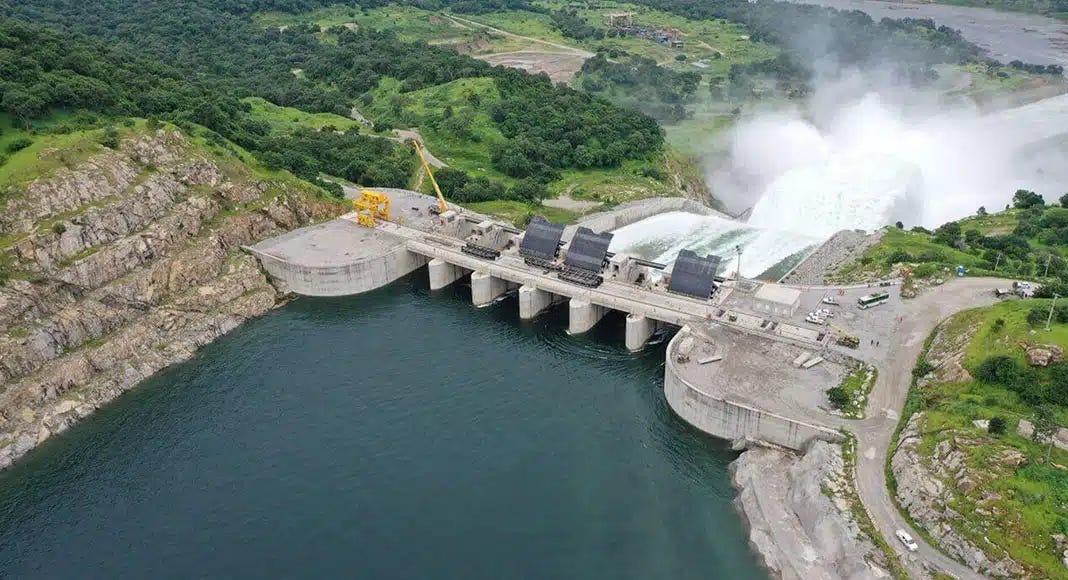
Water policy across much of Africa has followed a consistent and seemingly rational logic for decades: build large dams, drill deeper wells, transfer water across basins, and increasingly turn to desalination. These choices were often justified. In many cases, they helped avert immediate crises.
Taken together, however, they reveal a deeper problem—not of effort or investment, but of framing.
The dominant question guiding water policy has long been: how do we mobilise more water? In a time of climate disruption, land degradation, and rising energy costs, this question is no longer sufficient. A more fundamental one remains largely unaddressed: Why does so much water fail to remain where it falls?
Scarcity is not only climatic
From a hydrological perspective, water availability is not determined by rainfall alone. It depends on the condition of land, soils, and vegetation.
Degraded territories shed water quickly. Rain becomes runoff, erosion and floods with little infiltration or groundwater recharge. Healthy landscapes behave differently: they slow water down, absorb it and release it gradually over time.
Seen this way, scarcity is not merely a climatic condition. It is a territorial outcome.
Over decades, land-use decisions have treated soil as inert, ecosystems as expendable, and water as a resource to be captured, transported and controlled elsewhere—often far from the landscapes and communities that produced it.
Scarcity, in this sense, is cumulative.
A political geography of water
This cumulative outcome is political. It reflects how power has been exercised over land, planning, and time.
Large-scale infrastructure has frequently been prioritised over the long-term maintenance of soils, vegetation and local hydrological cycles. Centralised systems have displaced local practices that historically managed water through dispersion rather than concentration.
The result is a paradox. Ever larger investments are required to compensate for territories that no longer retain water on their own. Water insecurity becomes a permanent management problem rather than a shared territorial responsibility.
Restoring cycles rather than expanding extraction
Addressing this reality does not require rejecting infrastructure. It requires recognising its limits.
No technological system can indefinitely compensate for degraded landscapes. Desalination plants, inter-basin transfers and deep aquifer extraction may supply water, but they do not restore the conditions that allow water to remain accessible, affordable and resilient over time.
Rehydrating degraded territories—through soil restoration, vegetation recovery and landscape-scale water retention—reduces flood risks, strengthens food systems, lowers energy dependence and stabilises rural livelihoods.
These benefits are rarely captured in conventional cost–benefit analyses, yet they are central to long-term social and ecological stability.
Governance, coordination and responsibility
Landscape restoration is not a neutral technical task. It raises unavoidable questions of governance.
Who controls land-use decisions?
Which knowledge systems are recognised?
What time horizons guide public investment?
Restoring hydrological cycles requires coordination across ministries, legal frameworks that protect long-term ecological processes, and the political willingness to value local and traditional practices that have often been marginalised by top-down planning.
The role of the state is not to engineer nature but to redefine success: not only in cubic metres delivered but in risks reduced; not only in projects completed but in systems stabilised.
Sovereignty beyond infrastructure
Water sovereignty cannot be measured solely by the height of dams or the output of desalination plants. It is measured by a society’s capacity to maintain the territorial and ecological conditions that allow water to remain where it falls, circulate locally and support life over time.
The difference between scarcity and resilience is not rainfall. It is how power is exercised over land, knowledge, and long-term choices.
Until water policy confronts these structural realities, scarcity will continue to be treated as a technical failure—when it is, fundamentally, a management one.
