


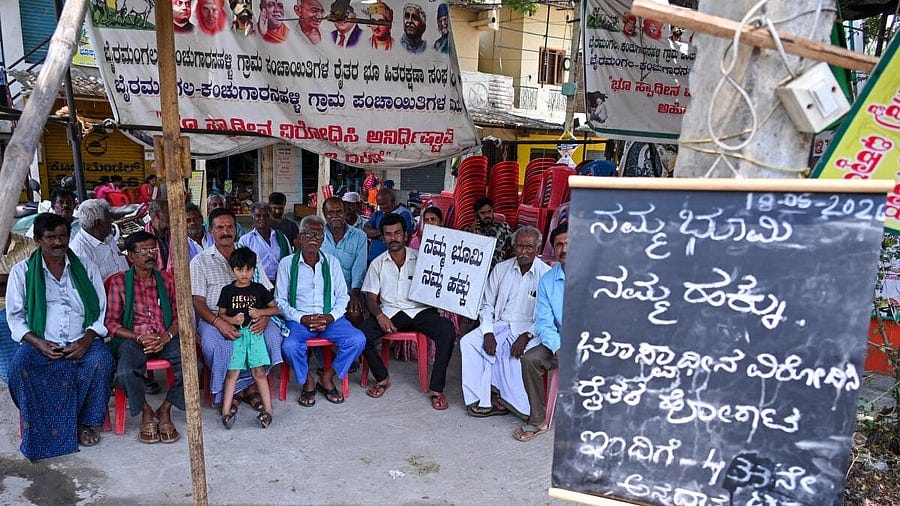
Farmers in the south Indian state of Karnataka have been protesting for over a year in defense of their land. On 10 May, day 426 of their protest against the notified acquisition of fertile, irrigated land in Ramanagara district to expand the state capital Bangalore, farmers occupied the Byramangala roundabout.
Cutting off all four connecting roads with bullock carts and tractors, over 3,000 farmers protested in this roundabout. Scores of cows and bulls they brought along chewed on the cattle feed in this critical node on a state highway, whose occupation disconnected the neighboring industrial areas of Bidadi and Harohalli.
What had been a sit-in demonstration under a tent on a square outside a temple at the roundabout, which rarely affected vehicular movement, escalated into this blockade after the state cabinet’s approval of the acquisition of 7,481 acres across nine villages on 30 April.
The preliminary notification, issued by the state government last year, on 13 March 2025, had eyed over 9,600 acres across 26 villages under the two Gram Panchayats (village councils) of Byramangala and Kanchugaranahalli.
However, the cabinet approval of only 7,481 acres does not indicate that the government is giving up on the remaining 2,000-odd acres it had initially sought, cautioned T. Yashavantha, general secretary of the state farmers union, Karnataka Prantha Raitha Sangha (KPRS).
It is rather a ploy to seize the remaining 2,000-odd acres without providing any compensation on the grounds that it is government land, he warned. Although cultivated by farmers for over half a century, the slow movement of the bureaucratic machinery has effectively stalled the process of transferring the land’s ownership, especially to the smaller peasants, who lack the social and economic capital to see it through.
But even the majority of farmers, officially owning their land and eligible for compensation, refuse to hand over their acres.
The government is “dreaming when they talk about turning our villages into Greater Bangalore. They should wake up. We will not surrender our farms,” Ramaiah, president of the committee elected by the farmers from the affected villages to resist the acquisition, told the sit-in demonstration on 25 April, only days before the cabinet approval.
“What can they do about it? Open fire?” he challenged the state. “We will give our chest to your bullets, but will not cede an inch of our land,” he declared, drawing cheers from the protesters.
The government insists that this land is needed to create a second business district to decongest Bangalore. “Did we ask them to congest Bangalore?” Ramaiah demands to know. “If they want to decongest Bangalore, let them build industries and create jobs in the arid regions in Karnataka’s north, so people from there won’t have to migrate to Bangalore in search of jobs,” said Ramaiah, speaking to Peoples Dispatch, before his address to the demonstration.
AI vs farmers?
While the state government’s touting of this project as India’s first AI-powered “work-live-play” themed city might hold a certain charm for a section of educated, upwardly mobile urban elite in Bangalore, “Will AI produce food?” Ramaiah asks. “We do.”
The 72-year-old patriarch owns three acres of his ancestral land on which he is now raising his second generation, growing millets, vegetables, and feed for cows, cultivated on his farm.
“My son is also a farmer. The young never had any other livelihood opportunities here,” he said, adding that there are a total of 20,000 people in 4,000 farm-owning households, whose livelihoods are at stake in this resistance to land acquisition.
The government has announced a compensation of 2-2.5 crore rupees (200,000-250,000 US dollars) per acre— a potentially attractive offer for large landlords.
“But there are hardly any here,” added Ramaiah. “More than 85% of us are small farmers and subsistence peasants. A family of two to three brothers and their wives and children make a living on anything between half to four acres.”
The compensation amount, divided between them, does little to mitigate the loss of land on which they count to sustain the generations to come. The smaller the land-holding, the more untenable monetary compensation becomes.
A cool enclave in a heating country
Nagesh Kumar, a 45-year-old farmer who offered his pillion seat to tour the affected villages on his 100 cc, owns barely 1.75 acres, on which a family of six makes a living.
“But we lack nothing,” he said, riding through the narrow, uneven, unpaved trail through the fields, towered over by timber and coconut trees, many cared for and nurtured over generations. Beneath them blossom arcanuts, mangoes, sapotas, and myriad other fruits on trees shading the ground sprawling with vegetables like babycorn, pumpkins, and cucumbers, growing alongside dense patches of napier grass for cows, and mulberry for silk worms.
The temperature dropping as we rode deeper into the farmlands was unmistakable, arriving from the city, historically known for its moderate climate, but scorching at the time at nearly 40 degrees centigrade as the country reeled under unprecedented temperatures.
“Can you believe you are only 30-odd kilometers from Bangalore?” Kumar asked, comparing the climate here with Malnad—the cool, rain-soaked slopes of the Western Ghats hill-range along India’s western coast.
The Malnad is a reference multiple farmers here make, taking pride in asserting that the trees they have nurtured over generations guard this cool enclave, despite the heat and smoke emitted by the two industrial areas on either side.
“Even if the government raises the compensation to 10 crore per acre, we will never allow them to destroy all this to lay more concrete,” Kumar declared, as he halted the motorcycle at the house of Thayamma.
“You must fight, not commit suicide”
The middle-aged dairy farmer had gathered a delegation of women farmers at her home to meet D. Raveendran, joint secretary of the All India Kisan Sabha (AIKS). The national farmers' organization had played a leading role in the historic, country-wide farmers' struggle that forced the central government to withdraw its pro-corporate farm laws in 2021.
Accompanied by Yashavantha and Bharat Raj, the joint secretary of KPRS, which is affiliated with the AIKS, Raveendran had arrived early in the day. He had surveyed the lands and met farmers in over 10 of the notified villages before stopping over at Thayamma’s house.
Heaping curses on the state government and its deputy chief minister, D K Shivkumar, who has fashioned the Greater Bangalore Township as his pet project, Thayamma declared, “I will consume poison if my land is taken.” Two farmers had already attempted suicide in protest last year.
“You must fight, not commit suicide,” Raveendran told her, waving his fist. “We are,” she yelled back, recounting the multiple marches by the women in these villages. “We have marched with torches, we have marched with brooms, we marched with onake,” a heavy, long-handled wooden pestle used for grinding in traditional kitchens. “If need be, we will also turn them into weapons to fight the state with. But we will have nothing to live for if we lose our land,” she insisted.
“Why should we give up the land that has fed us for generations, and will feed many more to come,” interjected another younger, softer-speaking woman farmer. “Well, the government is offering 2.5 crores per acre,” provoked Bharat Raj.
“If the government is suffering from poverty, let them ask us farmers for help. We will help them through our union. But we have not asked the government for any money. We are not poor. This land has been yielding plenty for us,” she retorted calmly.
“Blessed by the Suvarnamukhi River flowing on one side, and the Vrishabhavathi River, on the other, even those with just half an acre of land are able to prosper here,” maintains Ramaiah.
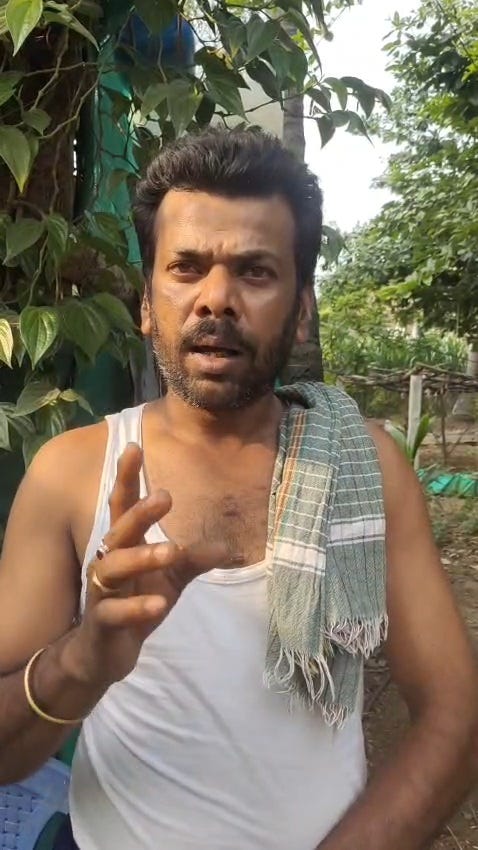
A case in point is Manjunath, whose father had left him less than half an acre of land when he passed away in 2000.
“My mother was long gone. I was orphaned at the age of 19 when my father died. I was still a wayward young boy back then,” he recalled. Now, at the age of 45, he is hailed in the surrounding villages as a highly productive farmer owning one of the smallest parcels of land in the two gram panchayats.
“They want to turn a skilled farmer like me into a bathroom cleaner”
The gate to his house opens onto his courtyard, in whose corner is a thermocol box with two holes on the sides for air circulation, and two fans on the inside of the lid, probably extracted from old CPUs. A light bulb glows between them, heating the box with a bowl of water and fertilized eggs, marked with a sketch pen on one side to allow for even flipping every day.
“Hens often lay many more eggs than they can warm to hatch. Many of them are wasted unless sold in time [to processing units]. So we place some of them in this box for warmth. When they hatch, we leave them with the hens, and they raise them,” he explained.
Along the perimeter of his courtyard is a fenced patch of land where about 50 country chickens run around under the shade of a makeshift roof of dried coconut leaves tied to the stems of arecanut, papaya, and other fruit trees. “I recently sold 200 grown chickens I raised as chicks. I am raising these now,” he said. The alpha among them is one white-feathered rooster with a red crown, standing as tall as a short adult’s thigh.
On one side of the fence are five young goats, chewing cud. Further up this fenced land is a pond he has dug out, barely 20 feet in diameter, and six to seven feet deep. Manjunath breeds many species of small fish here. “We use most for household consumption, but still earn about two lakh a year by selling the surplus,” he added.
Along the perimeter of the pond are several trees, blossoming with exotics like dragon fruit, the relatively rare water caltrop, the native custard apples, and jumbo Java plum, a premium variety of Indian blackberry. Pointing to another tree dense with a small but potent local variety of lemons, he said, “These cost 15 rupees each. But I give them away as gifts to all my guests.”
Across a muddy walkway along the line of fruit trees is another patch of land with a bundle of four sugar cane plants on one corner, with napier greening the rest. The harvested grass is laid out before the six cows in a shed adjoining his house. One of them is pregnant. Three others are calves, still growing, chewing on the napier he grows. A couple of them are heifers his wife was milking at the time.
His son has just finished his post-secondary vocational training at an Industrial Training Institute (ITI), while his daughter is set to enroll in an engineering degree, all paid for from the revenue he generates from this tiny parcel of land.
“It took me almost three decades to build all this. And now the government wants to destroy it all,” he cussed. The compensation offered by the government for his 0.375 acre, “will not even suffice to build a house in Bangalore. I will have to lease a house and make a living by cleaning their bathrooms. They want to turn a skilled farmer like me into a bathroom cleaner.”
The landless
An even worse prospect awaits the landless families. “About 30% of the households in the two gram panchayats own no land,” said a dairy farmer, residing a few houses beside that of Nagesh Kumar, also named Nagesh. “In this village of Chikka Byramangala, only 10 of the 40 households own land.”
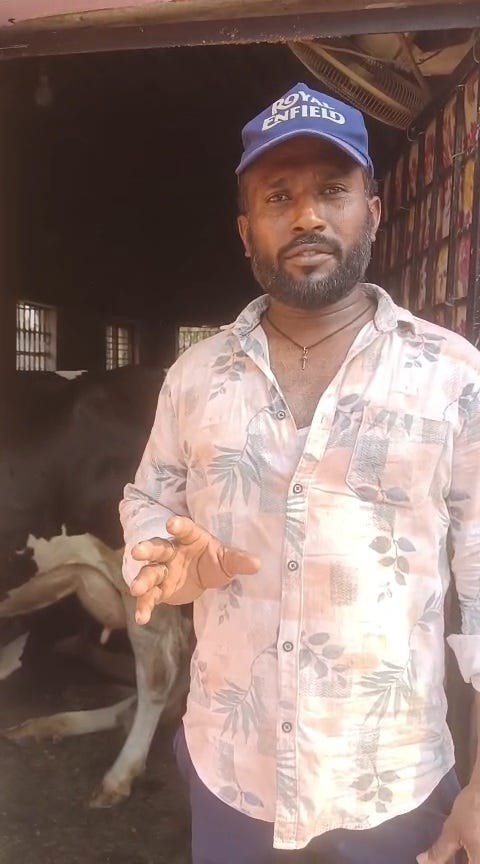
Renting an acre for 20,000 rupees a year, he grows napier grass to feed the five cows in the shed adjoining his small house. His wife and a daughter, schooling in 9 grade, also depend on the revenue he thus generates.
“The government has fixed compensation rates per acre. But I don’t own a cent. Will they also fix a compensation rate for our lives? I know no other trade. I had no schooling. Dairy farming is all I know,” he added, explaining his anxiety about losing his only livelihood.
“So we landless farmers” are also on the frontline of resistance. “As soon as I finish the morning’s labor in the fields, I sit at the protest site till evening,” coming back only in time to bring fresh fodder for the cows. “I often miss my meals, but always ensure that the cows are well-fed.”
The owners from whom landless farmers like Nagesh rent farm plots are not absentee landlords, who take a share in the crop. Most of them are also small farmers, renting out land they own in excess of what is cultivable by their own family labor.
Kumar has also rented out a small patch of land to 46-year-old Santosh. In his native village, near the semi-arid town of Kolar, about 70 km northwest of Bangalore, Santosh spent 10-12 lakh rupees, drilling deeper and deeper to find water to irrigate his ancestral land. None was to be found as the groundwater level had sunk deeper than he could drill.
After losing all his investment in search of water, he migrated with his wife and two children to greener pastures. Growing tomatoes on the small patch he has rented from Kumar, he supplements his income from sericulture on the three acres he has rented from another farmer.
The Ramanagara district, where these villages are located, is Karnataka’s largest silk producer, with a substantial portion of it generated from the two gram panchayats, marked for acquisition.
Chewing on mulberry leaves, thousands of white, fattened silkworms wave and crawl over the stalks onto fresh handfuls of sprigs laid out on wooden trays, shelved over one another from floor to roof in a shed owned by Thimmayya.
Among top 10% of India’s earners
The 70-odd-year-old is a successful sericulturalist we ran into while riding through his five-acre farm. Outside his shed where the larvae grow, beyond the courtyard where calves feed on napier, is a yet-to-be-painted and windowed, recently built house with a portico, on whose pillars lean about 300 bamboo mountages, stacked against one another in columns. Inside each of these bamboo boards is a spiraling channel in which the worms, matured in his shed, have spun themselves into cocoons.
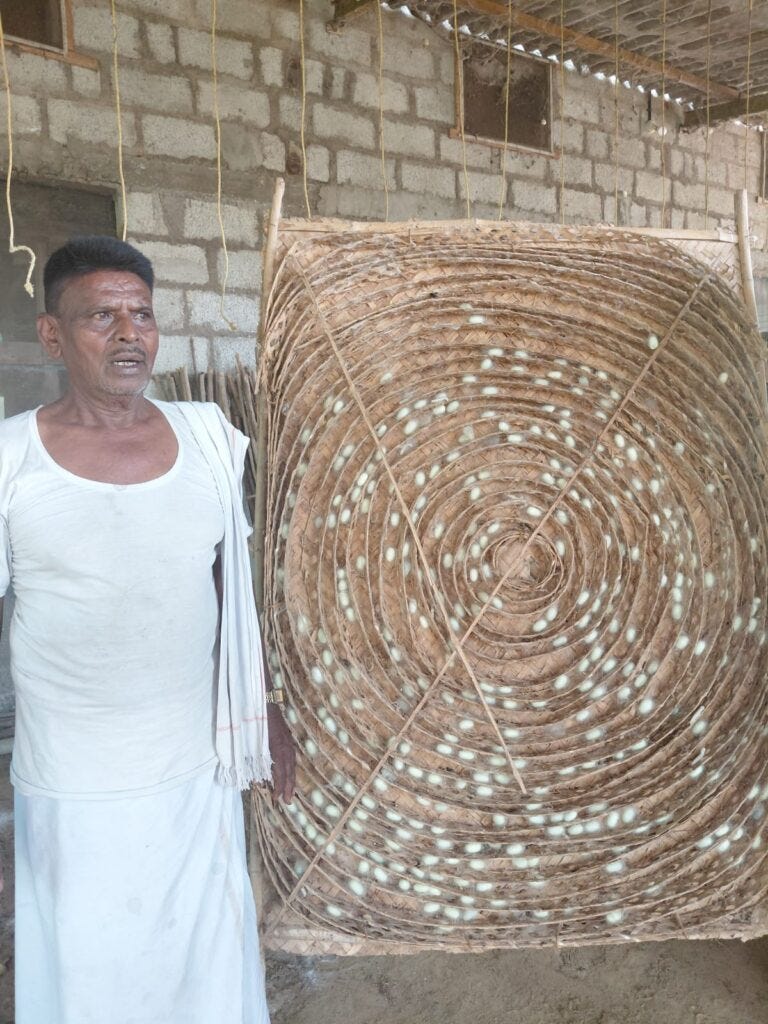
“In about four more days, they will be ready to be sold in the market,” either in Ramanagara, or in the town of Sidlaghatta, about 115 km north in the Chikkaballapur district, or in Kollegala, over 100 km south, depending on where the best price can be found.
Even with the recent drop in price, Thimmayya expects to earn between Rs.700-800 per kilo. For the 300 kilos he estimates the cocoons to add up to, he will earn over two lakh rupees, even at the lower end of the price range.
And this is the revenue from only one batch of cocoons. Soon after they are extracted from the mountage for sale, they will be replaced, after necessary disinfecting, with worms that have already matured in his shed. The shed itself will be replenished with more larvae and fresh leaves. In a year, he said, there are about six cycles of production, which will fetch him an annual revenue of over 12 lakh.
He could not instantly estimate the cost of production of sericulture in particular, because family labor time often overlaps with a number of other products on his farm, including milk, coconuts, and arecanuts.
But even 54-year-old Kaantaraju, who owns only 1.5 acres, in addition to the half acre he has rented, is placed comfortably in the country’s top 10% income group. Throughout the year, he grows a variety of micro-nutrient-rich green leaves—many unheard of by the younger urban population.
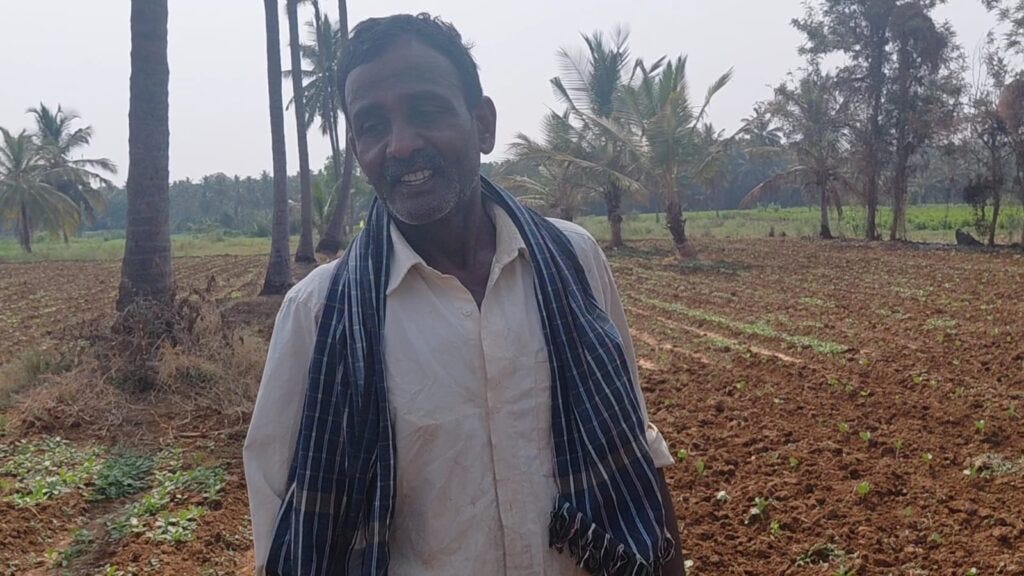
From these greens alone, he earns a profit of 20-25 thousand rupees per month, on average. The milk production from the three cows his household has raised fetches his family another Rs. 20,000. Without even including his revenues from sericulture, the sum total already places his household earning at about double the average earnings of the economic top 10%, estimated to be Rs. 20,380 per month, by the central government’s 2023-24 Periodic Labour Force Survey (PLFS).
Protecting the next generation against the traps of fast money
Accepting instant money in crores in the form of compensation for giving up this land, he argues, will not only amount to a selfish act of choosing to spend the rest of his own life in luxury against the interests of his future generations but will also lead his two children, still studying, astray.
“You are a journalist. You must have read about what the youngsters from villages do when they suddenly have money from the sale of land,” he insinuated. “But, if I instead pass on this land, generations to come can make a livelihood.”
“Even if the compensation amount is doubled,” Kaantaraju insists that he will never hand over his land—an assertion Thimmayya also reiterates. “Even if there is no rain for five years, we can still continue agriculture here. We need nothing from the government. All we ask is that they leave us alone,” Thimmayya said, clasping his palms in prayer.
A wavering farmer, joining the resistance
“Well, uncle, this statement of yours will be shared across all the villages,” Kumar intervened, warning, “All villages will hold you to account.”
“So be it,” Thimmayya responded. “I will answer whoever comes questioning at my door,” he added, possibly referring to real estate agents he might have already entertained.
Thimmayya was among the small group of farmers who had sought higher compensation, instead of outrightly resisting the government’s acquisition attempt. “Because many did not believe we could resist the government when they issued the preliminary notification. We were not unionized at the time,” Kumar recalled, as we rode to his house for evening refreshments.
Although a closely knit community, like most villages are, organizing resistance in the face of the government machinery and its coercive powers was not a task they had prepared for, he added, sipping on the coffee his wife had served us.
His eldest son, stepping into college years—“a topper in his class,” as Kumar says with some pride—was covering for him at his shop during his summer vacation.
The younger son, in his mid-teens, ran along to pluck guavas from his farm behind the house and served them to us in the tiny living room, whose walls are coated with green slaked lime, and the roof is low—a false wooden ceiling, serving as a store room below the thatched roof.
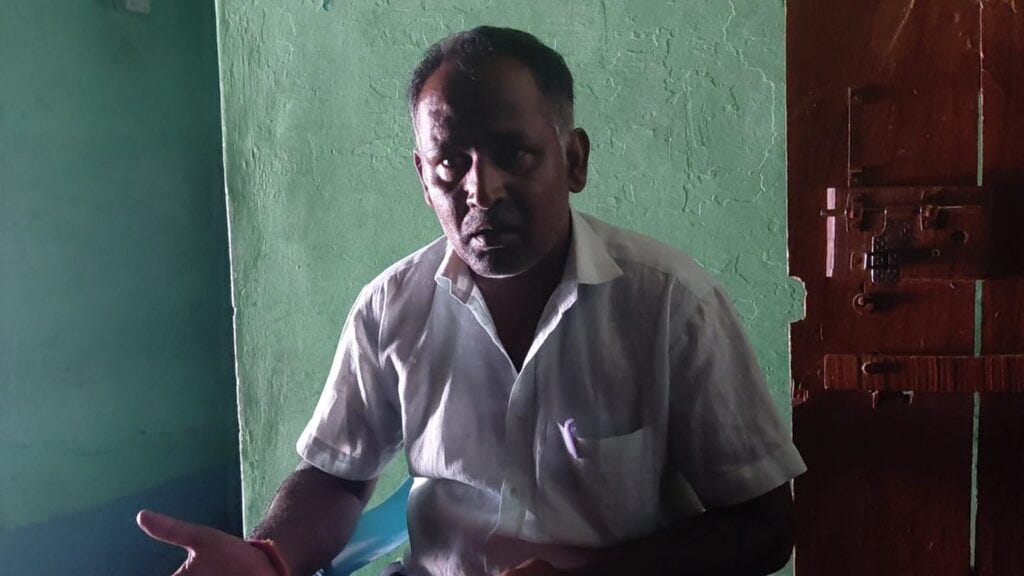
“So initially, a group of about 40,” including at least one farmer from each of the 26 villages marked by the state government for acquisition, got together to discuss how to resist the acquisition, Kumar recalled, adding that veterans of farmer struggles like Yashavantha helped them organize.
“Now, with one call, we can mobilize at least 3,000 farmers,” which has inspired confidence even in wavering farmers like Thimmayya to join the struggle, he said, with a certain pride about being among the early-resisting 40.
His assertion about the mobilization capacity bore out in evidence just over two weeks later, when the farmers occupied the Byramangala roundabout on 10 May.
“You are not alone”
“We occupied the square for over 30 hours,” said Yashavantha. Then, on the evening of 11 May, the deputy commissioner (DC) of Ramanagara District, “through the police surrounding us, sent us an invitation for negotiations at his office,” which has been the site of multiple confrontations before, leading to criminal cases against many of the farmers interviewed.
Yashavantha led a delegation of about 15 farmers into the DC’s office. By the end of the negotiations, the DC wrote a letter to the chief secretary of the state government, explaining the intensity of the farmers' opposition. He also reiterated their demands in the letter, calling for the cancellation of this land acquisition. In turn, he requested the farmers to end their agitations.
While clearing the blockade of the state highway, the farmers, however, continue their sit-in demonstration at the protest site they have held for days and nights, digging in for a protracted struggle, likely to escalate with every advance by the state government towards the acquisition.
On the other side, capital—both Indian and global—has also dug in around them, fielding the state government to soldier in their trenches.
But “you are not alone,” AIKS leader Raveendran had reassured the local farmers in his address to the sit-in demonstration after his visit to the affected farmlands on 25 April.
“The KPRS will mobilize thousands and thousands of farmers from all over Karnataka to join your struggle. They will march with you in strength to Vidhan Sabha,” the state legislature in Bangalore. Should this march fail to stop the acquisition, Raveendran promised, “the AIKS will also mobilize farmers from other states in India and take this struggle to the parliament.”
