


The killing of American pilot Nicholas F. Gosselin in July 2026—shot dead by West Papua National Liberation Army (TPNPB) gunmen who then burned his aircraft at a remote airstrip in Highland Papua—was a tragedy. Yet to frame West Papua through isolated incidents of rebel violence is to mistake the symptom for the disease.
The disease is a fully operational frontier system—a 21-century prototype of how modern states weaponise “national integrity” and “economic growth” to govern internal peripheries through militarised development, demographic engineering, and systematic erasure. Indigenous Papuans have endured this machine for decades. The world has chosen not to see it.
Consider the architecture. More than 83,000 Indonesian military and police personnel are deployed across Papua—56,517 from the TNI and 26,660 from Polri. That is not counterinsurgency; that is occupation by another name. Five new battalions were added in October 2024 alone, transforming the region into the most militarised zone in the archipelago.
And the violence is escalating: conflict-related deaths have risen month on month since the start of 2026, with civilians making up a significant share of the fatalities. In Yahukimo Regency alone, 35 armed clashes were recorded throughout 2025, with ten more between January and March 2026. In Intan Jaya and Puncak, military operations reportedly involve battle drones, mortars and air strikes in civilian-populated areas. This is not peacekeeping. This is state violence industrialised.
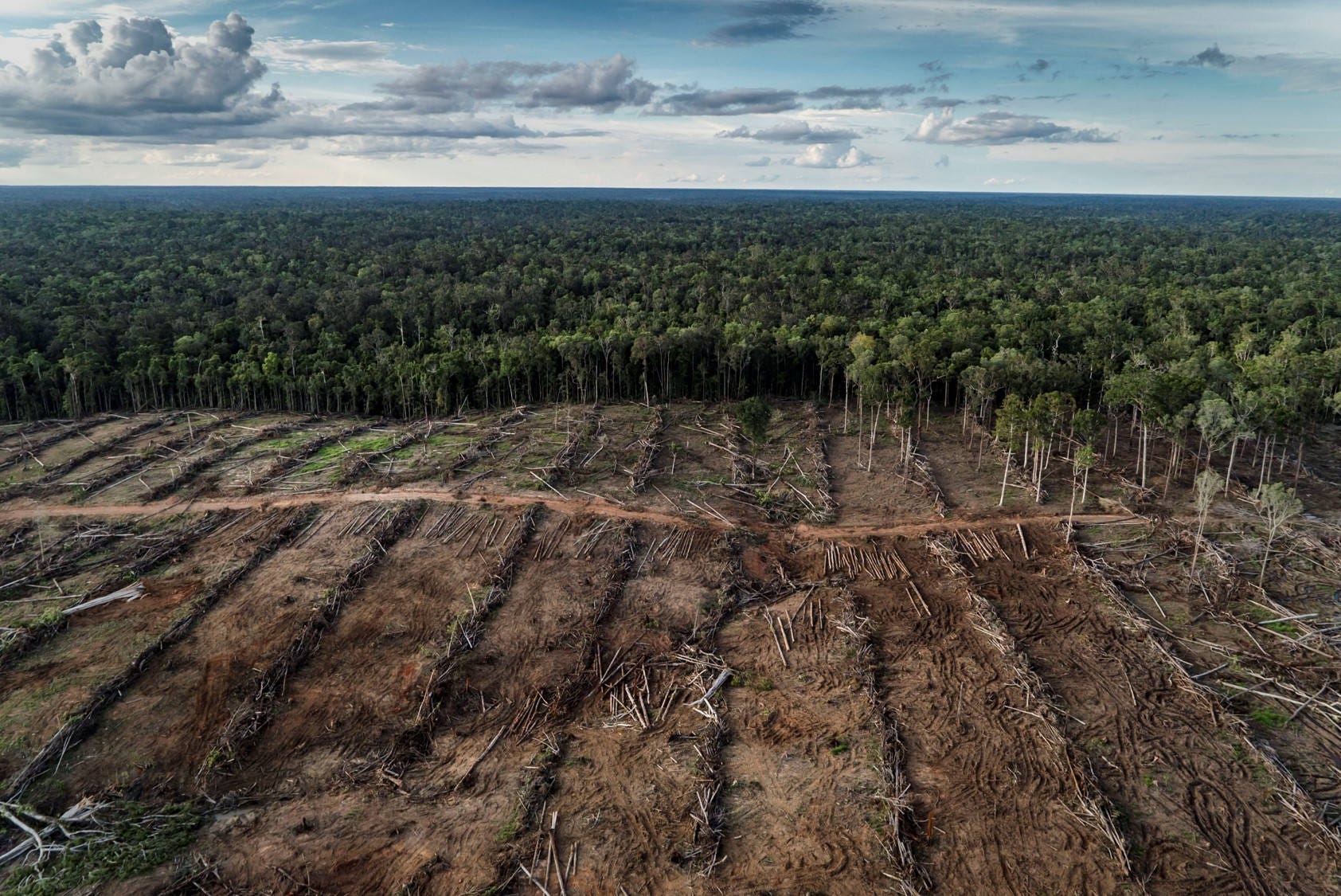
But bullets are only half the story. The other half is bulldozers. The Prabowo administration has advanced the Merauke “Food Estate” megaproject—a Strategic National Project allocating more than two million hectares of Papuan forest to rice and sugarcane plantations. In January 2026, the National Land Agency granted 328,000 hectares of cultivation rights for the rice component at “unusually rapid speed.” Fifty thousand Indigenous Papuans face displacement over the project’s lifespan.
Customary landowners—dozens of clans holding ancestral rights in Wanam—oppose the clearing, but dialogue has ended in deadlock. The military guards the bulldozers. The bulldozers clear the sago groves. The sago groves are not merely food; they are the material foundation of Papuan cosmology, social organisation, and identity. To destroy them is to annihilate a lifeworld.
This is ecocide as statecraft. And it is compounded by demography. At the time of the Dutch handover, Indigenous Papuans constituted over 99 per cent of the population. Today, in many urban and coastal centres, they have become a marginalised minority. Decades of transmigration—the systematic relocation of millions of non-Melanesian Indonesians from Java into Papuan lands—have diluted the demographic basis for self-determination claims.
The settlers become the visible face of “Indonesian-ness” while Papuans are rendered invisible in their own homeland. Their dispossession is framed not as theft but as the inevitable churn of modernisation.
The administrative fragmentation of West Papua into six smaller provinces completes the edifice. This move, which bypassed genuine Papuan consultation, dilutes unified political solidarity while creating new administrative centres staffed predominantly by non-Papuan civil servants—each guarded by its own military command.
The re-militarisation of civilian governance, including the placement of active-duty officers in state-owned enterprises under President Prabowo’s watch, dissolves the boundary between civil administration, economic management, and military occupation. The frontier state is complete: a zone where constitutional rights are permanently suspended under the sign of national development.
And what of the international community? The silence is manufactured. Foreign journalists, UN special rapporteurs, and humanitarian agencies are routinely denied access. The Indonesian government tightly restricts entry without special permission. Even diplomats are regularly denied permission to visit.
The result is a manufactured blind spot that serves the interests of a global economic order dependent on the uninterrupted flow of resources—gold, copper, natural gas, timber.
The Grasberg mine complex, operated in partnership with international capital, is an icon of this extractive logic. The TNI serves as the armed wing of a politico-economic system that guarantees security of investment. In this fusion, the Papuan villager standing in the way of a bulldozer is not a citizen to be protected but a friction to be eliminated.
The Pacific Islands Forum and the Melanesian Spearhead Group have attempted to pierce this silence. In July 2026, Solomon Islands Prime Minister Matthew Wale called on Indonesia to pursue dialogue and reduce tensions. The MSG has agreed to appoint a special envoy to engage with Indonesia. But these voices lack the leverage to compel Jakarta’s compliance.
Indonesia has strongly rejected the United Liberation Front for West Papua’s presence at any MSG meeting. The information embargo functions as the epistemic dimension of genocide: if a tree falls in the forest of West Papua and no international camera records it, does it make a sound that matters?
This is the deeper tragedy. Papua is not an isolated anomaly; it is a prophetic microcosm. In an era of climate collapse, resource scarcity, and mass migration, states will increasingly look to their internal frontiers as sacrifice zones for extraction and carbon offsetting. The model pioneered in Papua—militarised containment, demographic manipulation, information blackout, and ecocidal development—will, unless actively resisted, become the global template for governing the “internal others” who stand in the way of planetary resource grabs.
The Indonesian state, born in the crucible of anti-colonial revolution, now deploys the full grammar of colonial domination against its own Melanesian population.
The post-colonial state has become a more efficient coloniser than its European predecessor precisely because it operates in the name of national unity rather than racial empire, thereby disarming the critique that would otherwise be levelled against it. Frantz Fanon’s warning about the pitfalls of national consciousness—that the native bourgeoisie, once in power, would occupy the coloniser’s structural positions—finds its grimmest illustration in Papua.
The philosophical challenge is not merely to analyse the darkness but to commit to the light: to reimagine sovereignty as grounded in the consent of peoples rather than the sanctity of maps, to revalue life above minerals, and to build international solidarities that pierce the manufactured blindspots of global capital.
The future will be determined by whether the world rises to that challenge—or allows Papua to become the blueprint for a thousand forgotten frontiers.
