


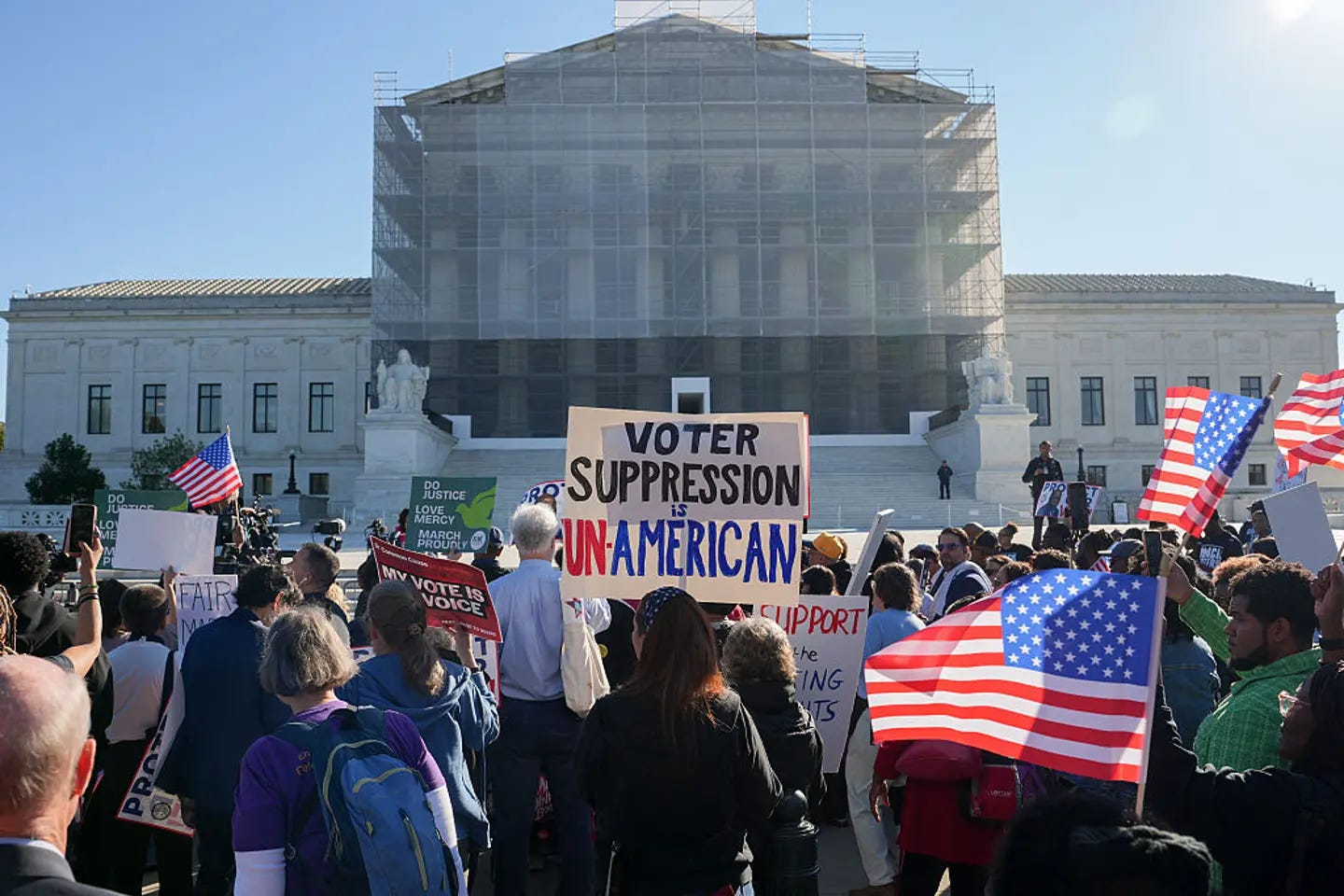
A few days ago, the Supreme Court severely limited a key provision (Section 2) of the Voting Rights Act of 1965, which “broadly outlawed discrimination in voting on the basis of race” and “has been interpreted to allow, and sometimes demand, the use of race-conscious data in redistricting, to protect the voting power of minorities.” The next day, Louisiana suspended its congressional primary elections and will likely redraw its congressional district maps. If nothing else, the GOP sure understands how to wield state power to achieve its warped, reactionary, and destructive political ends.
Of course, T.V. pundits, liberal activists, and politicians took to the cable news outlets, podcasts, social media platforms, and newspapers to express their disdain for the 6-3 ruling aimed at curbing the voting rights of minorities in the United States. But none of that will make a difference. Trump and Co. will charge ahead, doubling down on their efforts to undermine the electoral system and solidify GOP rule. They couldn't care less about the bad press, plummeting opinion polls, or sappy moralizing. Attacks on voting rights and the successes of the Civil Rights Movement will continue.
Turns out, millions of Americans simply assume that so-called free and fair elections will continue in perpetuity. However, we should not make such assumptions. Leaving aside the limits of electoral participation, which have been detailed and debated by social movement participants, intellectuals, writers, and artists, recent events, including the failed putsch of 6 January 2021, and MAGA's dream of a third term for Trump, raise the question: What would Americans do if there isn't a midterm election in 2026? What if there isn't an election in 2028?
The problem, as far as I can tell, is that most people don't seriously contemplate the creative and destructive ways in which the Trump administration and its tens of millions of supporters could potentially suspend, upend, subvert, or ignore national elections and their results. The MAGA crowd, however, has been keen to undermine democratic norms. They speak about it openly. Their aims have always been clear.
Indeed, the trouble with putting all of our political eggs in the electoral basket is that it leaves people with no recourse if or when those elections no longer exist. The issue, for me, is not that Americans have neglected or taken for granted the right to vote, but rather that Americans haven't participated in or have forgotten that voting is simply one aspect of the political process. It also doesn't help that each election cycle produces more vapid creatures than the one prior. Americans vote. Very little, if anything, changes for the better, and life continues to get more difficult by the day.
So, this brings us back to the main question: What if there isn't an election in 2026 or 2028? Americans—liberals, progressives, independents, leftists, and the unaffiliated—are not prepared or organized for such a possibility. Social movements are all but absent. Unions, while necessary, remain locked in a form of business unionism, prioritizing minuscule, specific economic gains for their members over any attempt to engage in a genuine class struggle.
College campuses are no longer hotbeds for radical political activism. Communities are fragmented. Religious institutions, with the exception of right-wing mega churches, are moribund. And the left, aside from a few individuals in limited geographic regions and municipalities, is virtually nonexistent. In short, we're in serious trouble. It's important to say that out loud. It's important to be honest, both with ourselves and with each other.
But that doesn't mean that we should give in to the retrograde forces circling the carcass of American Democracy. Political participation comes in many forms: protests, street demonstrations, strikes, civil disobedience, art, film, music, sabotage, revolts, and riots, to name a few. However, those approaches require organization and organizations. The idea that people can just wait around for the impending crisis to hit, then jump into a successful popular revolt, is absurd.
This country has seen its fair share of uprisings, no doubt. And some of them have been quite successful, though none in my time. The BLM protests of 2020 didn't lead to radical changes within the ranks of the police. On the contrary, most police departments enjoyed increased funding over the past several years. Occupy Wall Street created the language for Bernie's 2016 Presidential campaign, but wealth inequality continues to skyrocket. No bankers are in jail. And corporate executives continue to enjoy lavish bonuses.
If, in fact, Trump and the GOP find a way to subvert the election process, everyone who cares about the future of this country, the planet, and their families must prepare for sustained, radical, and disruptive acts of political resistance. Anything less is a recipe for disaster and failure.
For me, this starts with two essential elements: first, the understanding that we must create organizations outside of the major parties, traditional union structures, and the nonprofit industrial complex. Second, those of us who are familiar with the history of social movements, those of us who've participated in social movements, and have some understanding of basic organizing principles—mobilizing vs. organizing, spectrum of allies, leadership development, and so forth—must engage in radical popular education efforts to get our fellow Americans up to speed.
This doesn't mean that we aim to dominate or control independent political organizations. Quite the opposite: our goal should be to teach and provide skills to as many people as humanly possible in a short period of time. Perhaps a way to think about this would be a sort of Cliff Notes version of organizing and mobilizing theory.
We must convince and remind people of the tremendous power we hold, but only if we organize collectively. As individuals, we're powerless, despite what liberal ideology (still hegemonic among the non-politicized) tells us. We're dealing with an extremely alienated and fragmented domestic population. Nothing about political organizing is organic to our modern culture and society. We should keep this in mind as we engage our fellow Americans.
If you're in a union, you should start these conversations with your fellow brothers and sisters. Raise questions to the union leadership. Put them on the spot. Organize both outside and within your union. Create independent committees and associations. Set up meetings with your fellow union members. Educate them about the history of radical worker organizing. Remind them of the potential power workers hold when they act in solidarity, with clear aims and a radical vision. Strikes remain one of the most powerful forms of political engagement.
If you're on a college campus, disseminate information to your fellow students. Talk to your professors. Attend the meetings of campus organizations. If those organizations aren't up to snuff, create your own. There's a long and vibrant history of student protests, uprisings, and occupations. And plenty of that history has been documented, written about, and recorded. Hold discussions on campus and off campus. Connect with local community groups. Approach local union members. Shut down your campuses. Occupy administration buildings. Refuse to go to class.
If you attend a church, synagogue, mosque, or similar place of worship, strike up conversations with fellow attendees about the possibility of suspended elections. Use the core teachings of your respective religious leaders to justify your actions. Remind your fellow congregants of the crucial role religious organizations have played in the successes of previous social movements: civil rights, women's rights, anti-war, immigrant rights, and so on.
If you're not a member of any union, place of worship, or student group, start your own association/organization. Hold meetings. Educate each other. Debate. Strategize. Start coming up with ideas about how to properly respond to what should be considered an impending political catastrophe: namely, the overt subversion of the electoral process.
Unfortunately, elections represent the primary mechanism through which ordinary people participate in the political process. It's one of the few times in American society and culture when tens of millions of people engage in any form of politics. And while I agree with those on the left who remain fundamentally skeptical of the utility of elections, we can't ignore the fact that elections provide an opportunity to engage with tens of millions of Americans who otherwise aren't participating in other forms of political activism.
If Trump and Co. radically undermine or overturn not only election results, but elections themselves, the response should be severe, painful to those in power, and coordinated. Before any of that happens, however, we must grapple with the reality that elections are not guaranteed. Right now, people assume the 2026 midterms and the 2028 election will take place as sure as they are that the sun will rise tomorrow morning. I don't share this belief. Quite the opposite: I assume our days of so-called free and fair elections are quickly coming to an end if Americans are unwilling or unable to stop the right-wing extremists.
Authoritarian regimes don't concern themselves with democratic norms. They not only don't care about history, but they despise history. They seek to remake, rewrite, and control history. The only thing Trump and Co. understand is power. They have the power of the state, albeit not totally, which provides openings for political resistance. There are plenty of police officers, state, county, and municipal bureaucrats, members of the military, judges, lawyers, and elected officials who oppose Trumpism. We must reach out to and work with those individuals and entities.
Now is the time for a broad movement, a movement based on solidarity, unity, and democratic values, a movement aimed at stopping Trump and the GOP from upending our republic. This is not the time for milquetoast responses. We are in a crisis. Our response should adequately address the challenges we face. Here, I'm not naive. I fully understand that doing so will put people's lives at risk. Sacrifices will be made. If we organize effectively, those sacrifices will be shared.
The sort of response required in such a hypothetical situation (suspended/subverted elections) will need to be based on trust, shared values, and a shared radical vision of political participation that goes well beyond showing up to an election booth every two or four years and casting a ballot for candidates who more often than not sell out their constituents to the highest corporate bidder.
If we expect people to stay in the streets, if we expect them to shut down their workplaces, campuses, and places of worship, if we expect them to cause severe disruptions, we should understand that trust and mutual respect are key components of our potential success. People will require childcare, food, water, money, and various other resources to sustain ongoing protests, strikes, and occupations.
While the right's attacks on civic institutions represent a grave threat to society, they also offer opportunities for Americans to develop alternatives. Now is the time for creativity, outrage, and wisdom. Previous movements provide templates for what to do and what not to do. We have decades of history to learn from. Through the process of creating alternatives to the traditional state apparatus, we also better prepare and position ourselves for a future when the institutions of the state become even less responsive to the needs of ordinary people. Here, I'm thinking about economic calamity, future pandemics, catastrophic ecological events, and so on. In the end, there is no downside to preparing for the worst-case scenario. As many commentators have noted, the current geopolitical situation has the potential to become destructive beyond our wildest imagination. In the Global South, famon is now a reality. Food shortages, restrictions on the use of heating oil and petrol, and the threat of nuclear conflict loom. If or when the economy collapses, crashes, or takes a radical downturn, chaos will erupt. The only question is whether the left will be organized and prepared to coordinate a radical response that not only resonates with tens of millions of people but also provides them with a better alternative.

When I first saw your CV I thought here is another fool who went to war for capitalism. As I read your analysis and proposals I became convinced that you have learned the lesson that capitalism and its wars are what is causing the collapse of western society.
You bring forth ideas, some of which many of us held in the 60s-70s activism during my youth and before your birth. I point out two paragraphs of your article to emphasize what I also think people with sensitivity to what is really occurring now should be doing. The most dangerous of all the evil that capitalism causes is alienation, and the MAGA people are the most alienated individuals, albeit most of the rest of the US-ARME (United States of America Racist Military Empire) population is also alienated, just as was the Nazi population.
“We must convince and remind people of the tremendous power we hold, but only if we organize collectively. As individuals, we're powerless, despite what liberal ideology (still hegemonic among the non-politicized) tells us. We're dealing with an extremely alienated and fragmented domestic population. Nothing about political organizing is organic to our modern culture and society. We should keep this in mind as we engage our fellow Americans.”
“Educate them [people where you are] about the history of radical worker organizing. Remind them of the potential power workers hold when they act in solidarity, with clear aims and a radical vision.”
ronrorama@gmail.com: Ron Ridenour