


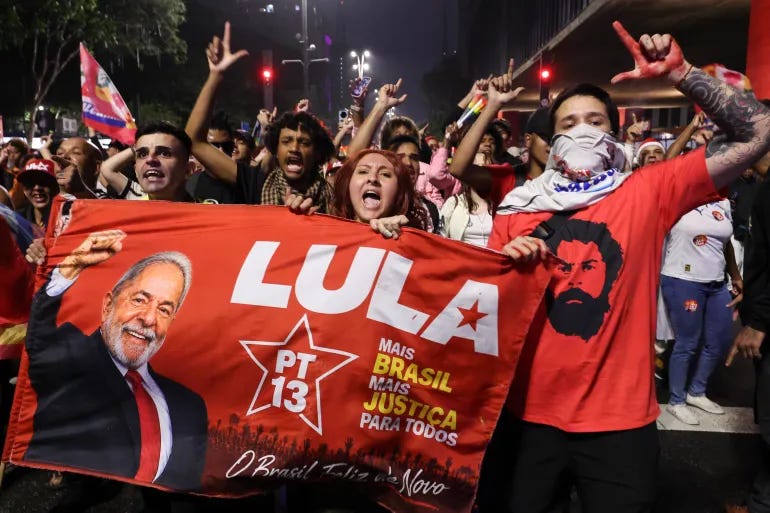
The democratic world closely and anxiously followed the Brazilian electoral process. The rise of the far right, imperial interference in the domestic politics of countries not fully aligned with U.S. interests, the massive manipulation of public opinion by large corporations that control media platforms, and the transformation of neo-Pentecostal evangelicalism into a religious equivalent of the CIA, USAID, Mossad, and MI6—these are global trends, and therefore, whatever happened in Brazil would have repercussions around the world. The repercussions would be just as strong in a world where liberal democracy—even if only in a limited form—still exists and relations with the US-Israel are complex, as they would be in a world where, regardless of its political regime, countries feel more aligned with China, Russia, or Iran.
Ultimately, the contest was between Lula da Silva and Donald Trump. If Lula won, democracy would prevail, along with the movement for a multipolar world based on a new version of peaceful coexistence. If Trump—in the person of a banana-republic fascista—had won, the global proto-fascist and reactionary movement would have triumphed, along with the recolonisation of the world in the service of a decadent empire, and the military-industrial-digital-financial complex would have mobilised for a new war that would make the deaths of millions of innocent people the solution to its crisis of profitability.
Global interest was even more intense because the elections took place in two rounds. While Lula da Silva’s campaign had made some mistakes in the first round—perhaps because it was convinced of victory—it was exemplary in the second round. It brought the democratic masses onto the streets in massive numbers—with young people taking the lead—learned from the defeat of Iván Cepeda in Colombia by making innovative use of social media, and above all, showcased an absolutely extraordinary candidate: a youthful eighty-year-old man running, jumping, dancing, and shining on social media at rallies and in debates. He was a candidate whose political energy had been forged during the dictatorship, accustomed to many difficult struggles and convinced that this was not only his final political battle but also Brazil’s last democratic struggle on the brink of a new and prolonged fascist darkness. Not since 1985 (the movement to end the dictatorship and restore democracy) had so many people taken to the streets with such enthusiasm in defence of a cause. Contributing to this was the horror of the memory of Jair Bolsonaro’s grotesquely arrogant and incompetent misrule.
Lula da Silva won; democracy won; the Brazilian people won. The main reasons for the victory are as follows: The left mobilised and united as it had not done in a long time; the mobilisation transcended partisan loyalties and tactics to become a flood of spontaneous acts of historic proportions, marked by democratic enthusiasm and participatory joy.
Contrary to what had been happening on the continent and around the world, the secular and religious far right—supported by the platforms of the major Big Tech companies—was unable to manipulate public opinion and spread disinformation as freely as before and had to contend with a surprising technical mastery of social media put to the service of democracy, truth, and the fight against fascism.
Voters in the political centre were alarmed by the web of illegalities and the sinister collusions between the far-right candidate and the underworld of organised crime and high-level corruption.
A significant number of voters, regardless of their political leanings, vividly remembered the humanitarian disaster and the erosion of democratic coexistence during Jair Bolsonaro’s misrule and were horrified by the risk of returning to that style of governance.
But beyond all these factors, it is fair to emphasise that this victory bears the personal stamp of a political giant—someone who felt more deeply than anyone else that the country would descend into chaos if the Bolsonaro clan and its allies were to reach the presidency. The energy with which he woke up every day was the energy of someone who had experienced hunger, the violence of labour without rights, and police repression firsthand; it was the energy of an entire people determined not to return to the hell of a political agenda committed to destroying everything and building nothing that would translate into greater well-being for the people.
Never before had a politician who came in second in the first round won the election; never before had a politician been able, in such a short time, to convince more than 10 million new voters to shift their voting intentions in his favour. Lula da Silva occupies a unique place in the history of global democracy over the past fifty years. He is the living embodiment of democracy’s rocky path in a world increasingly gripped by hatred, greed, and the politics of death. He is the symbol of struggles, risks, defeats, and victories. Lula da Silva has restored to Brazilians and the democratic world a new balance between fear and hope.
The biggest losers are the elites for whom democracy has always been seen as an attack on their privileges. Defeated are financial capital and the speculators in the futures or predictive markets (Polymarket and Kalshi), who, despite being banned, multiplied their bets on the assumption of a landslide victory for Bolsonaro. Defeated are Meta and Mark Zuckerberg and all their schemes to steal democracy and well-being in exchange for fabulous profits, sumptuous bunkers in Hawaii, and trinkets from this world or the next distributed to the people who use their networks. Above all, Donald Trump and his clique of gauleiters in the White House—and scattered throughout the world—have been defeated. They were determined to destroy everything they saw as a threat to the continuity of their power, especially the emergence of a multipolar world led by major countries for whom independent sovereignty has once again taken on a defensive, nationalist flavor.
With the defeat of Trump and the far right, American Democrats may regain some hope in the upcoming midterm elections. The European far right is losing the arrogance it had been displaying, and the European Union—captured by the military-industrial-financial-digital complex—will have to rethink its reckless policy of dragging Europe into a war that no one wants to defend Europeans from a threat that no one sees. The imposition of austerity to serve the interests of the arms-dealing financial elite will be increasingly challenged, and Emmanuel Macron will have to return to where he came from—as an employee of the Rothschild family—just as Friedrich Merz will have to return to his job at BlackRock, the largest asset manager.
The First Steps
Brazilians have the right to rest and celebrate today and tomorrow, because the day after tomorrow they must once again mobilise to fill the streets at the slightest sign that the victory might be overturned. Let there be no doubt: the far right will try to stir up trouble, and we should not expect the coming period to be characterised by the “normal functioning of institutions.” The streets will continue to serve as the democratic shield against any attempt at destabilisation. Between now and the inauguration of the new government, a great deal can happen.
A sign of the rot at the heart of Brazil’s current political system is the fact that an entire family of far-right figures—led by a former president currently imprisoned for five crimes (leading a criminal organisation; attempting to violently abolish the democratic rule of law; a coup d’état; damage to federal property; and deterioration of a listed historic site)—and sentenced to 27 years and 3 months in prison—has managed to get no fewer than five members elected to political office: his wife and two sons, who are senators; his third son, a federal deputy; his brother, a federal deputy; and his ex-wife, who, although not elected, still received 65,496 votes. It is a clan entrenched in a parliament dominated by the party to which he belongs.
The Second Steps
The left will have to engage in deep reflection, not only on the many mistakes it has made in the past but also on the demands of this new era. The flip side of this charismatic giant, Lula da Silva, is the difficulty of rebuilding robust political leadership that is as effective as he is—while always bearing in mind that a charismatic leader is irreplaceable. It will not be easy to govern in this new era, since Congress is now an even more grotesque caricature of the social and political diversity of the Brazilian people. But at least the independence of the Supreme Federal Court (STF) can be safeguarded, which is no small thing.
The struggles for rights and improved living conditions will lead to immense frustration if they are limited to the spaces opened up within institutions. The democratic struggle will be predominantly extra-institutional—in the streets, in labour unions, in social movements, and in civil society organisations. The democratic struggle will necessarily be defensive at first—that is, a struggle to restore previously won rights. But, in due course, it will have to become offensive in order to secure the political and social reforms that prevent the far right from returning to power.
The Third Steps: Five Guiding Principles
This medium- and long-term thinking does not belong exclusively to Brazil. It belongs to the entire democratic world.
1. At present, the far right uses democracy to come to power, but once in power, it neither exercises it nor relinquishes it democratically. Therefore, elections can never be the sole means used to remove the far right from power.
2. Colonialism did not disappear with independence. It was followed by internal colonialism, and it is precisely the elites produced by that system who are now calling for greater intervention by U.S. imperialism to sustain their power. Internal colonialism has always been intertwined with imperialism. That is why the far right—which in other contexts has been nationalist—is now subservient in today’s Latin America to accommodate the ongoing process of recolonisation by the U.S. The case of Venezuela is tragically paradigmatic. Argentina and Colombia will follow the same path if there is no popular resistance. Just as in historical colonialism, loyalty is never guaranteed through peaceful means alone. It always requires the possibility of military intervention. Hence the Shield of the Americas, a military protection alliance created by the U.S. with the subservient collaboration of Latin American governments that are gradually falling under its control. The victory of democracy in Brazil represents a blow that could prove fatal to the Shield of the Americas.
3. The strategy pursued by the BRICS to foster multipolarity/multilateralism is gaining new momentum. To maintain a strong presence in Latin America, it will have to further strengthen relations with the countries best positioned to resist U.S. unipolarity: China, Russia, and Iran.
4. Not only Latin America but also Africa and Europe are being overrun by a new, highly ideological reactionary movement—neo-Pentecostal evangelismo—whose defining feature is the religious endorsement of far-right policies and the most radical forms of neoliberalism. According to this view, since there is no solution in this world to the permanent crisis and no social responsibility for individual crises beyond that attributable to the individual in crisis, there is no remedy for a damaged life except in the afterlife. To ensure salvation, it is necessary to act, in this world, in strict accordance with the existential philosophy of neoliberalism. Prosperity theology is the clearest expression of religious conformism: “Because you are divine and one with God, the mere thought that you are one with God means you cannot be poor, because God cannot be poor […] Since poverty is, from the outset, a mistaken belief, change that belief and poverty will be cured. Faith makes us prosperous.”
Feelings such as love, charity, compassion, solidarity, and care must be confined to one’s own church. Outside of it, hatred, alienation, indifference, individualism, and violence are the norm.
Neo-Pentecostal reactionary thought creates in the minds of believers two parallel and incomparable realities: the reality of suffering experienced in this world and the reality of the prosperity of salvation in the next world; those who are prosperous in this world are the blessed ones who foreshadow the prosperity that all believers will enjoy in the next world. The existence of these two parallel realities renders democratic deliberation meaningless to believers. Their vote does not concern this ephemeral world but rather the immortal world of salvation.
The creation of two parallel realities has been fuelled by social media, whose modus operandi consists precisely in creating a digital world independent of the world of life lived in the flesh.
5. Capitalism is today, more than ever, incompatible with nature and with democracy. Democracy in the future will not be possible unless it includes the democratisation of the relationship between human beings and nature—Mother Earth, as indigenous peoples call her. The recolonisation of Latin America aims to take to the extreme, and in the same process, the two incompatibilities of capitalism (with democracy and with nature).
Based on these five ideas, I offer two reflections for discussion among democrats in Brazil and around the world—in families, in bars, in workplaces, in schools, in universities, in churches, in political parties, in public squares, and at parties. Preferably, without cell phones to prevent the theft of data that would allow algorithms to discern our aspirations and neutralise them, either by eliminating them or by trivialising them.
Nature does not belong to us: we belong to nature.
Cartesian philosophy lies at the foundation of Western modernity. According to Descartes, there is an absolute separation and a hierarchy between humanity and nature, as well as between mind and body. Nature is subjected to an abysmal exclusion from society, and the same logically applies to all social groups considered closer to nature. Women, Indigenous peoples, and people of African descent (the majority of the Brazilian population) have been the targets of this exclusion. All the main mechanisms of exclusion and discrimination existing in modern societies—whether based on class, race, or gender—are ultimately grounded in the radical dualism between society/humanity and nature, between mind and body. The ways in which modern society deals with inferiority are modelled on the ways it deals with nature. If abysmal exclusion signifies domination through appropriation and violence, then nature—including the land, rivers, and forests, as well as the people and ways of being and living whose humanity has been denied precisely because they are part of nature—has been the primary target of this domination in Western modernity since the 16th century.
This conception was radically challenged by another European philosopher, Baruch Spinoza, and most importantly, Spinoza’s conception is entirely consistent with that of the indigenous peoples of the Americas and Oceania. For Spinoza, a method different from Descartes’ is necessary. Descartes’ method is based on the dualism between mind and body, between thoughts and things, and between human beings and nature. But if God is the creator of the universe, He and His creation are one. God is not transcendent because He is the totality of His creation, of which we are a part. If we cannot grasp His will, we can understand the nature of all things that exist, based on the laws that God has embedded within them.
Mind and body, humanity and nature, are one: nature is a unity. Things—Descartes’ discrete parts or objects, disconnected and impenetrable—are false abstractions. Like ideas, things exist only through their association with other things or ideas. The human body is as much a part of nature as the human mind, and extension and thought are both distinct attributes of the same totality. The differences are superficial and inessential, since everything exists in relation to everything else.
Now, the principle of immanence is precisely the point where Spinoza’s conception intersects with the indigenous peoples’ conception of nature. They view nature as Pachamama, or Mother Earth, and assert that nature does not belong to us; rather, we belong to nature. If the earth is our mother, we must care for her so that she can care for us. This radical belonging contradicts any idea of dualism between human beings and nature. The divine entity, regardless of how it is conceived, is an entity of this world and can manifest itself in a river, a mountain, or a particular territory. The divine is the spiritual dimension of the material, and both belong to the same immanent world. As Davi Kopenawa, a Yanomami shaman, states:
What [white people] call “nature” is, in our ancient language Urihi, the forest-earth, and also its image—visible only to shamans—which we call Urihinari, the spirit of the forest […] So, for us, the xapiri spirits are the true owners of nature, not humans […] White people find the nature they see beautiful, without knowing why. We, on the other hand, know that true nature is both the forest and the multitudes of xapiri who inhabit it.
We find Kopenawa’s argument echoed in the public statements of a large number of indigenous leaders and intellectuals who are increasingly making their voices heard, expressing their own points of view and contrasting them with “what white people call nature.” In Brazil, Ailton Krenak has stood out among them all.
Indigenous peoples—the most marginalised by capitalist and colonialist modernity—are showing us the way forward. It does not matter whether they are many or few. If they are few, it is because they were exterminated by the colonialists and their descendants. Their significance is not quantitative; it is qualitative. We must integrate their perspectives into future debates because they best reveal the contradiction between capitalism and nature and offer us alternatives.
Toward Demodiversity
In the short and medium term, we must initiate the broadest possible debate on the nature of political power and political systems in order to bring civilisational changes onto the political agenda.
In the period we are entering, the working classes find themselves in a paradoxical and somewhat dilemma-ridden situation: they cannot do without either liberal democracy (where it exists) or the modern state, but neither, as they currently stand, is adequate to address the challenges that lie ahead. Liberal democracy has deteriorated sharply, to the point of becoming a hybrid regime in which democratic elements are mixed with anti-democratic, fascist-leaning elements—the latter of which are constantly on the rise. It is becoming increasingly easier to monitor citizens than to protect them.
In the coming decades, the working classes will have to make the best possible use of the available institutions—namely human rights, social and economic rights, democracy, and the nation-state—while simultaneously fighting for the democratic refoundation of politics and the state. Societies in general are set to enter a period of great social upheaval and tense relations between institutional and extra-institutional struggles, between political parties and street protests, between the mainstream media and social media and community-based forms of communication, between legal and illegal initiatives, and between secular responses to the political use of religion and politico-religious responses to secular and republican politics.
Will it be possible to save representative democracy? And for whose benefit? In any process of progressive social transformation, the initial terms of the conflicts are defined by the dominant classes or elites. The best way to measure the progress of social demands and struggles lies in the changes observed in the very terms of the conflict. Currently, the initial terms of the conflict are democracy and human rights. This does not mean, however, uncritically accepting the dominant understanding of these signifiers from the outset. Elections do not guarantee that the interests of the majority will be represented—if they ever did. The merchants of fear will always ensure that the dreams of the working classes never rise above the level of a nightmare. If discipline fails and resistance arises, the state will be in a permanent state of readiness to repress. In the coming decades, the state of exception (state of emergency, state of siege) will be more the norm than the exception.
The first progressive changes to occur in the context of political conflict will have to come from demands aimed at demonstrating that the only way for representative democracy to save itself is by integrating with participatory and deliberative democracy, both at the local and national levels. Far more than the mere exercise of the right to vote, citizen participation in political life—in an organised and non-partisan manner—is crucial.
Political parties, in their current form, have no future. They must give way to movement-based parties that make use of the tools of participatory democracy. This means reinventing political parties so that they become entities shaped by participatory democracy, thereby ensuring the active participation of their members and supporters—particularly in the formulation of party platforms and the selection of candidates for elected office. The logic of bureaucratic time must give way to the logic of democratic time.
It is crucial to separate the political sphere from the economic sphere, as envisioned by liberal theory, through measures such as, for example, ending corporate financing of political parties and eliminating lobbying and public-private partnerships, the creation of a robust system of disqualifications and oversight regarding conflicts of interest, the revocation of mandates, participatory budgeting, and the adoption of electoral reforms that bring representatives closer to those who elected them. Once the political system has been reformed, the justices of the supreme and constitutional courts and the Attorney General of the Republic must be elected by direct suffrage.
Media reform is just as urgent as political reform. There must be a robust public media sector, and those who control private media cannot have economic interests in other areas. It is imperative to restore, foster, and strengthen citizen-led or community-based media, including media in non-colonial or non-official languages whenever warranted.
Other progressive changes—deeper ones—in the context of the political conflict will require viewing democracy not as a political regime, but as a comprehensive process aimed at the gradual democratisation of social, economic, cultural, political, and interpersonal relations within society. There is not just one legitimate form of democracy, but several, which together constitute what I call “demodiversity.” Just as we cannot live without biodiversity, neither can we live without demodiversity.
In the various spaces and times of our collective life, the tasks of democratisation must be carried out differently, and the types of democracy will likewise be distinct. The democratisation of the state is not possible without the democratisation of society, without the democratisation of international relations, and without the democratisation of the relationship between humanity and nature.
In its broadest sense, democracy is the sum of the processes through which unequal power relations are replaced by relations of shared authority. Societies are constituted by a multiplicity of spaces and times: family, production, community, market, citizenship, the world, and perhaps others as well. In each of these, the need for democratisation is the same, but the forms and practices of democracy vary.
By adopting the political ideology of liberalism, the capitalist, colonialist, and patriarchal societies in which we live have reduced democracy to the space-time of citizenship—or, to put it another way, to what we call the space of citizenship—even though all other spaces are also political. For this reason, liberal democracy tends to be, at best, a democratic island in an archipelago of despotisms. When reduced to the space of citizenship, liberal democracy—also called representative democracy—is fragile and often defenceless when attacked by anti-democrats, fascists, neo-Nazis, and other far-right forces. Current political events speak for themselves.
While in some countries democratic struggles centre on defending existing constitutions, in others the most advanced democratic struggles focus on convening constituent assemblies to draft new constitutions, moving toward a transformative constitutionalism.
National societies today are subject to a dual constitutionalism: national constitutionalism, which in most cases guarantees citizens’ rights and the existence of democratic institutions, and the global constitutionalism of multinational corporations, free-trade agreements, and financial capital. There are enormous contradictions between these two forms of constitutionalism, since global constitutionalism does not recognise democracy as a civilisational value. And what is most serious is that, in the event of a conflict between them, it is global constitutionalism that generally prevails.
The lessons learned from the constitutional processes of the past seventy years point to three guiding principles. First, constituent power must be kept alive even after the conclusion of the constituent assembly’s work and the formation of political power. Second, for the articulation between representative and participatory democracy to be taken seriously, it is necessary to break with Montesquieu’s triad of the three sovereign powers and add a fourth power—a citizen-based oversight body designed to ensure that citizens have control over the implementation of democratically made decisions. Finally, legal pluralism, interculturalism, and plurinationalism must be recognised whenever necessary to ensure that people have the right to be equal when difference makes them inferior and the right to be different when equality decharacterises them.
Revolutionising Democracy and Democratising the Revolution
The initiatives and measures mentioned above to illustrate the challenges ahead may be considered by some to be a revolution and, by others, an overly ambitious conception of what democracy is. When it comes to social struggles, the tragedy of the last century was to pit democracy against revolution. I dare to suggest that what is at stake is a twofold movement—democratising the revolution and revolutionising democracy. Socialism is democracy without end.
The fundamental condition for this movement lies in the coordination of social struggles. The fragmentation of social struggles is today, perhaps, the greatest obstacle to the struggle for a radically democratic society. The 21st century has witnessed the consolidation of a collective critical consciousness that had emerged in the previous century. This awakening involved identifying and assessing the various structural factors responsible for collective suffering and damaged lives—above all, capitalism, colonialism, and heteropatriarchy. The World Social Forum, which convened for the first time in the city of Porto Alegre (Brazil) in 2001, served as the major global catalyst for this new consciousness of the oppressed’s resistance against domination. This awareness entailed recognising, on the one hand, the various forces of domination at play (and, therefore, the different social groups responsible for oppression) and the interconnected way in which they operate, and, on the other hand, the need to coordinate the struggles of resistance against these forces.
However, the main dynamic that emerged from that point on was not, in fact, one of interconnectedness, but rather one of fragmentation, based on the idea that “my struggle is more important than yours.” The inability to distinguish between struggles that, while equally important at the structural level, were not equally urgent in light of the different regional, cultural, or political contexts in which they were embedded, proved fatal. This fragmentation reached a critical point in the case of some of the movements involved in struggles that, despite the nobility and urgency of their objectives, ultimately compromised the success of other struggles or even proved counterproductive to the cause they defended due to their isolationist and extremist nature. Throughout the 20th century, the labour movement was a classic case of isolationism; in the 21st century, there is every reason to believe that the next example will come from certain feminist movements.
I recognise that revolutionising democracy and democratising the revolution is no easy task, but in my opinion there is no other way to halt the rise of far-right and fascist forces that have been encroaching on the democratic space while promoting economic freedom as the supreme value—superior to all other dimensions of freedom, not to mention equality and fraternity. The misery of freedom will become evident when the vast majority of the population has only the freedom to be miserable.