


The most dangerous illusion in the Middle East today is not that peace is close. It is the belief that diplomacy is still keeping pace with the war.
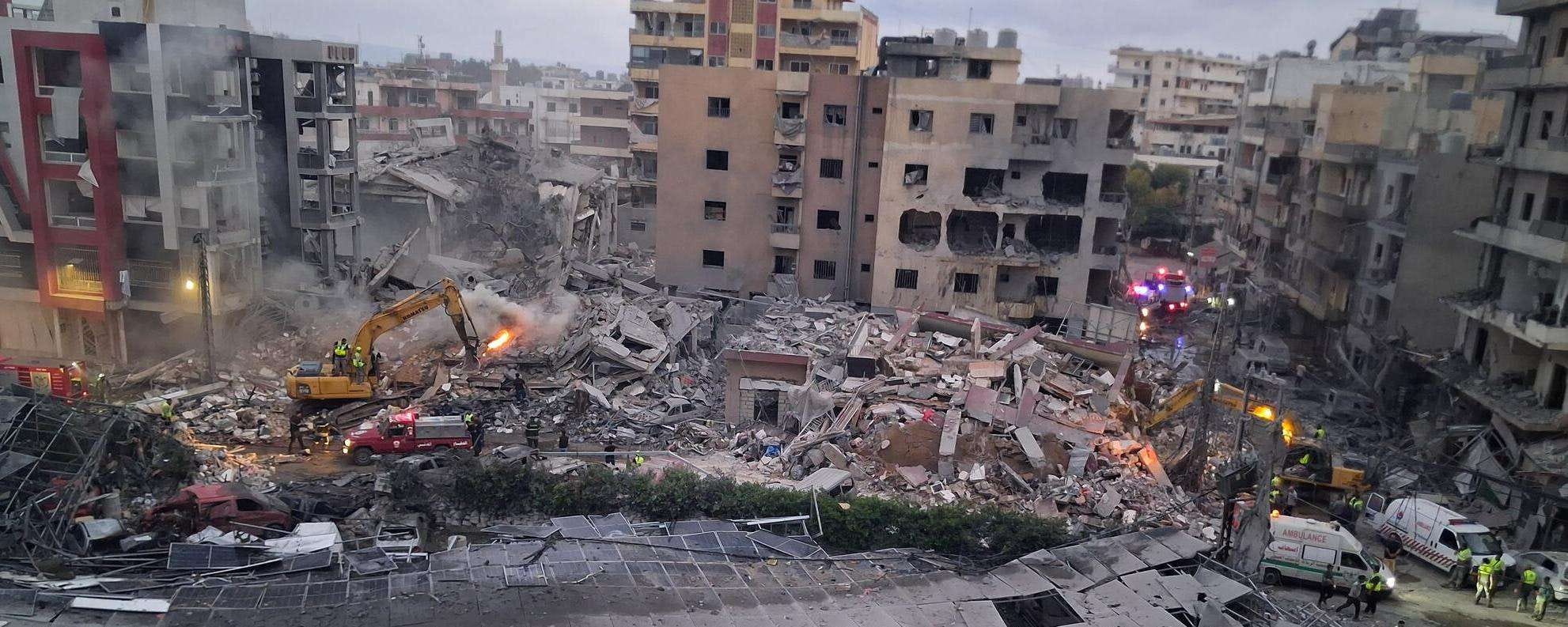
Across Lebanon, hospitals, homes, schools and centuries-old communities continue to absorb the shockwaves of a conflict that was supposedly paused weeks ago. The language of ceasefires remains active in diplomatic communiqués; the language of destruction remains active on the ground. As Israel presses deeper into Lebanese territory despite internationally backed truce arrangements, and as Hezbollah continues its attacks on northern Israel, the region is confronting a reality that policymakers have been reluctant to acknowledge: the mechanisms designed to contain escalation are failing faster than they can be deployed.
Lebanon has become the clearest test of whether the international system retains any meaningful capacity to protect civilians once military logic takes control.
The numbers alone reveal the scale of collapse. According to Lebanon’s health authorities, more than 3,400 people have been killed since the war’s escalation, including hundreds of children and healthcare workers. More than 1.3 million Lebanese have been displaced, one of the largest internal displacement crises in the country’s modern history. Entire districts across southern Lebanon have been emptied as Israeli military operations expanded far beyond immediate border zones. Reuters reporting indicates that more than 150 villages have faced evacuation orders, while areas amounting to roughly one-fifth of Lebanese territory have effectively become inaccessible.
Yet statistics only partially explain the crisis. The deeper story is institutional failure. Within hours of a ceasefire announcement in April, renewed Israeli strikes reportedly killed more than 250 people across Lebanon. The United Nations High Commissioner for Human Rights described the attacks as “nothing short of horrific.” Hospitals were struck. Ambulances were damaged. Critical infrastructure was degraded. For civilians trapped between military campaigns and diplomatic promises, the distinction between wartime and ceasefire conditions became almost meaningless.
History offers uncomfortable parallels. Lebanon has experienced this pattern before. Israel’s invasions in 1978, 1982 and the 2006 war all emerged from security calculations intended to create strategic depth and deterrence. Each operation achieved tactical gains. None delivered lasting stability. The resistance survived, evolved, and often drew renewed support as a force against Israeli incursions.
The current campaign risks following the same tragic arc witnessed in Gaza: security goals expanding into a humanitarian calamity. Israel’s security concerns are genuine, but so too is the reality that every deeper incursion leaves behind more shattered neighbourhoods, more displaced families and a growing sense that military force is outrunning the political solutions needed to end the conflict.
The seizure of positions such as Beaufort Castle and the expansion of military operations beyond the Litani River may create temporary tactical advantages. They also risk transforming a border war into a prolonged occupation dynamic that history suggests is extraordinarily difficult to sustain. Every destroyed village, every displaced family and every damaged hospital becomes part of the political landscape that follows the fighting.
Military victories rarely remain military. They become social, economic and generational realities. The broader regional implications are even more alarming.
Iran has explicitly linked the continuation of attacks on Lebanon with the future of wider diplomatic negotiations. Tehran has warned that further escalation could undermine already fragile discussions with Washington. This matters because Lebanon is no longer merely a Lebanese theatre. It sits at the intersection of virtually every major fault line in the contemporary Middle East: Iranian influence, Israeli security concerns, Gulf calculations, American credibility and the future of regional order itself.
The danger is no longer a contained conflict. The danger is escalation by accumulation. Every strike increases pressure on Iranian-aligned actors to respond. Every response creates pressure for retaliation. Every retaliation narrows the diplomatic space available to regional and international mediators. The result resembles less a managed crisis than a system steadily exhausting its own safety mechanisms.
What makes the situation particularly striking is the relative silence across much of the Arab world. Several Arab governments have expressed concern and support for Lebanese sovereignty. Few have translated those statements into meaningful political pressure. The geopolitical logic is understandable. Many Arab states have prioritised economic transformation, strategic partnerships and the containment of Iranian influence. Hezbollah itself remains deeply controversial across the region.
Yet silence carries costs. For many Lebanese, the perception is increasingly one of abandonment. A founding member of the Arab League now confronts one of the gravest crises in its modern history while regional responses remain cautious and restrained. The contrast with the rhetoric often deployed in other regional conflicts has not gone unnoticed.
This is not merely a question of solidarity. It is a question of precedent. If the sovereignty of smaller states becomes negotiable whenever larger strategic interests are involved, the foundations of regional order become progressively weaker.
Global powers face an equally uncomfortable reckoning. The United States, European powers, Russia and China all speak regularly about stability, international law and civilian protection. Yet the Lebanon crisis exposes the widening gap between principle and enforcement. The United Nations remains constrained by familiar geopolitical divisions. Calls for accountability continue to collide with strategic alliances. Humanitarian concerns remain secondary to calculations of influence and deterrence.
The consequence is not only Lebanese suffering. It is the erosion of confidence in the rules-based order itself.
When ceasefires fail repeatedly without consequence, when civilian infrastructure remains vulnerable despite international legal protections, and when diplomatic guarantees prove unable to restrain military action, trust in global institutions begins to fracture. Smaller states observe these failures carefully. So do non-state actors. So do populations living under conflict.
Lebanon therefore represents something larger than a national tragedy. It has become a measure of whether diplomacy still possesses coercive relevance in modern conflict. The uncomfortable answer emerging from southern Lebanon is that diplomacy increasingly follows events rather than shaping them.
The tragedy is that civilians bear the cost of that imbalance.
From Beirut’s southern suburbs to the villages scattered across the country’s south, communities are being forced to absorb shocks that no political process has successfully contained. Hospitals cannot function on diplomatic statements. Families cannot return home on the basis of future negotiations. Children cannot rebuild their lives around promises of eventual de-escalation.
The real crisis is not simply that war continues. It is that the institutions designed to stop it are steadily losing the race.
Lebanon now stands alongside Gaza as a stark warning to the world: when diplomacy becomes reactive, humanitarian catastrophe becomes inevitable. The question confronting global policymakers is no longer whether the conflict can be managed. It is whether enough political courage remains to prevent a wider regional rupture before the final restraints disappear altogether.
Because once diplomacy loses its ability to protect civilians, it loses its most important purpose. And when that happens, wars do not merely continue. They accelerate beyond anyone’s control.
