


Indonesia’s democracy was never meant to fear its own thinkers. Yet across the archipelago today, an increasingly dangerous idea is taking hold: that criticism grounded in evidence is somehow less patriotic than political obedience. Researchers are accused of advancing foreign agendas. Economists warning about fiscal sustainability are dismissed as disconnected elites. Indigenous communities defending ancestral forests are portrayed as obstacles to national progress. Scientific findings that complicate state narratives are recast as threats to national unity rather than as contributions to it.
What is unfolding is larger than a dispute over policy. It is an epistemic crisis—a struggle over who has the right to define truth in Indonesia.
That crisis carries implications far beyond Jakarta. Indonesia is the world’s third-largest democracy, Southeast Asia’s largest economy, and a pivotal Indo-Pacific power courted by Canberra, Washington, Beijing and Tokyo alike. When a state of 280 million people begins to securitise knowledge itself, the consequences ripple into regional governance, democratic resilience, climate diplomacy, and the future of global pluralism.
The warning signs are becoming impossible to ignore.
Under President Prabowo Subianto, a former general whose worldview remains deeply shaped by military hierarchy and threat perception, the language of governance is increasingly infused with suspicion toward dissenting expertise. The atmosphere echoes aspects of Indonesia’s New Order era, when “stability” justified the suppression of critical inquiry and the military treated information as a strategic asset rather than a public good. The difference now is that this dynamic is unfolding inside a hyper-connected digital society where disinformation spreads faster than institutional trust can recover.
The tragedy is not simply that academics or activists are being marginalised. The deeper tragedy is that ordinary Indonesians are being encouraged to distrust evidence itself.
“We produce science, but the framing from the government and even from the bazaar is more serious”, one researcher laments in a recent reflection. Research funded internationally becomes suspect. Critics become “traitors.” Evidence-based disagreement is interpreted as disloyalty rather than democratic participation. “The public is made to disbelieve in critical data”, the text warns. “Those who speak with data, but have a different view from the government, are considered enemies of the country”.
This is the anatomy of post-truth authoritarianism.
Around the world, democracies are wrestling with disinformation. But Indonesia’s challenge possesses a distinct civil-military texture rooted in the unresolved legacy of Reformasi. After Suharto’s fall in 1998, Indonesia painstakingly rebuilt civilian institutions and rolled back the military’s infamous dwifungsi doctrine, which embedded the armed forces across civilian governance. For two decades, that democratic transition appeared remarkably successful. Freedom House still classifies Indonesia as “Partly Free,” but its indicators on civil liberties and freedom of expression have steadily deteriorated over recent years.
Global think tanks repeatedly noted growing democratic backsliding: the weakening of institutional checks, shrinking civic space, digital intimidation campaigns, and the increasing use of nationalism to delegitimise criticism. The Economist Intelligence Unit now categorises Indonesia as a “flawed democracy,” reflecting widening anxieties about the erosion of liberal norms.
Yet statistics alone cannot capture the emotional shift underway. The most dangerous authoritarian systems are not those that merely silence dissent. They are the systems that convince citizens that independent thought itself is suspicious.
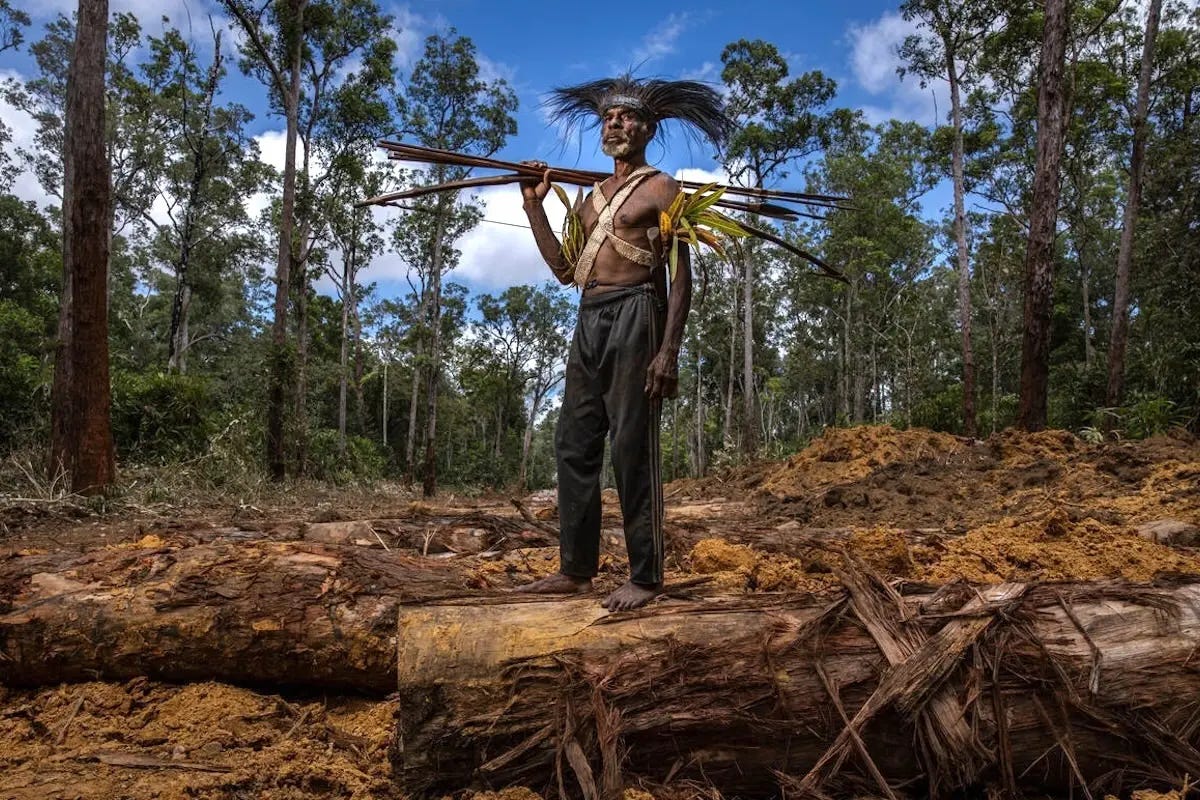
That transformation is visible in how environmental conflicts are discussed. Indigenous Papuan communities resisting extractive projects are frequently cast as anti-development actors. Environmental scientists documenting deforestation linked to nickel, palm oil, and mining expansion are increasingly framed as obstructing national prosperity. Researchers examining ecological costs become vulnerable to accusations of serving foreign interests eager to weaken Indonesia’s rise.
This framing is politically potent because it exploits historical trauma. Indonesia’s post-colonial identity was forged through anti-imperial struggle. Foreign intervention remains an emotionally charged memory. By associating criticism with foreign manipulation, political elites convert legitimate democratic scrutiny into a question of patriotic loyalty.
The effect is devastating for democratic deliberation. Once evidence becomes securitised, public debate ceases to revolve around whether policies work. Instead, debate revolves around who belongs inside the nationalist fold. Expertise becomes secondary to ideological conformity. Truth becomes transactional.
Political theorists from Hannah Arendt to Michel Foucault warned of this danger decades ago. Arendt observed that authoritarian systems do not survive by persuading citizens of a single lie. They survive by destroying confidence in the existence of objective truth altogether. Foucault described how states discipline populations not merely through force, but by controlling the production of knowledge itself.
Indonesia now stands perilously close to that threshold. The implications extend directly into economic governance. Indonesia’s ambitious free school meals program, projected to cost tens of billions of dollars annually, has already prompted concerns from economists regarding fiscal sustainability and bureaucratic capacity. Yet when economic caution is framed as insufficient patriotism, governments lose vital early-warning systems. Policy errors become harder to correct because criticism itself is treated as sabotage.
The same pattern appears in academia. University leaders have reportedly been summoned into closer alignment with state development agendas, while student activists protesting budget reallocations or democratic erosion face intimidation. Academic freedom groups inside Indonesia increasingly warn of a chilling effect spreading across campuses. Self-censorship flourishes long before formal censorship becomes necessary.
This is how democratic erosion becomes normalised: gradually, bureaucratically, emotionally.
The fear extends beyond intellectuals. Human rights defenders, journalists, indigenous leaders and ordinary civilians increasingly face online harassment, digital surveillance, and threats under Indonesia’s Electronic Information and Transactions Law. Amnesty International and CIVICUS have documented escalating intimidation against activists critical of state policy. In such an environment, citizenship itself becomes conditional. Rights depend less on constitutional guarantees than on demonstrated loyalty.
For the broader international community, complacency would be profoundly shortsighted. Indonesia is not sliding into a dictatorship. Its elections remain competitive. Its civil society remains vibrant. Its young population is digitally sophisticated and politically engaged. But democratic decline rarely arrives through dramatic rupture anymore. It emerges through narrative capture—through the slow monopolisation of patriotism by political elites who define dissent as danger.
Global strategists often discuss Indonesia primarily through the lenses of maritime security, critical minerals, ASEAN leadership, or US-China competition. Yet the deeper contest unfolding inside Indonesia concerns whether democratic societies can preserve trust in evidence during an age of algorithmic nationalism and permanent disinformation.
That question is universal. When governments portray scientists as enemies, societies lose more than expertise. They lose adaptive capacity. Climate resilience weakens. Public health deteriorates. Corruption deepens. Strategic planning becomes distorted by political vanity rather than empirical reality. Nations begin governing through mythologies of strength while quietly eroding the institutions that sustain actual strength.
Indonesia’s researchers, economists, activists and indigenous communities are not demanding the collapse of the state. They are demanding that the state listen.
That distinction matters enormously. The most patriotic voices in any democracy are rarely those who praise power unconditionally. They are often those willing to confront uncomfortable truths before crises become irreversible. A nation confident in its future does not fear data. It does not criminalise inquiry. It does not treat knowledge as contraband.
Indonesia’s democratic story remains unfinished. The country still possesses extraordinary democratic resilience, intellectual depth, and civic energy. But if evidence continues to be recast as foreign contamination, and if nationalism continues to be weaponised against critical thought, Indonesia risks entering a future where reality itself becomes subordinate to power. And once a state begins fearing its own citizens' capacity to think, it ultimately begins fearing its own future.
