


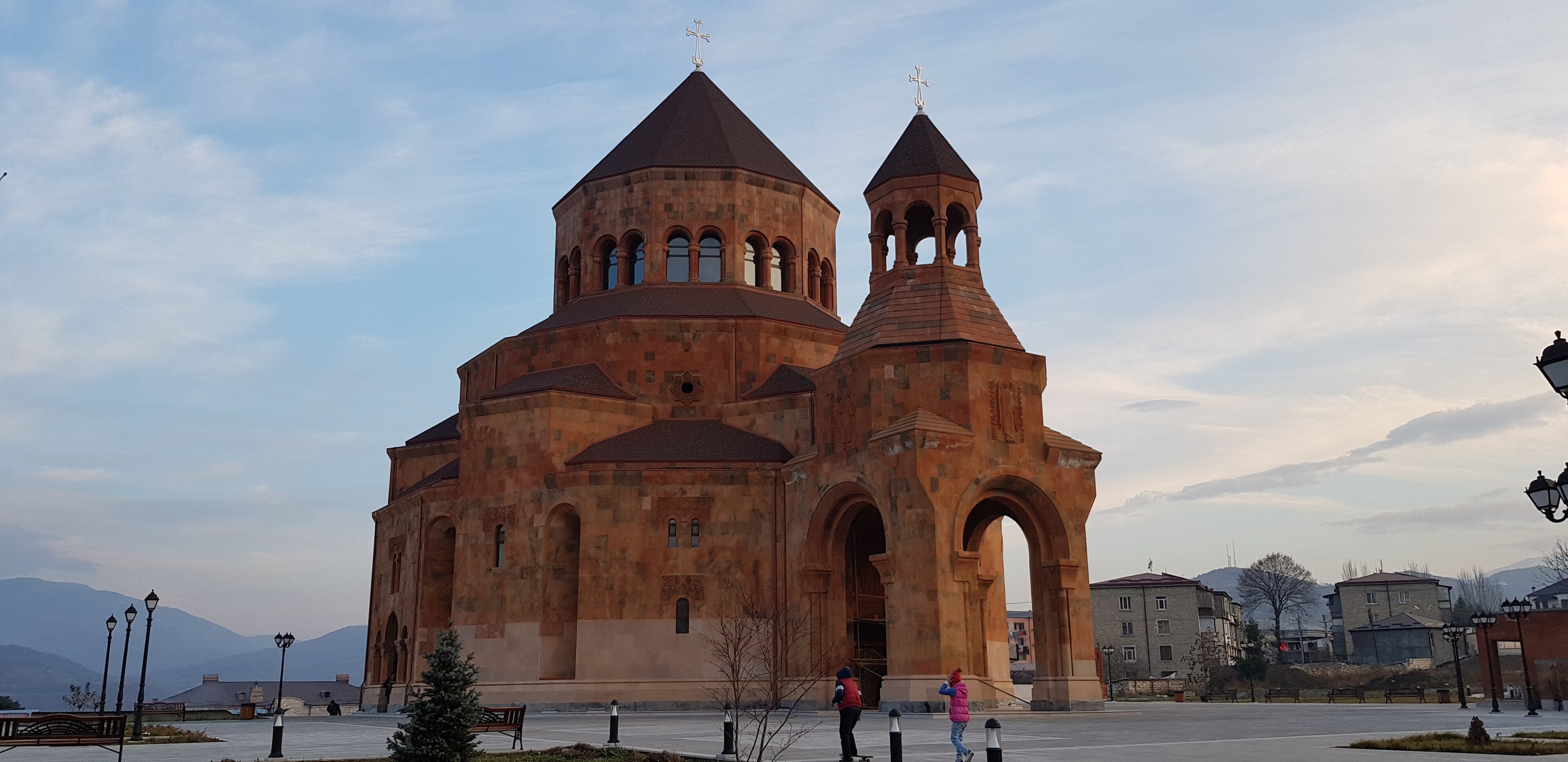
There are moments in international affairs when the destruction of stone says more than the signing of treaties. In Nagorno-Karabakh, the bulldozing of Armenian churches by Azerbaijan is one of those moments. It is not simply about architecture, nor only about post-war reconstruction. It is about whether sovereignty grants the right to erase memory—and whether the international community is prepared to accept that silence can be a form of complicity.
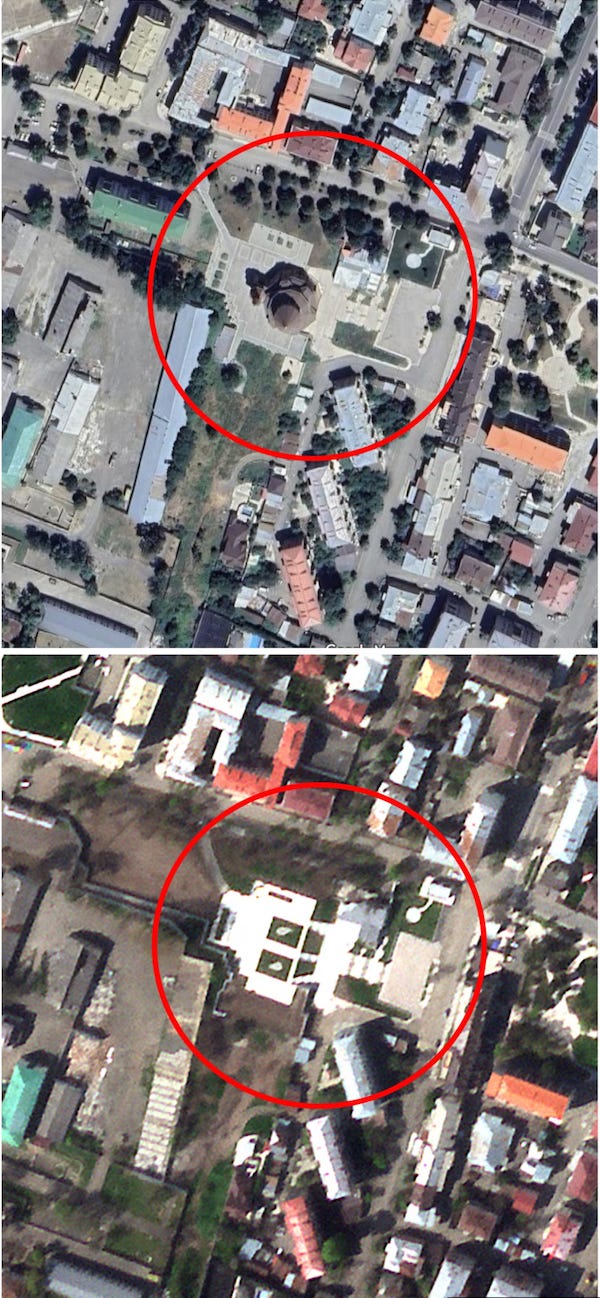
Satellite images rarely provoke moral outrage. Yet the before-and-after images of Stepanakert's Holy Mother of God Cathedral are impossible to ignore. On 3 March 2026, the church stood intact. By 2 April, it had been reduced to rubble. Shusha's 177-year-old Kanach Zham Church suffered the same fate, completely bulldozed by early 2024. These were not accidental wartime casualties. They were deliberate acts carried out in peacetime, under state authority, in full view of the world.
Baku insists otherwise. Officials describe these churches as “illegal buildings” constructed during the Armenian “occupation,” arguing their demolition is a lawful correction of history rather than cultural destruction. Religious authorities aligned with the state have framed the removals as morally justified, while redevelopment rhetoric paints the razing as necessary for roads, housing, and the return of displaced Azerbaijanis.
Another pillar of justification lies in the controversial “Caucasian Albanian” theory—the claim that many Armenian churches are not Armenian at all, but relics of an ancient Christian Albanian civilisation later “Armenianised.” In 2022, Culture Minister Anar Karimov openly vowed to remove Armenian inscriptions from such churches.
This is not restoration. It is revisionism with excavators. The world has seen this script before. In Nakhchivan, Azerbaijan's exclave, nearly all medieval Armenian churches and some 3,000 khachkars—intricately carved Armenian cross-stones—were erased by the late 2000s, including the famed Djulfa cemetery. Officials denied Armenians had ever lived there. What was once dismissed as a regional tragedy now looks disturbingly like a national doctrine.
International law is clearer than diplomacy often allows. In December 2021, the International Court of Justice ordered Azerbaijan to “take all necessary measures” to prevent vandalism and desecration of Armenian cultural heritage. The European Parliament has repeatedly condemned what it called Azerbaijan's “continued policy of erasing and denying the Armenian cultural heritage” and demanded compliance with the 1954 Hague Convention on the protection of cultural property.
UNESCO's own convention warns that the disappearance of any cultural heritage constitutes “a harmful impoverishment of the heritage of all the nations of the world.” Yet enforcement remains anaemic. Heritage destruction sits in that uncomfortable diplomatic space where outrage is abundant, but consequences are scarce.
The strategic cost for Azerbaijan is profound. States seeking legitimacy do not usually bulldoze cathedrals under satellite surveillance. Baku aspires to regional leadership, energy diplomacy, and greater influence within institutions such as UNESCO, where it was elected to the World Heritage Committee for 2025—29. Critics have called this a Kafkaesque contradiction. A country accused of cultural cleansing now helps govern the world's heritage standards.
Soft power cannot survive selective memory. A nation that preserves minority heritage signals confidence. A nation that destroys its projects projects insecurity.
There is also a greater regional danger. Heritage destruction is rarely about the past alone; it shapes the future. When churches, cemeteries, and monasteries disappear, so too does the psychological possibility of return. For displaced Armenians, the message is unmistakable: there is no home left to come back to. As art historian Christina Maranci has argued, destroying churches does not merely erase buildings—it severs the “connective tissue” of a people's history.
That fracture feeds grievance, and grievance is the most durable fuel in the South Caucasus. Azerbaijan often points, with some justification, to the destruction of mosques and Islamic heritage during decades of Armenian control. Azerbaijani sources report that 63 of 67 mosques in Karabakh were destroyed or heavily damaged during that period. These losses matter. They deserve acknowledgement and restoration. But reciprocal vandalism is not justice. It is simply an inheritance of the worst kind.
There are better models, and they are not theoretical. Spain's Mezquita-Cathedral of Córdoba was transformed from a mosque to a cathedral after the Reconquista, yet its iconic Islamic arches were preserved rather than demolished. Today, it stands as one of Europe's most visited monuments and a UNESCO symbol of layered history.
In Türkiye, Hagia Sophia has moved from cathedral to mosque to museum and back to mosque, yet Byzantine mosaics remain beside Islamic calligraphy—not as a contradiction, but as testimony. The restored Great Synagogue of Edirne and Sumela Monastery reflect the same principle: historic buildings belong to humanity, not merely to whoever controls them today.
This is the real power move in statecraft: not demolition, but stewardship. For global policymakers and from the chambers of the United Nations to the quiet corridors of UNESCO, Nagorno-Karabakh poses a far larger and more unsettling question than the legality of sovereignty, for borders can be redrawn by war. Still, legitimacy is written in how victory treats memory. The issue is no longer whether Azerbaijan holds the land; it does.
The true test is whether modern statehood in the twenty-first century is defined by possession or by stewardship, by the right to govern or by the duty to protect even the painful inheritance of those displaced, defeated, or silenced. Every demolished church in Karabakh sends a message far beyond the Caucasus: to Ukraine and Crimea, to Kosovo and Palestine, to Xinjiang, Cyprus, Kashmir, and the sacred ruins of Mosul—that if sovereignty becomes a licence to erase the cultural fingerprints of the “other,” then the international order itself begins to fracture at its moral foundation.
Strategic thinkers understand that monuments are not passive stones; they are geopolitical texts, repositories of legitimacy, and silent guarantors of coexistence. When a cathedral is razed, it is not only heritage that disappears, but the future architecture of trust, the possibility of return, and the fragile belief that peace can outlive war. Great powers should recognise that cultural destruction is not a peripheral humanitarian issue but a frontline strategic concern, because states that erase memory often normalise exclusion, and exclusion is the oldest accelerant of instability.
True victory in foreign policy is never secured by emptying a landscape of inconvenient history; it is secured when power is confident enough to preserve what once challenged it. Sovereignty without moral restraint becomes conquest in modern dress, while preservation becomes the rarest and most powerful form of diplomacy: the quiet declaration that civilisation is strong enough to remember, and wise enough not to fear memory.
Moreover, the question is what sovereignty means in the 21 century. Is it possession, or responsibility? Is victory measured by territory alone, or by the moral imagination to protect what belonged to those who lost?
Preserving Armenian churches in Karabakh would not weaken Azerbaijan's sovereignty. It would strengthen it. It would tell the world that confidence does not require denial, and that legitimacy grows not from flattening the past, but from carrying it honestly.
Diplomacy often speaks of confidence-building measures. Here is one made of stone. A moratorium on demolitions, independent UNESCO monitoring, and a bilateral Armenian-Azerbaijani heritage protection pact would be a beginning. Reframing these churches as part of a shared Caucasian inheritance—rather than an enemy imprint—could turn monuments of division into instruments of peace.
History in the South Caucasus has been written too often in blood. It does not need to be rewritten in dust.
The ruins of Karabakh are being watched by more than satellites. They are being watched by every state that claims to value international law, by every institution that speaks of cultural diplomacy, and by every displaced family searching for proof that memory can survive power.
A church destroyed is not only a local tragedy. It is a warning. Because when a state decides that the past must be demolished to secure the future, it is rarely the stones that are the final target.
